CK5
Register an account today to become a member! Once signed in, you'll be able to participate on this site by adding your own topics and posts, as well as connect with other members.
2021.02.21 - UPDATE! - NEW FLEXIBLE SHAPE PATTERN...

Today was tape day.

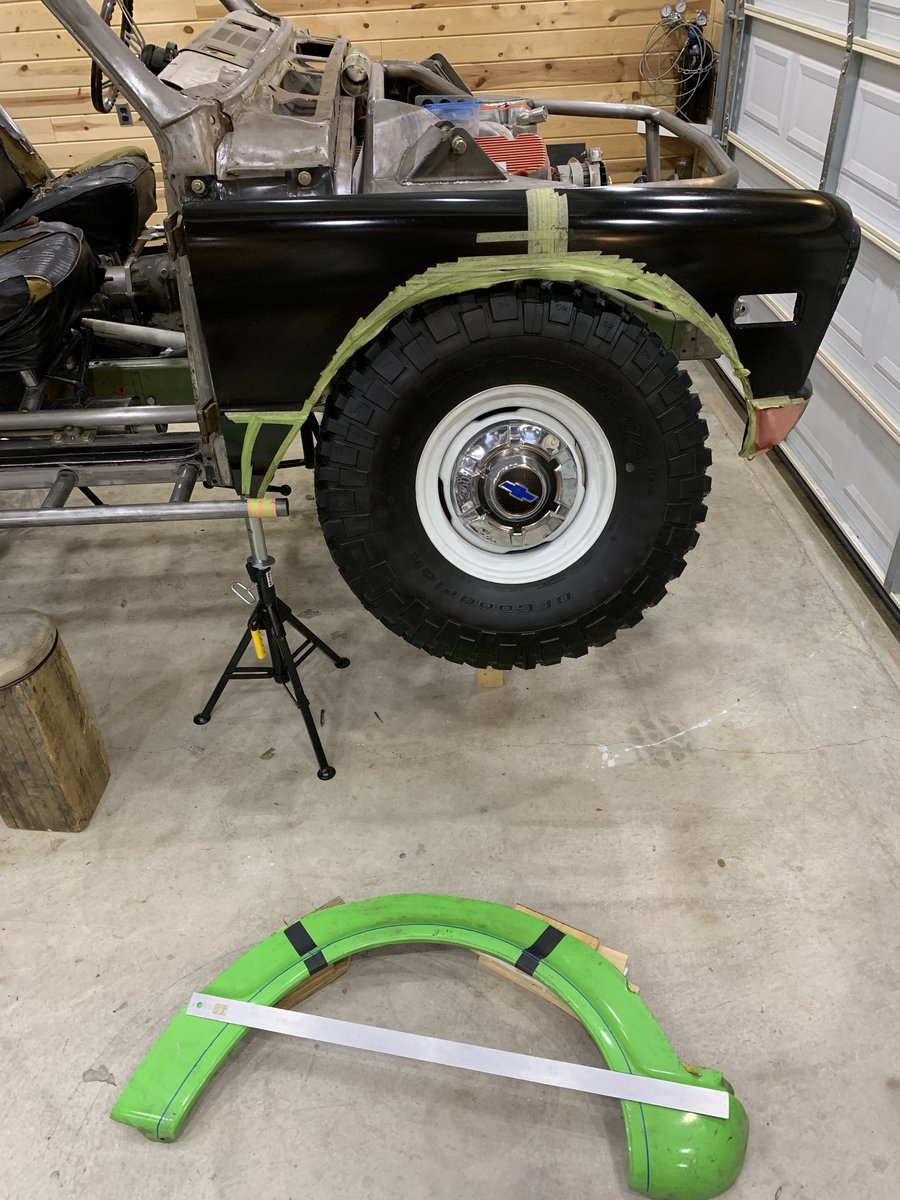
The wheel well rendered last week really wanted to be installed on the truck, but it was important to pull a template from it first, so that the mirror-image panel for the driver's side would take less than 20 hours to complete.

As mentioned before, I've been watching a LOT of YouTube videos from ProShaper.com and the concept of creating and using a "Flexible Shape Pattern" seems like the single fastest way to get a 3-D reference that is simple to work with and develop flat sheets of metal into nice compound curves.

Step one is just cleaning the metal so that the low-stick tape will at least stick a little bit...
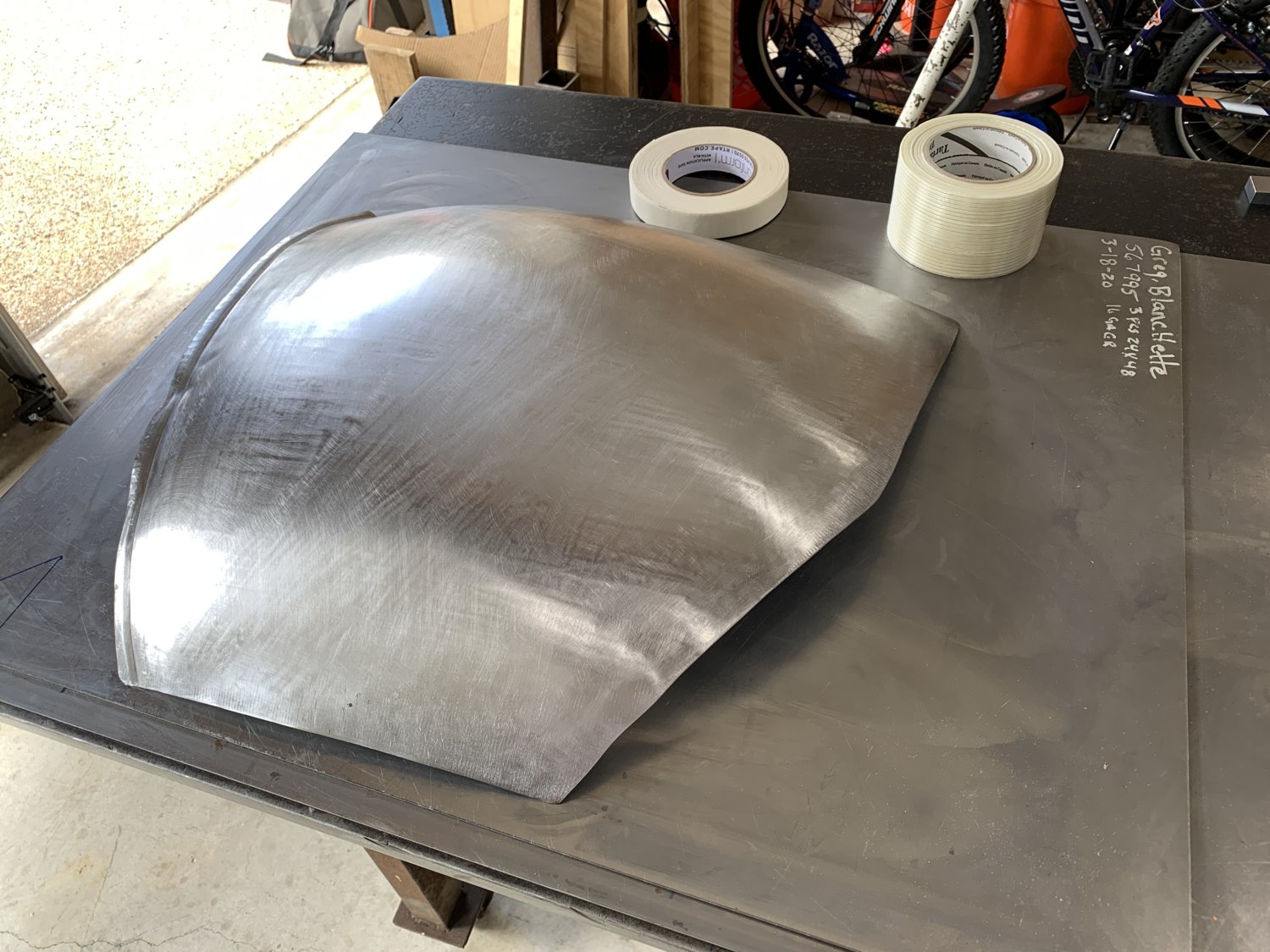
full


The basic process is just lay stripes down making sure they don't overlap. With a high-crown part, you sometimes have to cut slivers since the tape doesn't really stretch very much.
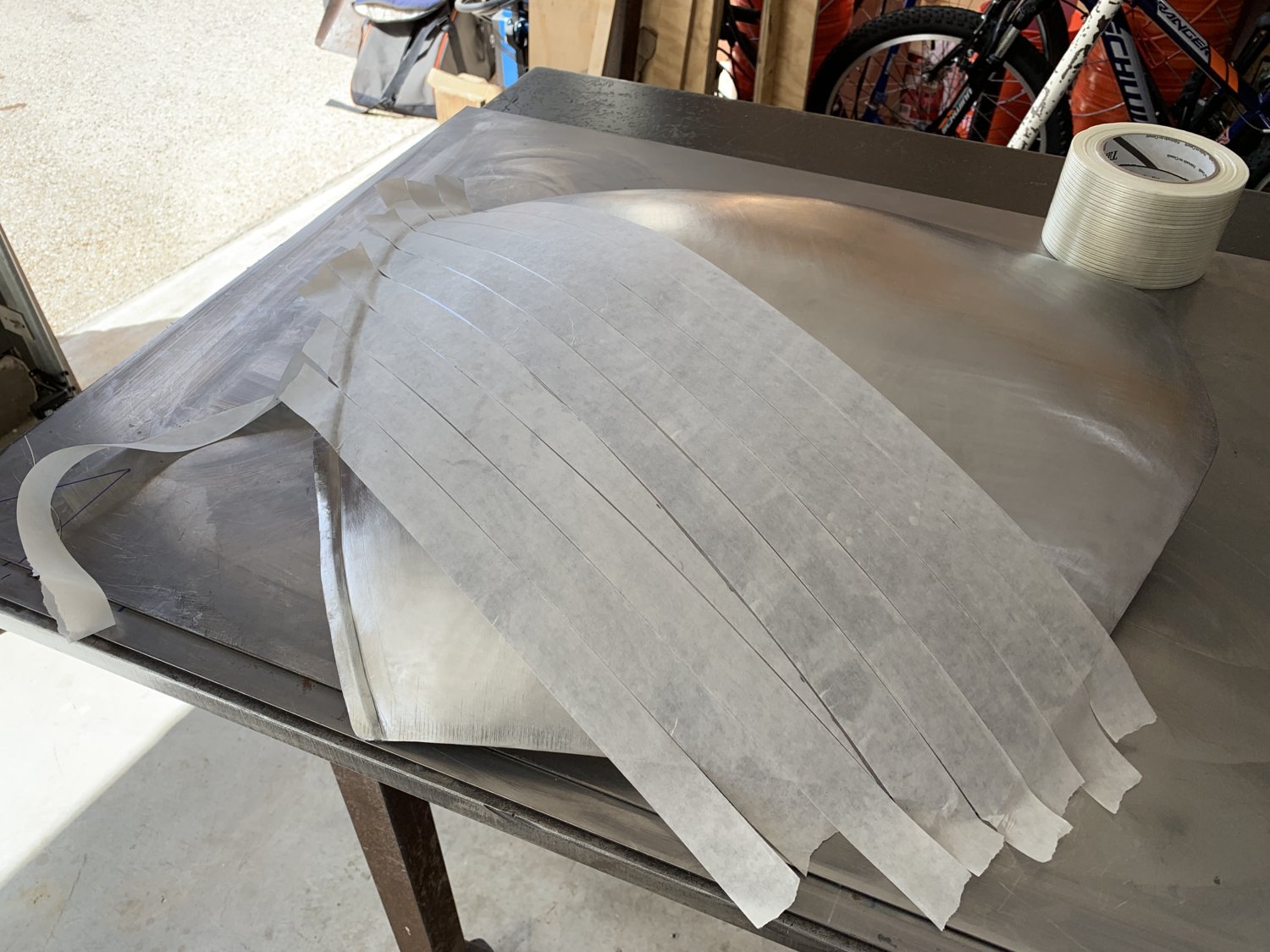
full


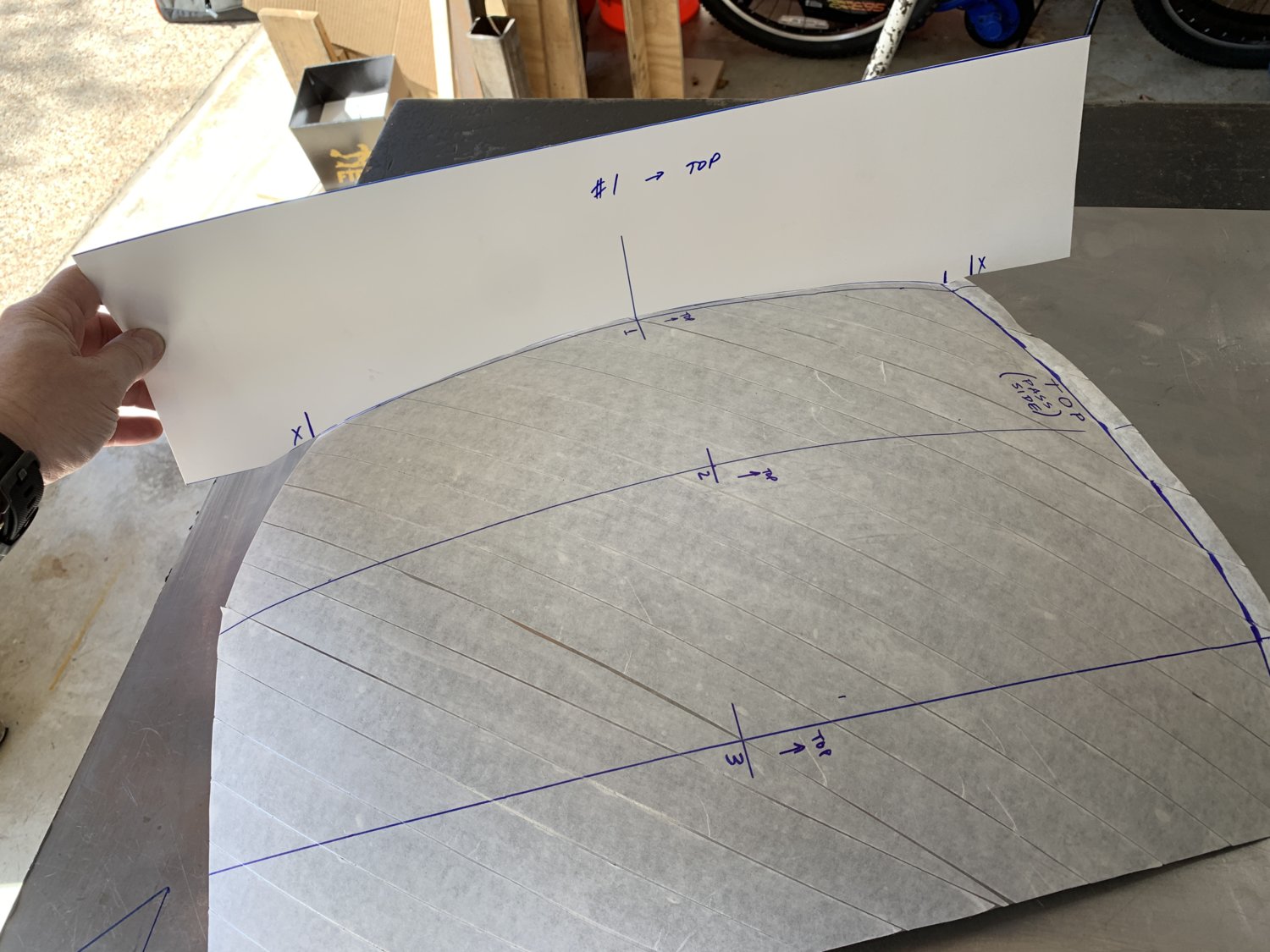
Once the panel is fully covered, it's time to draw a few reference lines, mark "TOP" and cut out a few profile gauges to use later on. These are really just a good way to doublecheck the pattern and make sure everything is developing properly as it's stretched and wheeled smooth.
full


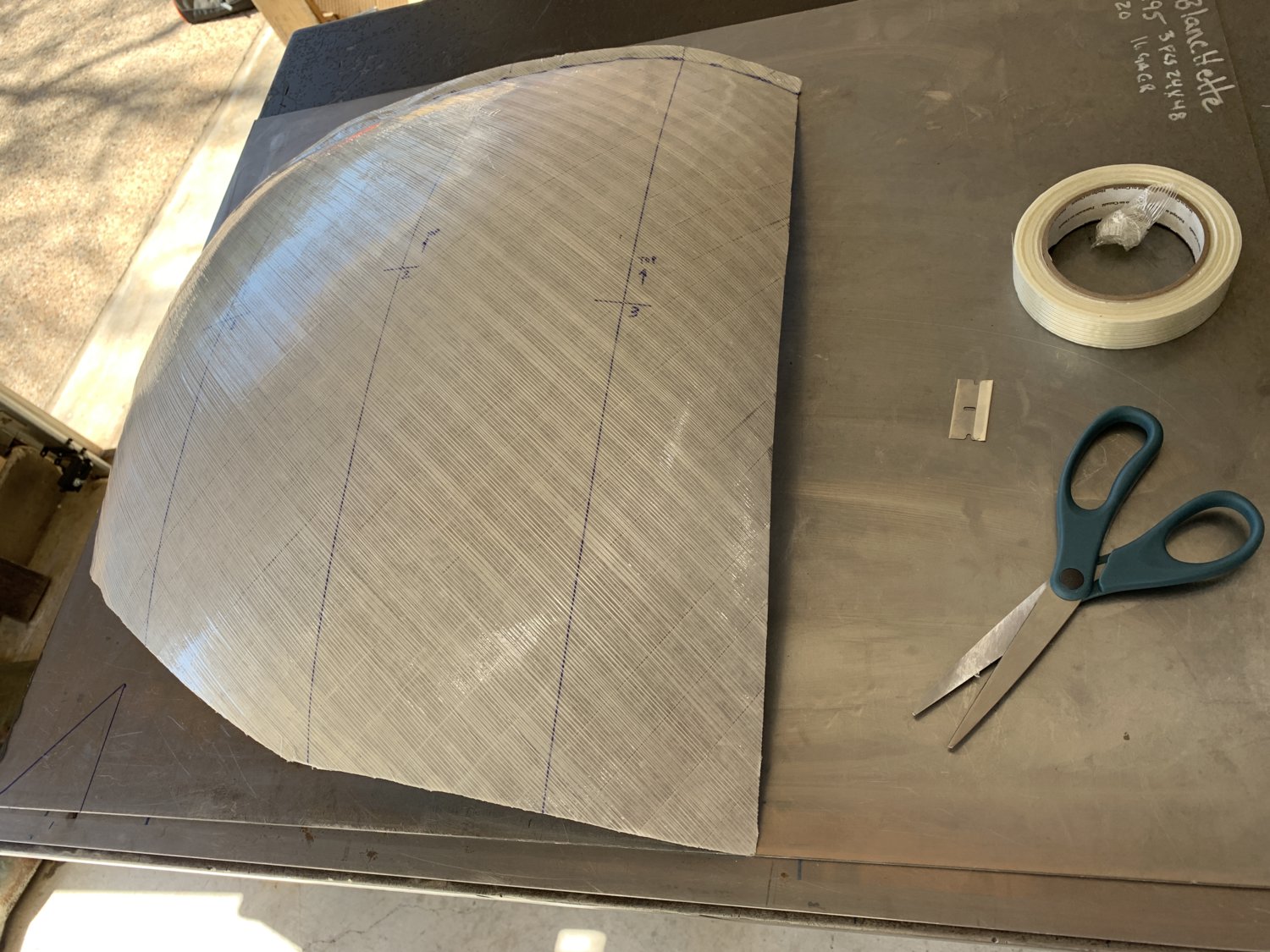
Next step is to apply a bias-ply layer of fiberglass reinforced tape across the first layer. This does a couple of things. Obviously, it helps to bind all the strips together from the first layer, but it also adds a protective layer that is a lot more durable. And if you put all your markings on the first layer, the fiberglass tape will encapsulate them so that they don't smudge or lose clarity later on.
full


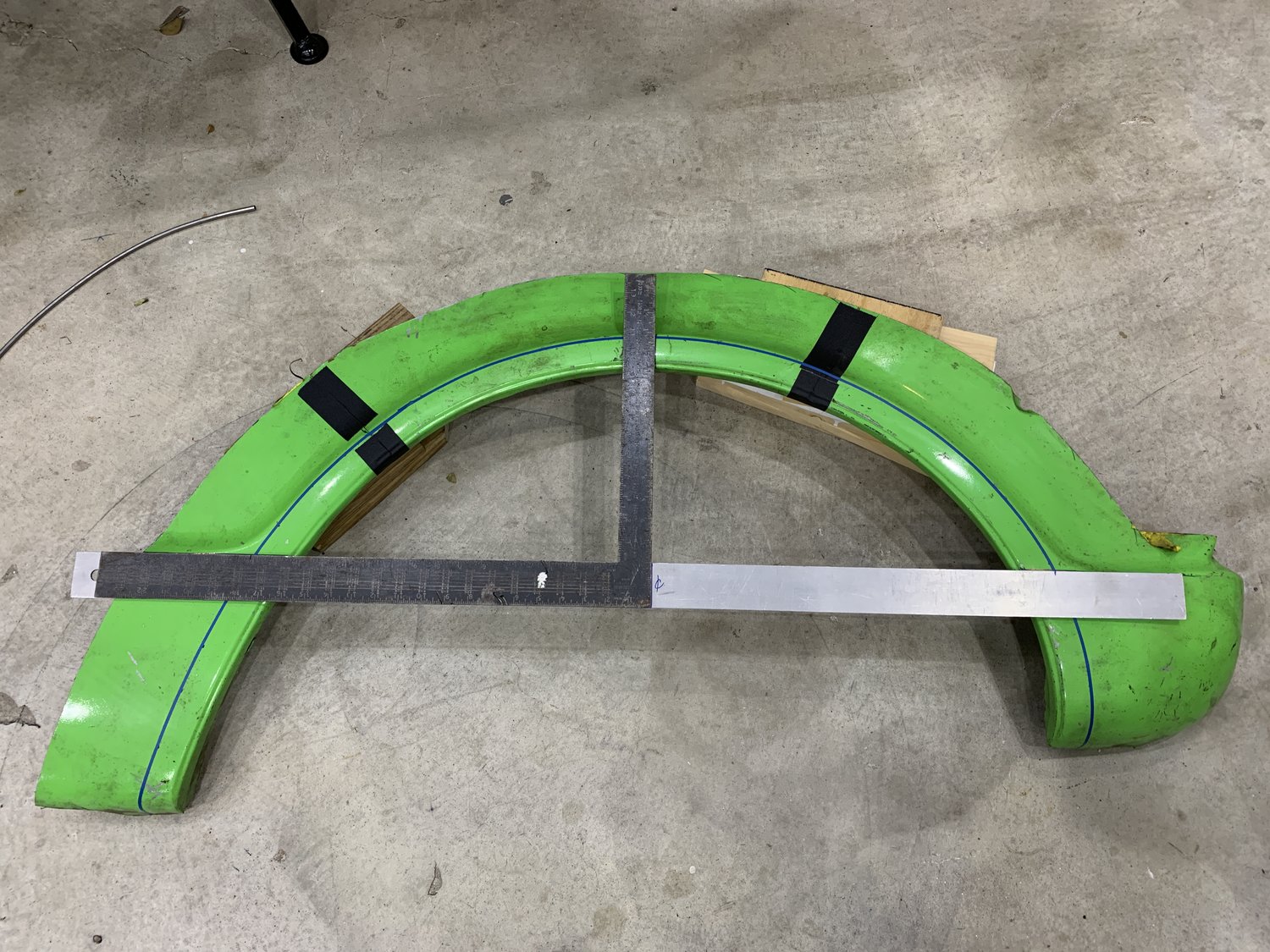
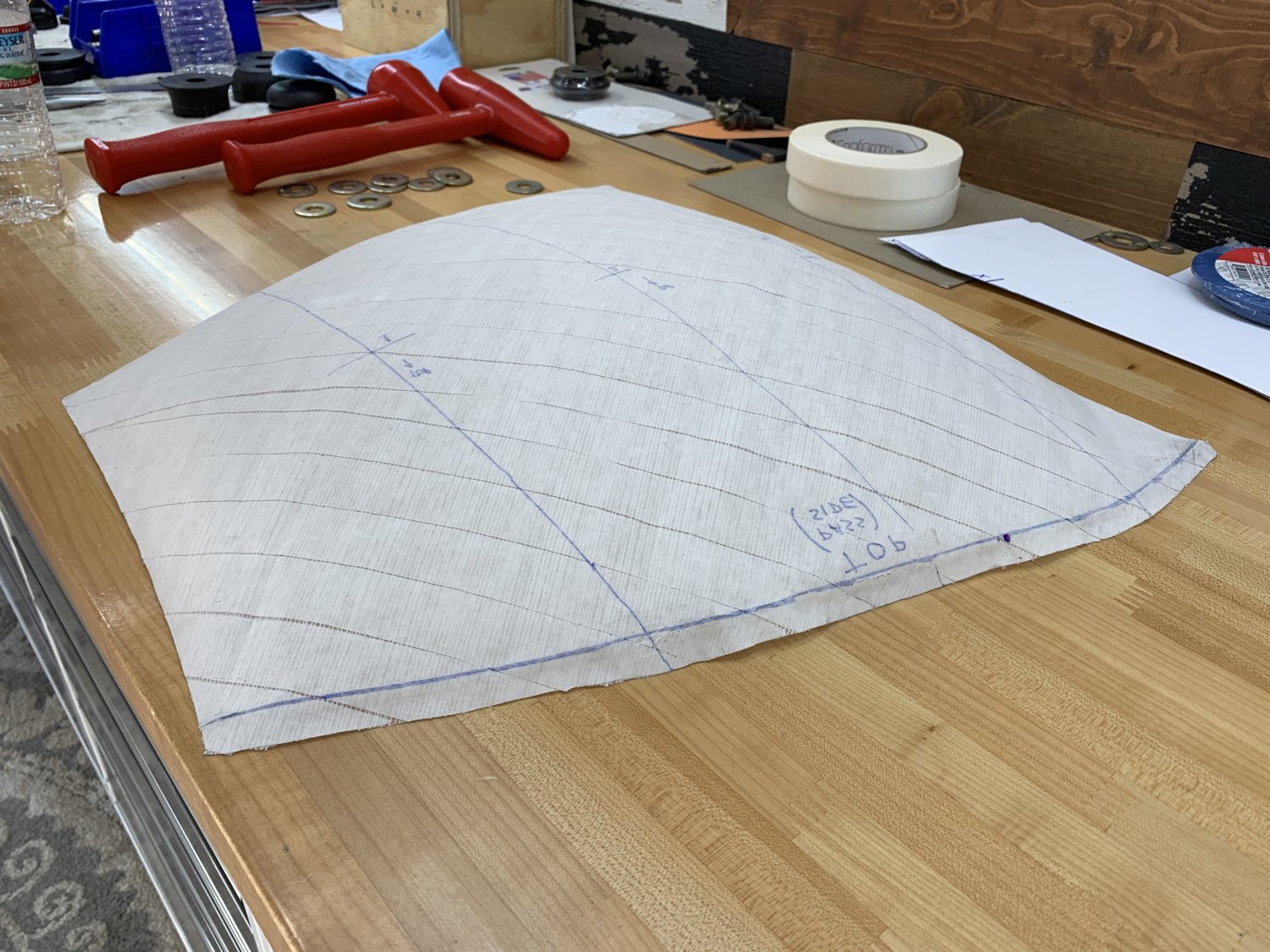
Final step is to carefully trim all the edges and then peel off the tape from the original part. The tape is still slightly sticky, so a bit of baby powder does a great job of killing the remaining adhesive. The pattern can now be flipped inside-out and is ready to be used as a driver's side template in the coming weeks. (I'm waiting on some new tools that will make the next one a lot simpler, so this there is no rush now to replicate the panel). Even as it just sits on the workbench here, you can really see how it holds the profile of the part perfectly and will show instantly where any low spots are (by how far down the pattern caves-in when laid down over the new part).
full


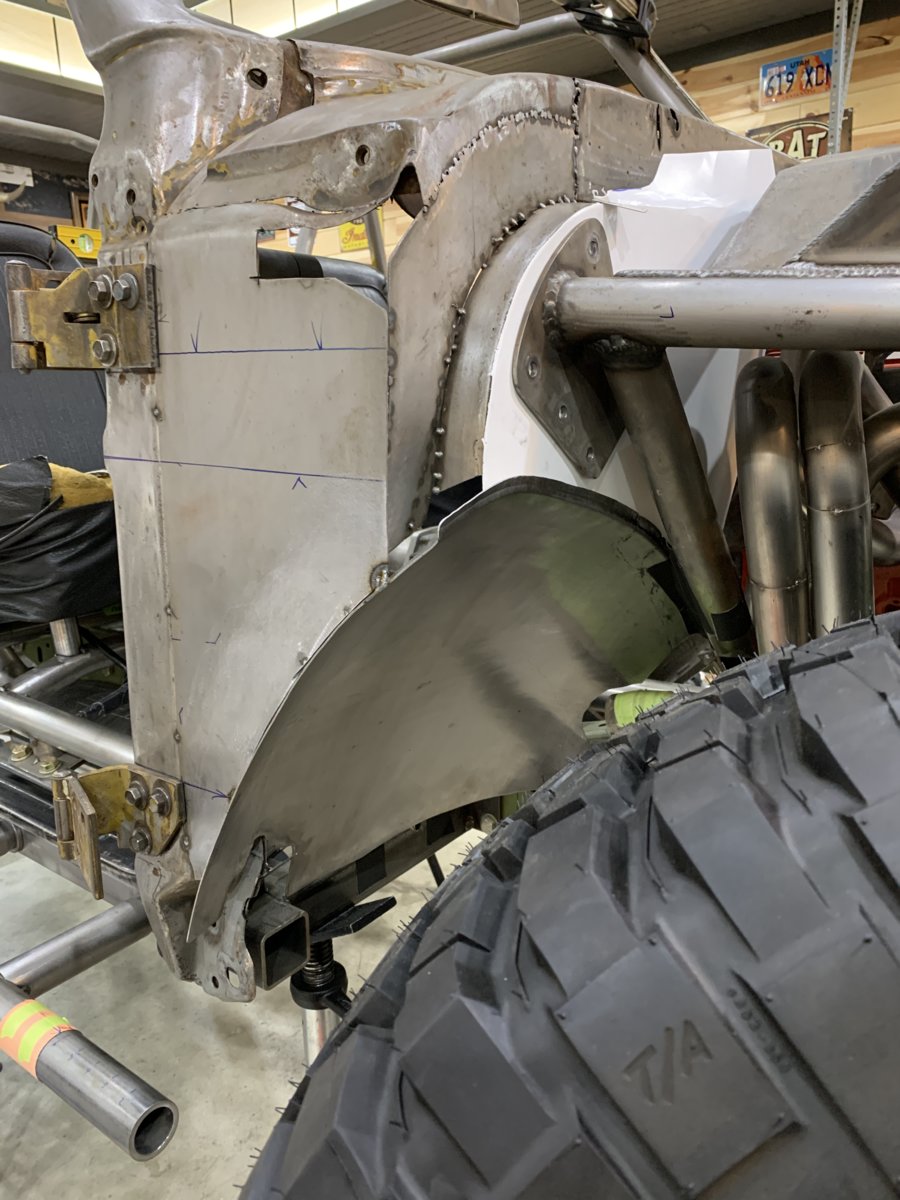
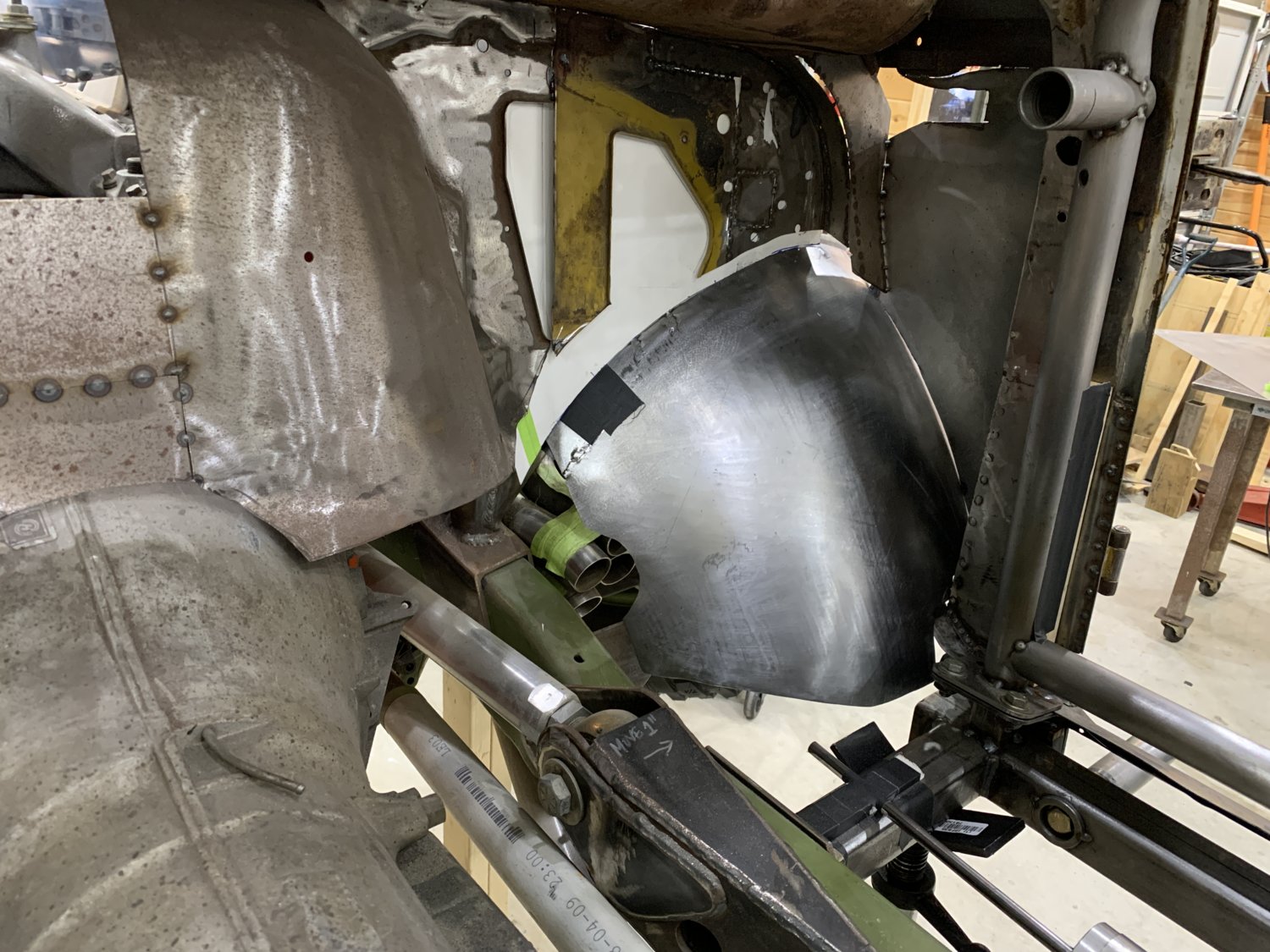
The payoff for completing all of that work, is that the original footwell panel can finally be fitted-up permanently to the passenger side of the truck, and the remaining firewall above it can be templated to meet up perfectly with it.
full


After a long day / night, it felt good to climb way up into the driver's seat and take in the view (and this photo) of the progress. It looks REALLY cool to see a fresh, custom-rendered wheel arch over there!!!
full


So the next step is to lay that white cardstock down onto some 18GA sheet stock (thankfully the firewall is not as thick as the floor panels were!) and trim out basically 1/2 of the firewall to replace the patchwork of grafted pieces in there now. This will be a new opportunity to practice more with the beadroller to help bend the flanges around the top curve... and then a lot of shrinking to get that top lip to fold over at 90* like the factory panel does.

More fun coming.... more tools coming.... stay tuned!!!


-G
 
Your build is bad for my wallet. I want more tools now.:D

That arch looks awesome. Its fun watching the high level stuff you're doing for the first time in your own garage with some time and a lot of YouTube training. Definitely some inspiration to up my game.
 
Your build is bad for my wallet. I want more tools now.:D

That arch looks awesome. Its fun watching the high level stuff you're doing for the first time in your own garage with some time and a lot of YouTube training. Definitely some inspiration to up my game.


The power of YouTube as a training tool cannot be overstated.

I've basically been learning from a guy with 30+ years of metalshaping expertise... just posting videos and teaching me for free. Of course, I need to invest time to watch and study them.... try a few techniques myself, then go back and re-watch the videos (once I have better context about the topic).... to really drive the concepts home. That second viewing of a video is critical to the learning process... until you've actually tried to do something yourself, it doesn't mean as much and you aren't watching as carefully and noticing all the little details that end up being so important.

Tool purchases are a delicate balance as well.... I am not one of those "fill my garage with expensive stuff then figure out how to use it later" type guys. The floorspace is too valuable, and as I've said before many times....each new tool is an investment of time and effort to learn. It needs to be a REALLY important tool to justify taking time away from the K5 build for a 2 or 3 week "excursion" to learn some new technique or process. Some are easier to justify than others... like welding, tube bending, etc. Metalshaping is becoming a necessity at this phase of the build. The firewall and floors need a lot of those techniques, and the fenders are all going to need to be custom-built to fit the larger tires so it really can't be put off any longer.

It's also tough to choose a point on the continuum to balance time vs tool costs. I've bought what I consider to be the "essential" metalshaping tools now (Shrinker / Stretcher, English Wheel, Beadroller, Hammers/Shotbag) but the first formed panel took me about 20 hours. About half of that was just learning new techniques, but the other half was struggling with a slow hammerforming process on thick metal. As I learned that technique, I realized that there is still one more tool that I don't have that's actually really important... and that's a deep-stretcher. Basically, it's a tool that puts large "taco shaped" creases in metal to agressively gather-up metal at the edges of the panel to quickly develop high-crown shapes. If you can shrink like that, you aren't just limited to stretching the center of the panel as your only method for increasing the crown of the part. And hammering all day to stretch the center is really hard work and is extremely time-consuming. So my next tool is a set of special shrinking dies and a deep-throated arbor press that will allow me to create those "taco" shapes and then crush the gathered metal back down quickly. This will turn a multi-hour exhausting procedure of hammering into a few minutes of very quick shaping of high-crown parts.... so stay tuned for that update in the coming weeks. :waytogo:

Time is money, and with only a few hours each week to work on this project the time spent needs to be efficient. I can't waste an entire weekend hammering on a single sheet of steel or this truck will never be ready for BlazerBash 2022...


-G
 
The power of YouTube as a training tool cannot be overstated.

I've basically been learning from a guy with 30+ years of metalshaping expertise... just posting videos and teaching me for free. Of course, I need to invest time to watch and study them.... try a few techniques myself, then go back and re-watch the videos (once I have better context about the topic).... to really drive the concepts home. That second viewing of a video is critical to the learning process... until you've actually tried to do something yourself, it doesn't mean as much and you aren't watching as carefully and noticing all the little details that end up being so important.

Tool purchases are a delicate balance as well.... I am not once of those "fill my garage with expensive stuff then figure out how to use it later" type guys. The floorspace is too valuable, and as I've said before many times....each new tool is an investment of time and effort to learn. It needs to be a REALLY important tool to justify taking time away from the K5 build for a 2 or 3 week "excursion" to learn some new technique or process. Some are easier to justify than others... like welding, tube bending, etc. Metalshaping is becoming a necessity at this phase of the build. The firewall and floors need a lot of those techniques, and the fenders are all going to need to be custom-built to fit the larger tires so it really can't be put off any longer.

It's also tough to choose a point on the continuum to balance time vs tool costs. I've bought what I consider to be the "essential" metalshaping tools now (Shrinker / Stretcher, English Wheel, Beadroller, Hammers/Shotbag) but the first formed panel took me about 20 hours. About half of that was just learning new techniques, but the other half was struggling with a slow hammerforming process on thick metal. As I learned that technique, I realized that there is still one more tool that I don't have that's actually really important... and that's a deep-stretcher. Basically, it's a tool that puts large "taco shaped" creases in metal to agressively gather-up metal at the edges of the panel to quickly develop high-crown shapes. If you can shrink like that, you aren't just limited to stretching the center of the panel as your only method for increasing the crown of the part. And hammering all day to stretch the center is really hard work and is extremely time-consuming. So my next tool is a set of special shrinking dies and a deep-throated arbor press that will allow me to create those "taco" shapes and then crush the gathered metal back down quickly. This will turn a multi-hour exhausting procedure of hammering into a few minutes of very quick shaping of high-crown parts.... so stay tuned for that update in the coming weeks. :waytogo:

Time is money, and with only a few hours each week to work on this project the time spent needs to be efficient. I can't waste an entire weekend hammering on a single sheet of steel or this truck will never be ready for BlazerBash 2022...


-G

How many more parts are requiring that kind of deep draw forming? Sounds like you are planning for more than just the opposite fender well.
 
How many more parts are requiring that kind of deep draw forming? Sounds like you are planning for more than just the opposite fender well.

Brian,

At some point (though not before BB2022)... I will need to build complete inner fenderwells for the front tires to keep crud out of the engine bay. That will be a massive undertaking to work around the struts and exhaust and match them up to the larger wheel arch openings. Probably will have to make those in either 2 or 3 separate pieces then weld them together.


-G
 
Brian,

At some point (though not before BB2022)... I will need to build complete inner fenderwells for the front tires to keep crud out of the engine bay. That will be a massive undertaking to work around the struts and exhaust and match them up to the larger wheel arch openings. Probably will have to make those in either 2 or 3 separate pieces then weld them together.


-G
Would it be worth keeping them in pieces and maybe using a bead rolled flange to dzus them together?
 
Would it be worth keeping them in pieces and maybe using a bead rolled flange to dzus them together?

Not really sure about that. :thinking:

Usually Dzus fasteners are to allow for quick access to something important. The inner fenderwells aren't really going to block anything critically important...

Maybe it would be cool to put small horizontal access panel for swapping out spark plugs though... that is often easier to do from the fender side than from inside the engine bay.


-G
 
Not really sure about that. :thinking:

Usually Dzus fasteners are to allow for quick access to something important. The inner fenderwells aren't really going to block anything critically important...

Maybe it would be cool to put small horizontal access panel for swapping out spark plugs though... that is often easier to do from the fender side than from inside the engine bay.

-G

There’s so much homer bucket clearance it might just be easier to air up the struts and change from underneath. :D
 
The power of YouTube as a training tool cannot be overstated.

I've basically been learning from a guy with 30+ years of metalshaping expertise... just posting videos and teaching me for free. Of course, I need to invest time to watch and study them.... try a few techniques myself, then go back and re-watch the videos (once I have better context about the topic).... to really drive the concepts home. That second viewing of a video is critical to the learning process... until you've actually tried to do something yourself, it doesn't mean as much and you aren't watching as carefully and noticing all the little details that end up being so important.

Tool purchases are a delicate balance as well.... I am not one of those "fill my garage with expensive stuff then figure out how to use it later" type guys. The floorspace is too valuable, and as I've said before many times....each new tool is an investment of time and effort to learn. It needs to be a REALLY important tool to justify taking time away from the K5 build for a 2 or 3 week "excursion" to learn some new technique or process. Some are easier to justify than others... like welding, tube bending, etc. Metalshaping is becoming a necessity at this phase of the build. The firewall and floors need a lot of those techniques, and the fenders are all going to need to be custom-built to fit the larger tires so it really can't be put off any longer.

It's also tough to choose a point on the continuum to balance time vs tool costs. I've bought what I consider to be the "essential" metalshaping tools now (Shrinker / Stretcher, English Wheel, Beadroller, Hammers/Shotbag) but the first formed panel took me about 20 hours. About half of that was just learning new techniques, but the other half was struggling with a slow hammerforming process on thick metal. As I learned that technique, I realized that there is still one more tool that I don't have that's actually really important... and that's a deep-stretcher. Basically, it's a tool that puts large "taco shaped" creases in metal to agressively gather-up metal at the edges of the panel to quickly develop high-crown shapes. If you can shrink like that, you aren't just limited to stretching the center of the panel as your only method for increasing the crown of the part. And hammering all day to stretch the center is really hard work and is extremely time-consuming. So my next tool is a set of special shrinking dies and a deep-throated arbor press that will allow me to create those "taco" shapes and then crush the gathered metal back down quickly. This will turn a multi-hour exhausting procedure of hammering into a few minutes of very quick shaping of high-crown parts.... so stay tuned for that update in the coming weeks. :waytogo:

Time is money, and with only a few hours each week to work on this project the time spent needs to be efficient. I can't waste an entire weekend hammering on a single sheet of steel or this truck will never be ready for BlazerBash 2022...


-G

I definitely need to check out the channel you've been watching. I've seen some videos here and there, but I haven't seen that one yet.

I hear you on the tools. I have a 3 and a half car garage- its amazing how quickly that space gets taken up, especially when you still want to park 3 cars in it. There's more tools in the want category, but floor space is limited enough I've had to keep myself from buying stuff until I absolutely need it.
 
2021.02.24 - UPDATE! - IT'S ALL CONNECTED....

It's just about impossible to tackle any single project on the MightAsWell build without considering their impact on the larger desired end-result.

Case in point: To properly template the firewall area, you need to have a fender mounted up to see what's going on there and what sort of odd gaps and clearances are being created. Plus with the truck fully articulated for the 1st time ever, it was a good time to confirm clearances on the massive fender cutout that was made a couple of years ago.

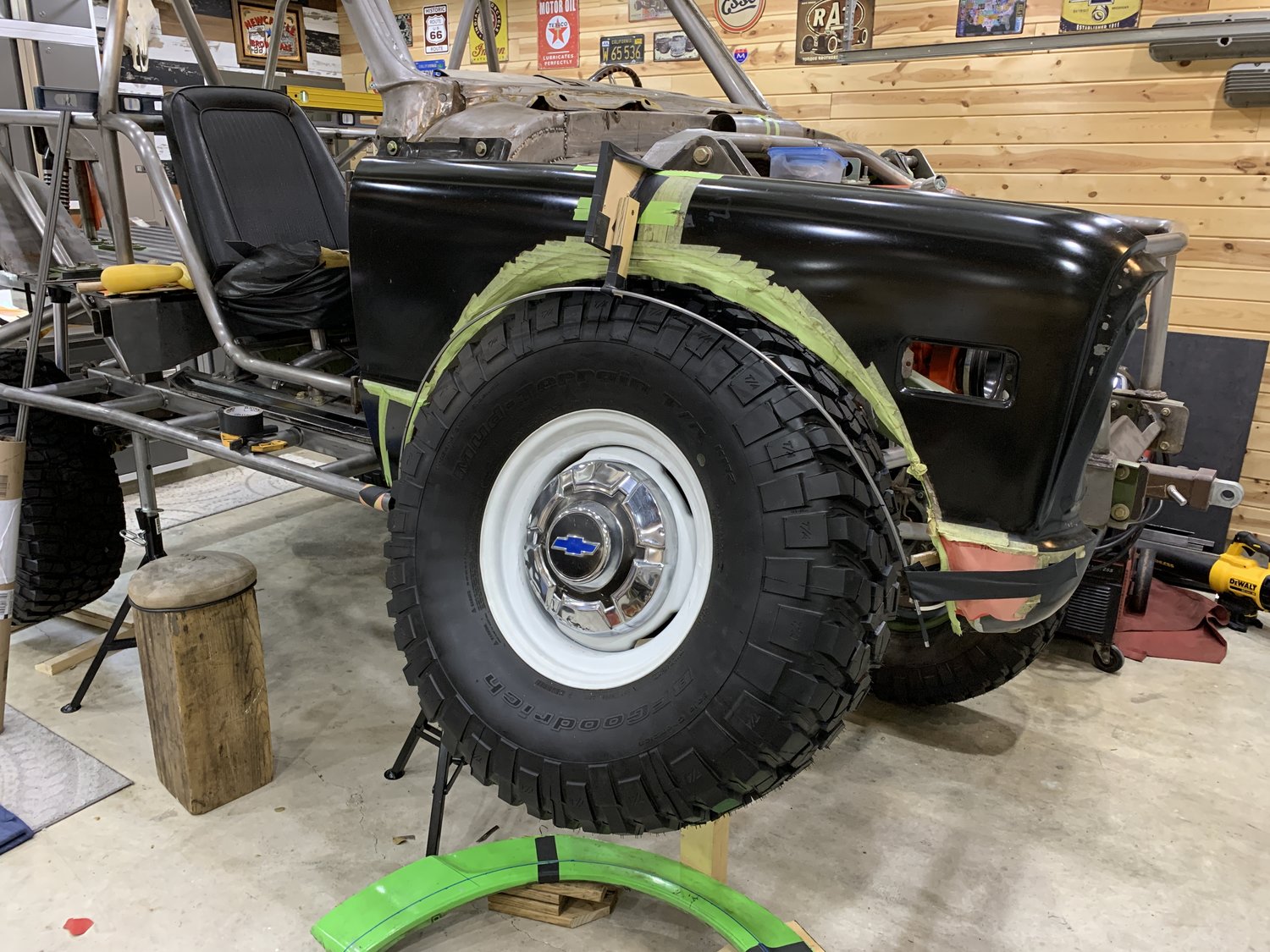
Start of the night.... fender mounted, with a template fender arch from @NorCal69 to use a a reference part.

full


If you measure across the style line... the fender opening is only 31.25" which probably should be an early warning sign that a 38" tire isn't going to fit without a LOT of work.

full


Grabbed a 6' length of 3/16" solid rod and bent up the profile of the arch. This stuff is cheap and great for building wireframe models and for this sort of quick templating of curved shapes. After a few attempts and experiments with the height of the arch, width of the arch, etc. It was in a pretty decent location that allowed the tire to swing fully without interference.

full


It's a delicate balancing act for sure. With a small fender flare, the arch needs to be REALLY large to allow the tire to tuck in properly behind it as it swings from left-to-right. With a more pronounced flare you can actually make the radius of the fender opening a lot smaller, which improves the proportion and aesthetic of the fender. But if the flare itself gets too large, the fender will end up looking "cartoony" or like a prerunner-style fender.

This was just a first-effort to start the process and identify the challenges. Over time, this will need to be refined and rendered in metal.... then viewed from a distance and various angles to see what the effect is. If I'm being honest... at least a few of the next attempts are going to end up in the "tuition pile" before the proper balance is struck... so we might as well just get started and let the iterative process begin. :waytogo:


-G
 
2021.02.24 - UPDATE! - IT'S ALL CONNECTED....

It's just about impossible to tackle any single project on the MightAsWell build without considering their impact on the larger desired end-result.

Case in point: To properly template the firewall area, you need to have a fender mounted up to see what's going on there and what sort of odd gaps and clearances are being created. Plus with the truck fully articulated for the 1st time ever, it was a good time to confirm clearances on the massive fender cutout that was made a couple of years ago.

Start of the night.... fender mounted, with a template fender arch from @NorCal69 to use a a reference part.

full


If you measure across the style line... the fender opening is only 31.25" which probably should be an early warning sign that a 38" tire isn't going to fit without a LOT of work.

full


Grabbed a 6' length of 3/16" solid rod and bent up the profile of the arch. This stuff is cheap and great for building wireframe models and for this sort of quick templating of curved shapes. After a few attempts and experiments with the height of the arch, width of the arch, etc. It was in a pretty decent location that allowed the tire to swing fully without interference.

full


It's a delicate balancing act for sure. With a small fender flare, the arch needs to be REALLY large to allow the tire to tuck in properly behind it as it swings from left-to-right. With a more pronounced flare you can actually make the radius of the fender opening a lot smaller, which improves the proportion and aesthetic of the fender. But if the flare itself gets too large, the fender will end up looking "cartoony" or like a prerunner-style fender.

This was just a first-effort to start the process and identify the challenges. Over time, this will need to be refined and rendered in metal.... then viewed from a distance and various angles to see what the effect is. If I'm being honest... at least a few of the next attempts are going to end up in the "tuition pile" before the proper balance is struck... so we might as well just get started and let the iterative process begin. :waytogo:


-G

I had a feeling that all those cool new tools were needed for more than inner fenders.
 
I had a feeling that all those cool new tools were needed for more than inner fenders.

I'm really hoping I can find a die set that will allow me to beadroll that 1st Gen fender detail on the outer lip of the fenders.... It's a pretty crisp stamping on NOS fenders, and usually too "soft" on the reproduction fenders.

Getting that "just right" would be a nice victory.


-G
 
I'd aim for a wider opening and as little flair as you can pull off. The bigger tires should keep the wider opening from looking too weird, but it's real hard not to notice a big bubble flair especially from the front.

I'm sure you'll figure it out, so I'm looking forward to seeing what you come up with.
 
I'd aim for a wider opening and as little flair as you can pull off. The bigger tires should keep the wider opening from looking too weird, but it's real hard not to notice a big bubble flair especially from the front.

I'm sure you'll figure it out, so I'm looking forward to seeing what you come up with.

The answer is out there.... :)

The big fat tires make the factory lip look too thin.... but too much flare on that lip is going to give it a "1st Gen with too much Botox" look.

Portal knuckles have a REALLY wide swing compared to a conventional D44/D60. If you just keep cutting until it clears, the wheel opening is massive.... and that's ugly too.

It's going to take a few tries I'm sure..... and it will be obvious as soon as you step back and look at the side profile of the truck.


-G
 
I keep forgetting about the portals and what that does to the tire swing. Looking forward to the process. :)
 
I look forward to watching you're fender flare process. That's in my 5 year plan for my Spirit, once I address the suspension and lower it. Obviously different aplications, but I'm sure the process of building a flare is the same.
 
2021.03.01 - UPDATE! FIREWALLS AND FLARE...

Some really good progress yesterday.

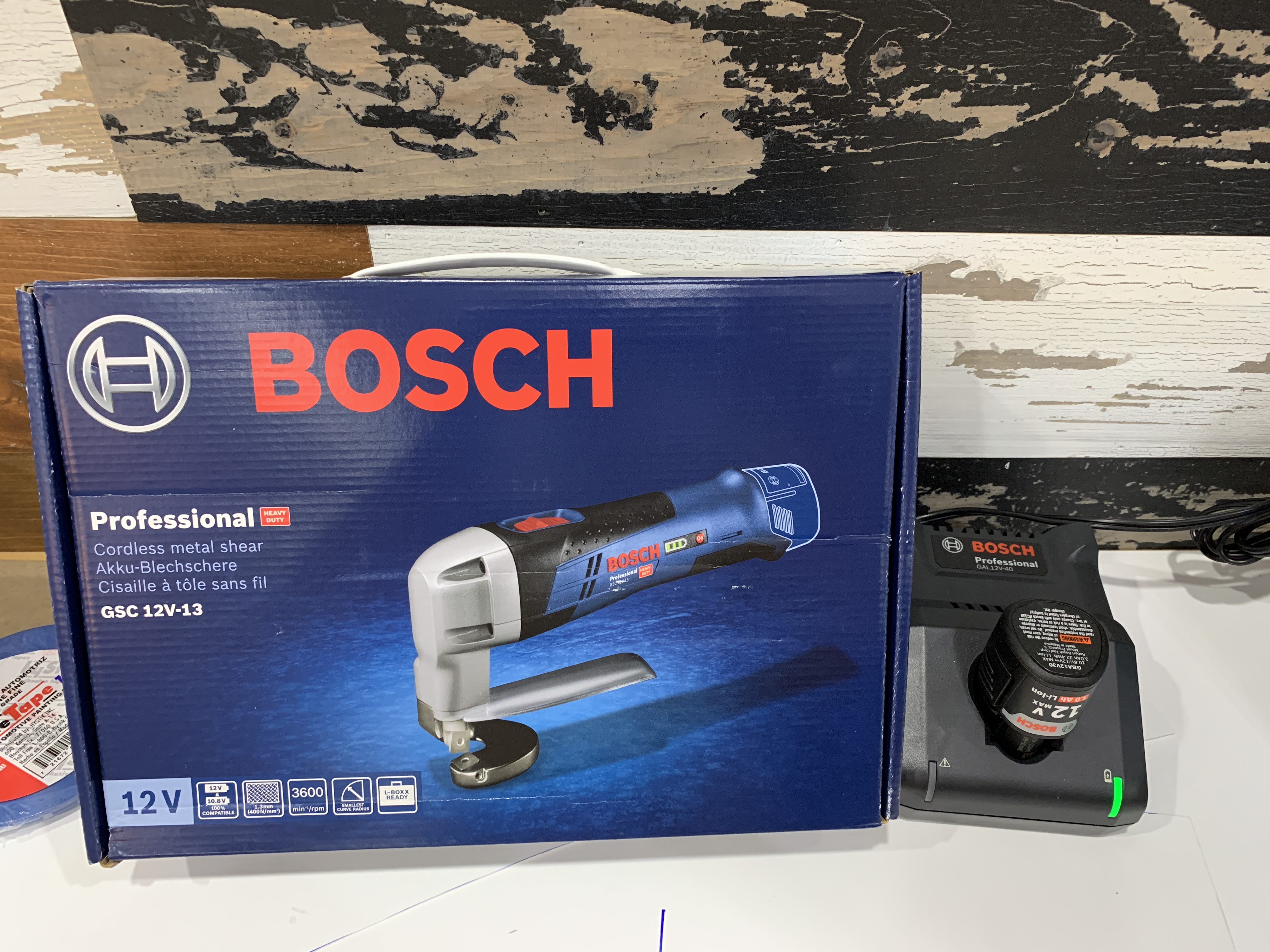
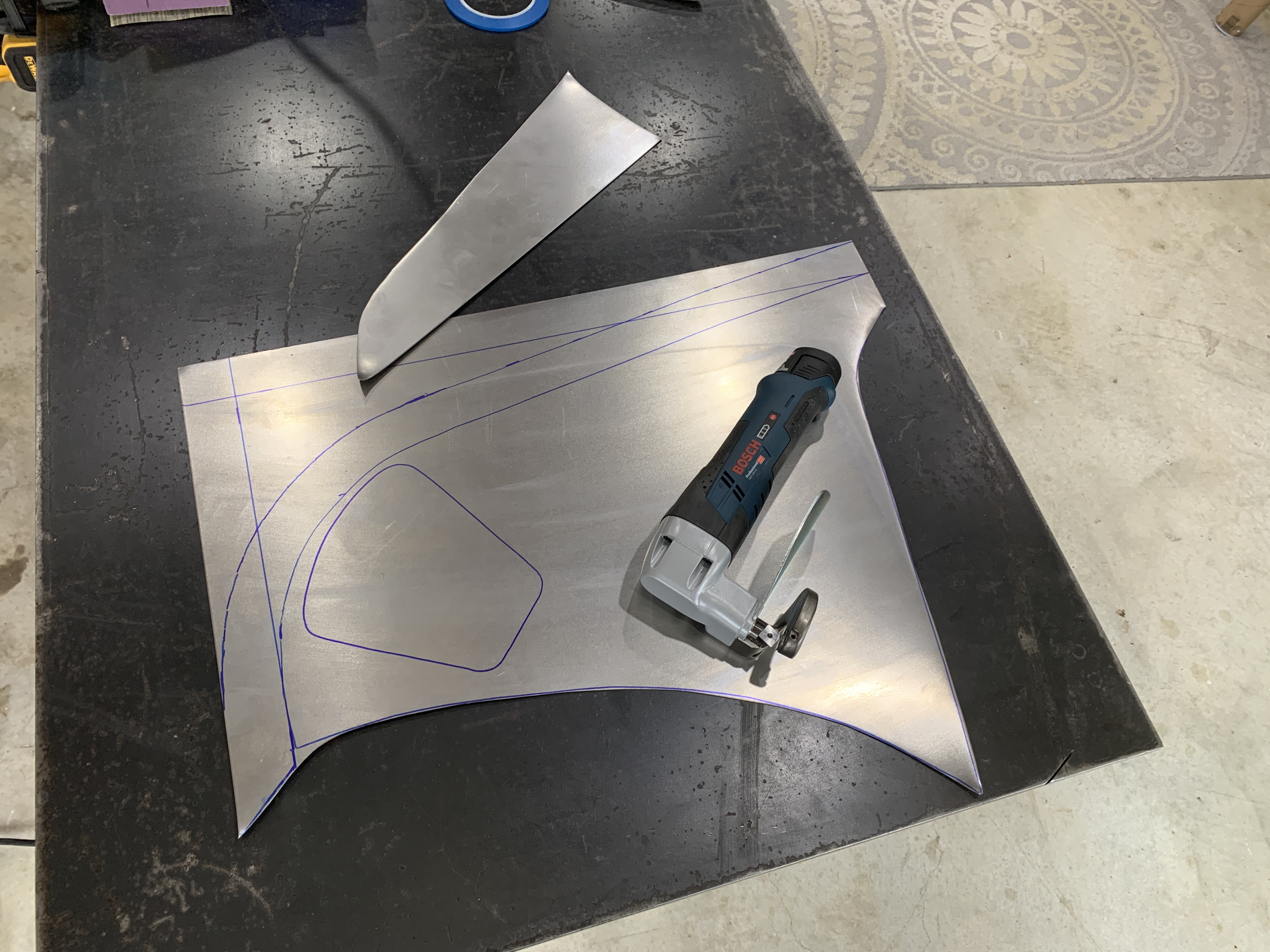
One of the tools I'd been waiting for finally arrived... It's a cordless metal shear, and from what I'd read online it is supposed to be a real gamechanger.

full


It was!... Compared to my only other options of an airsaw or a cutoff wheel, this tool was awesome. It's quieter than I expected, and it moves across 18GA like butter... and was super easy to follow curves too.

full


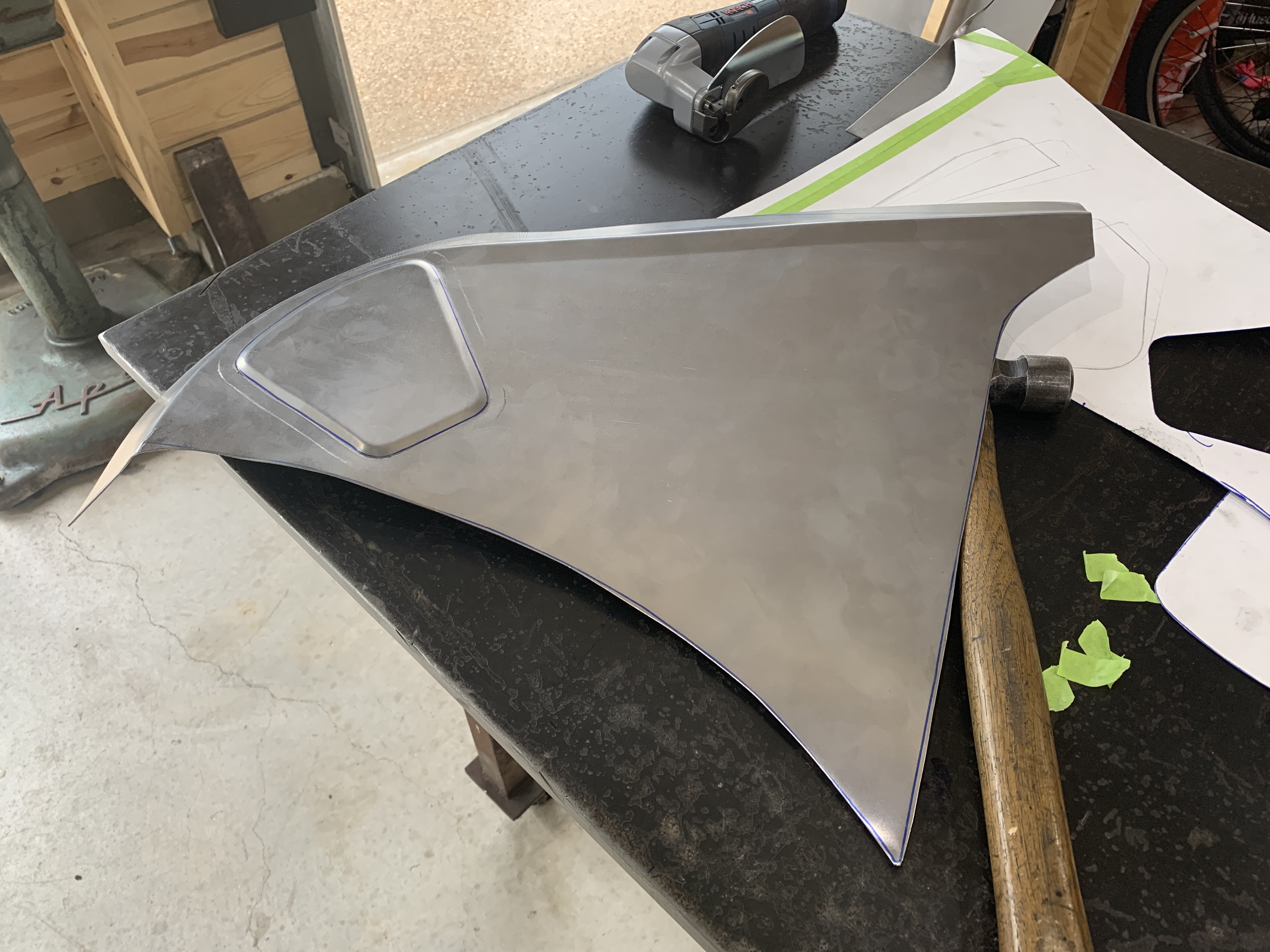
Got 1/2 of the firewall cut out and tried somewhat successfully to beadroll and then fold the profile needed to attach this panel to the new footwell part as well as the factory cowl.

full


Took a break from that and started on the wheel arch / flare with some heavy black foamboard that I'd picked up over the weekend.

full


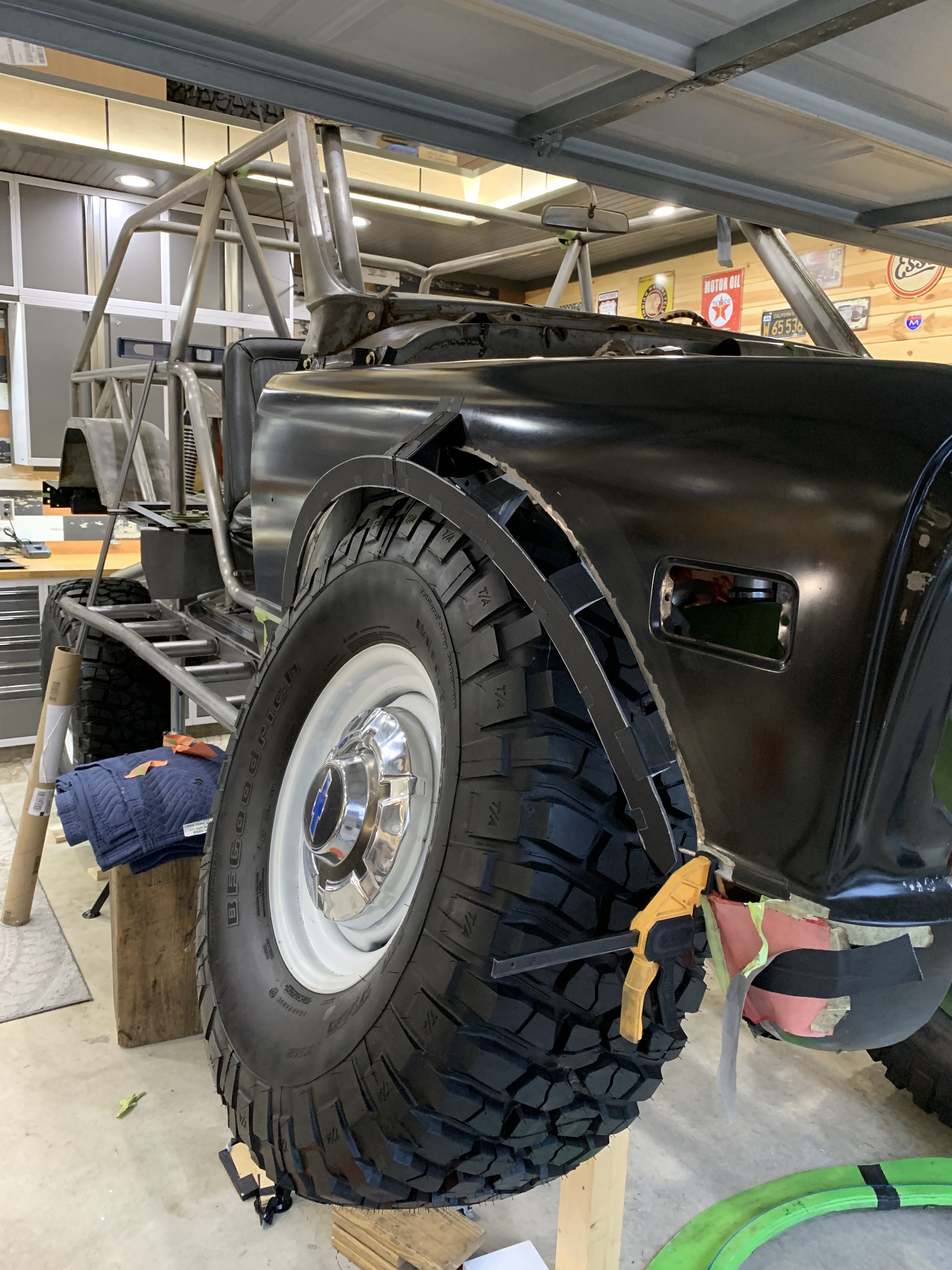
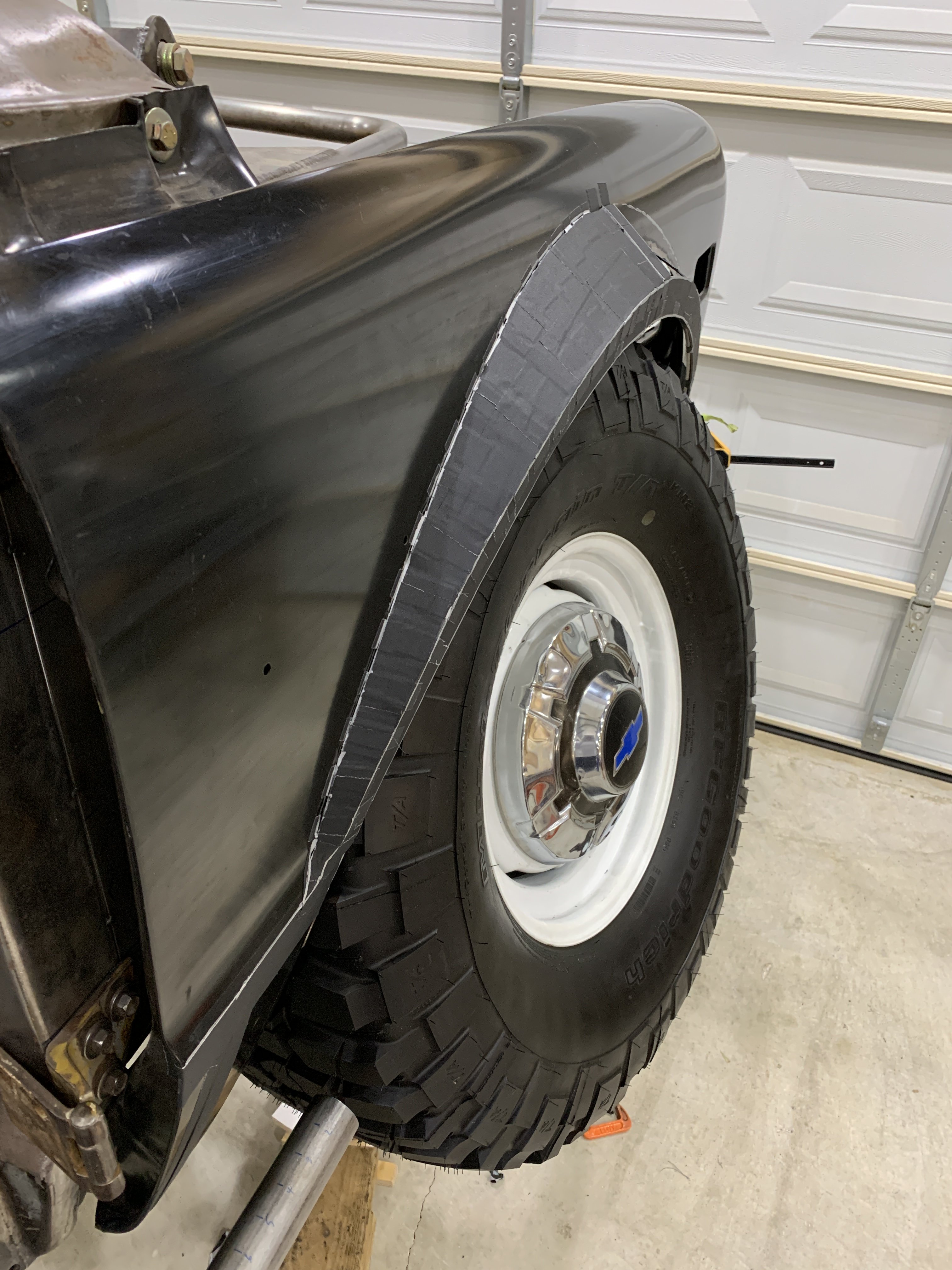
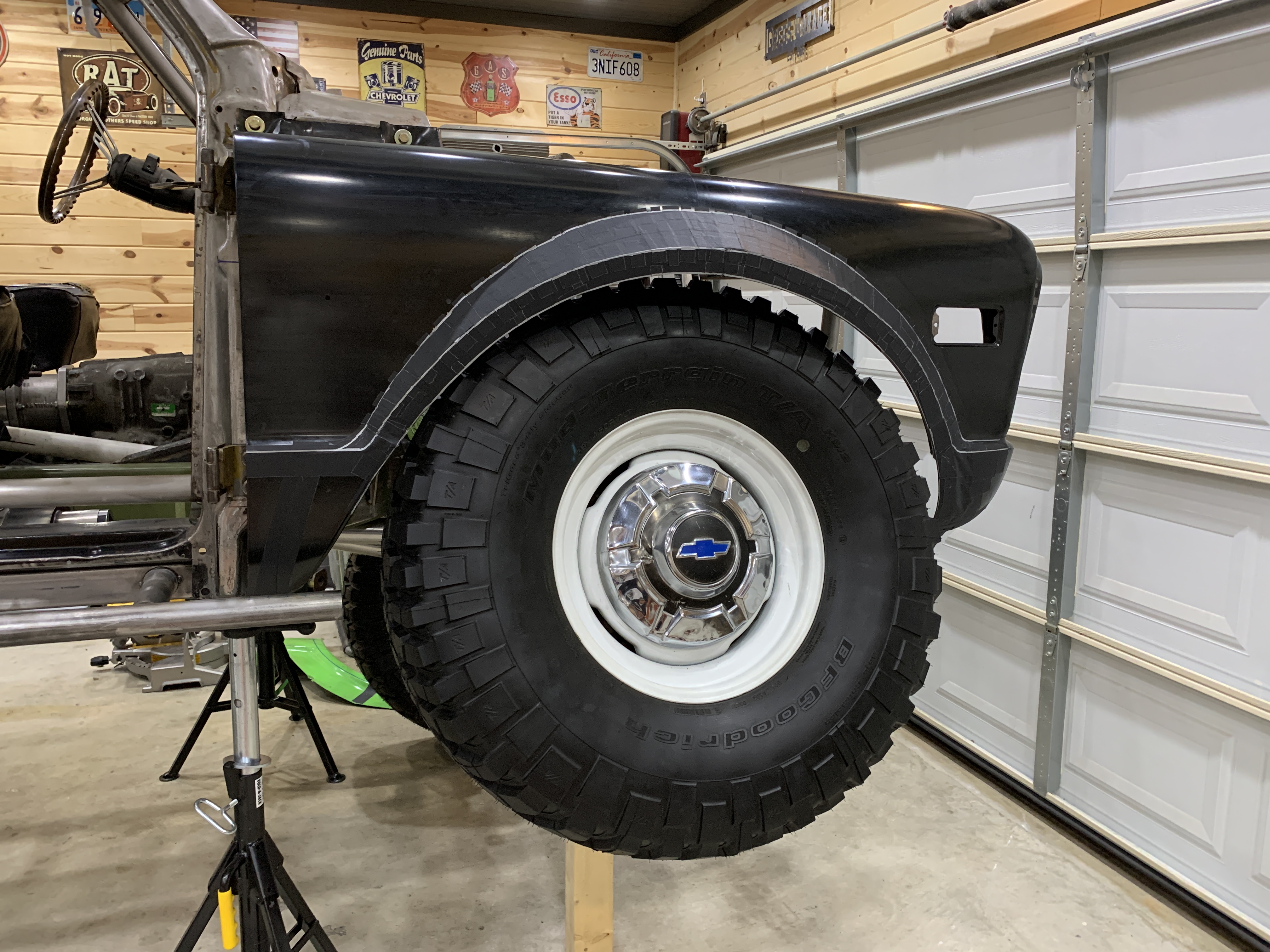
Knowing that there is no way that I'd hit the correct proportions / flare size on the first attempt, I just jumped in and started with something close. That turned out to be a 2.5" flare as low on the fender as it would go while still giving clearance for the tire at full-lock in both directions. This photo shows the fitting of the strips of foam board to add rigidity, and to allow the gaffer tape to lay down more smoothly.

full


After a couple of hours, the entire shape was rendered with 3/16" rod, cardboard and lots of black gaffer tape...

full


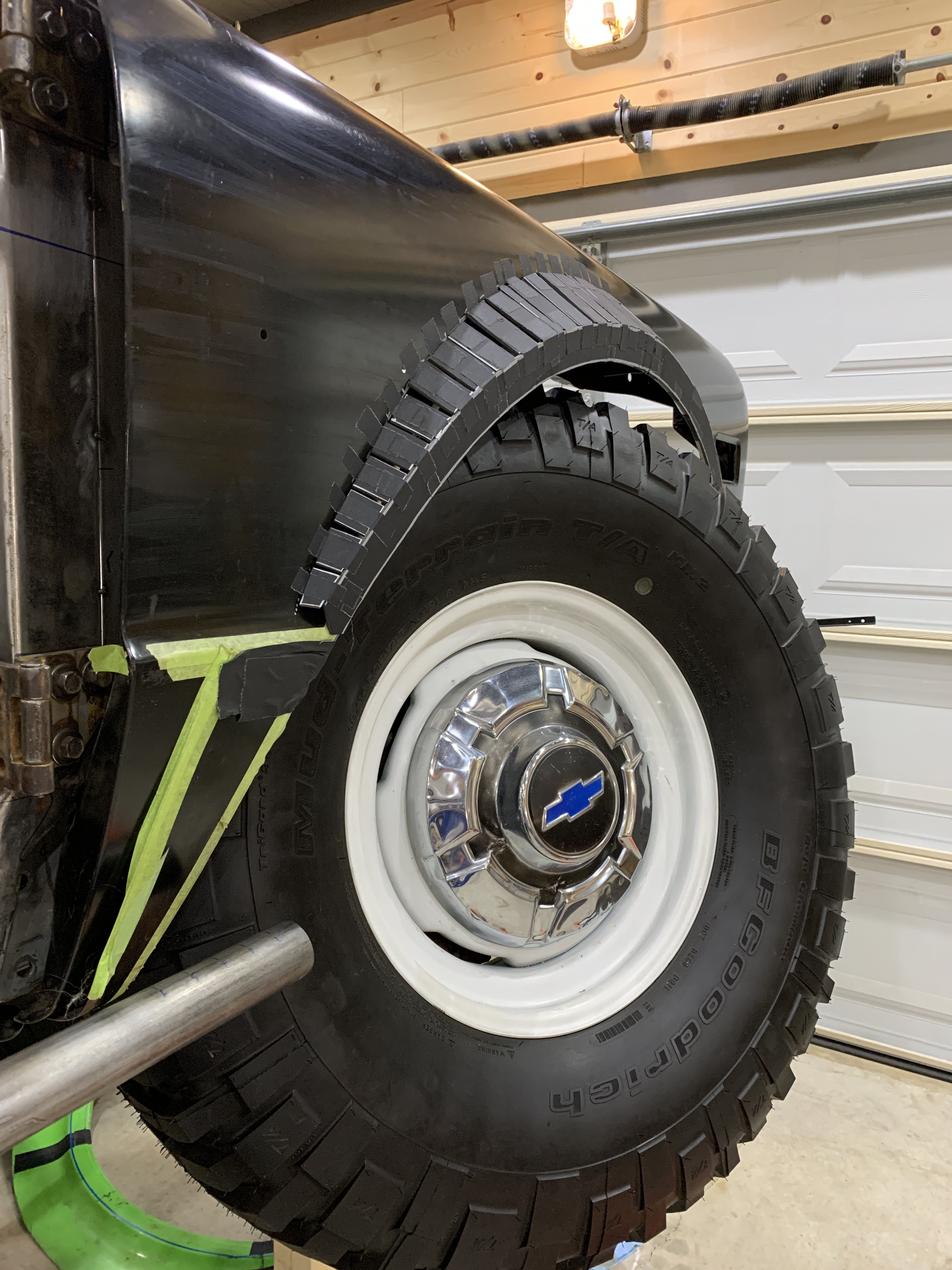
The final shot of the night. There are a few awkward spots that will need to be cleaned up, but I wanted to just let this design sit for a few days and not mess with it anymore for now. I'll come back to it with a fresh set of eyes and refine it some more... not sure if I want to raise the entire opening slightly, or mess with the proportions... time will tell.

full


Overall, I'm pretty pleased with how the flare came out. I am fully expecting to revise it at least a couple more times anyway... so the fact that this first one came out looking pretty clean is encouraging.
I'm sure the next one will be better....and as the tuition pile grows, the results should get really good.


-G
 
I like it!

The body lines seem to flow well. Having them all the same color helps with the visualization. Hopefully you can get a touch of roundness to the edges to match the stock part of the fender.
 
It looks a lot better than I expected. I think right now it looks like there’s a bit too much flare, but when you soften the transition between the fender and the arch (so it’s no longer flat) it may look pretty close to the original style.
 
It looks a lot better than I expected. I think right now it looks like there’s a bit too much flare, but when you soften the transition between the fender and the arch (so it’s no longer flat) it may look pretty close to the original style.

I think you're right. If that was even just a 1/4" radius (or slightly more) it would reduce the apparent size of that flare. It is amazing that small changes like that WILL have a noticeable effect. The fine-tuning will improve a lot of what is still wrong with this first prototype.

The stock fender arch is also not 100% circular in the upper hemisphere either. The side on the corner marker side goes slightly oval, and then actually curls back toward the "fang" area to close up the curve on that side...

The flare definitely helped a TON with keeping the overall wheel opening smaller. It's was an easy tradeoff to make.


-G
 

Latest Posts

Top Bottom