CK5
Register an account today to become a member! Once signed in, you'll be able to participate on this site by adding your own topics and posts, as well as connect with other members.
That new panel looks beautiful! It's cool to see this area going back together since this is an area that a lot of us 1st gen guys have rust issues in, but most of us have never seen the onion peeled back this far to really understand how all the pieces fit together.

How much of the cross seal are you going to have to cut out for drive shaft fitment? Is the drive shaft brake far enough forward that it will sit in front of the cross seal without interference?


Driveshaft?

AWWW CRAP!!!!!! :doah:


j/k :)


The driveline brake sits in front of the step panel (even with my more aggressive engine/trans/atlas setback position). The CV part of the shaft is the part that passes through the panel. For obvious strength reasons I want to be VERY precise with the amount of material that I remove to provide clearance for the rear driveshaft. The material will get pretty thin above that cutout, so I don't want to create a weak point that will buckle if I ever let a "fat kid" climb into the back seat area. :haha:

It might be a good area to incorporate a driveshaft loop (which I wanted to do anyway)... that way I can close-off the underside of that driveshaft cutout and add a lot of strength back into the area.


-G
 
I need to find air pressure sensors for the CTIS.

12vdc
0-50 psi max

I'm looking for something that will put out a voltage vs. pressure type signal that I can work with.

I think these are typically called "transducers" as opposed to "sensors". I'd like to find something ideally out of an automotive application so that it is already proven for vibration/heat/cold environments

Any clever ideas out there??? :dunno:

@dremu
@bp71k5

-G
 
What about an aftermarket TPMS system? You'd have to install a set of valve stems to locate a sensor at each wheel though.
 
why reinvent the wheel? the in-tire sensors in most new cars transmit the pressure wirelessly to the BCM.... of course, I'm sure there's other solutions that will make those auto-engineer-types feel pretty foolish when they see your 6 beer solution :)
 
I've been trying to avoid a wireless system since I'd have to worry about dead transmitter batteries and/or unreliable signals to the control unit. However it just occurred to me that unlike a "typical" TPMS system, I don't HAVE to mount the TPMS sensors inside the tires at all!! :thinking:

I could build a small distribution block and put all 4 sensors in a more convenient location and maybe that would make me less concerned about a weak signal, and servicing a bad TPMS sensor would be a breeze....just unscrew the faulty sensor and swap it out. :waytogo:

My concerns would still be:

Resolution - My tires will need to operate in a range of maybe 10psi (offroad) to like around 25psi (street pressure). That may not be working range that the sensor is very accurate operating in... :dunno:

Analog Voltage Output - To build my little Arduino CTIS controller, I need some kind of electrical input to the CPU so that I will know what the pressure is... that will let me determine if the pressure needs to go up or down, and whether I should be opening the dump solenoid or the fill solenoids.

Requires Motion - So far, the sensors I've found only operate (broadcast) at speeds >20mph. That's not going to be a great option when trying to monitor tire pressures at low offroad trail speeds.

@blazinzuk: There WILL be a rear seat in the truck, and you'd certainly be welcome to cram yourself back there if you want. You might even be able to reach the cookies in the cooler from there!! ;)


-G
 
OK.... may have found a better solution:

Instead of trying to find automotive sensors, and then adapting them to Arduino... I realized that it makes more sense to just look on Arduino-type sites for sensors that are already proven compatible for that application.

The sensors typically need a 5V DC input, and will provide an analog output in the range of 0 - 4.5Vdc


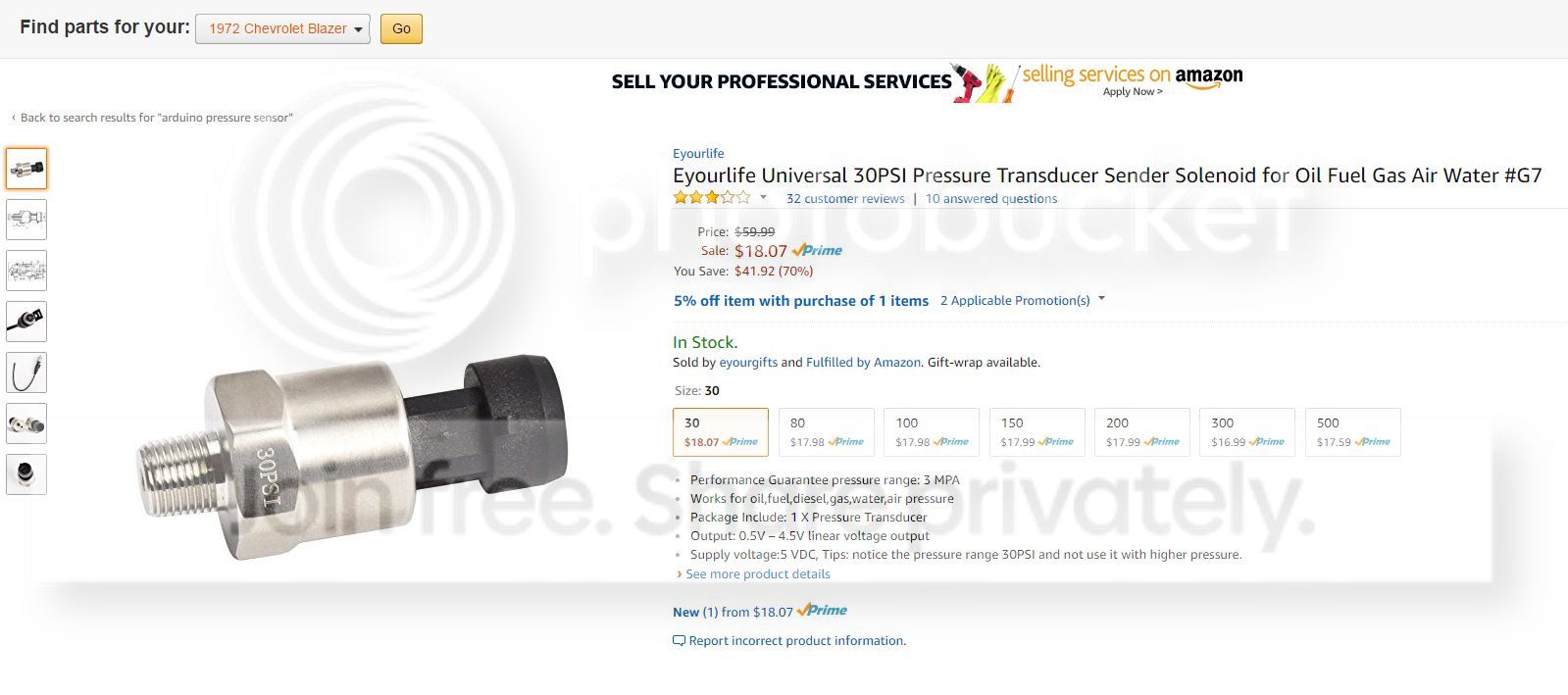
This one is pretty cheap, and comes in a variety of different pressure ranges...

PressureSensor.jpg


I just bought a 30psi one to fool around with, and I'll see how accurate it is when compared to an analog pressure gauge. :waytogo:


-G
 
Was just going to say, the tpms system in my g8 reads from stationary. I can air up/down in the driveway and it reads it. In fact, the procedure when rotating the tires is to lower the pressure in the order dictated by the directional blinker system - as controlled by the cpu.
 
Semi trucks all run 3 wire air pressure sensors now days for reading air tank pressure for the dash gauges. They also run 3 wire oil and boost pressure sensors. Honeywell makes tons of different pressure sensors.
 
An "autometer" pressure sensor looks an awful lot like that arduino one. Might be easier to run that since its already made for 12V system. Probably goes from 0-50PSI as well.
 
You don't expect to run over 30 PSI in your tires?
Martin

Not likely.... even as heavy as my truck is likely to be, it doesn't seem that they'd need more than 30psi. My street pressures on my old 38" (bias-ply) TSLs was only 17psi.
I want the sensor with the closest maximum pressure to what I will actually use. The resolution is going to be better if I use a 0-30psi gauge than if I chose a 0-80psi one. Kind of installing an Autometer 200MPH speedometer in your truck.... more than half of the gauge is useless and the part you actually care about is so small that you can't really differentiate between say, 30 and 40mph. I'd rather just have a 100MPH speedo.


An "autometer" pressure sensor looks an awful lot like that arduino one. Might be easier to run that since its already made for 12V system. Probably goes from 0-50PSI as well.

Brian, I don't think it's actually helpful to run 12V sensors with the Arduino. If my thinking is right, I'd have to provide power to the sensor from the vehicle battery and then run just the sensor wire to the Arduino. If I use a 5V sensor I can build a single wiring harness that goes directly to each sensor and provides power, ground and pressure information. :thinking:


-G
 
Not likely.... even as heavy as my truck is likely to be, it doesn't seem that they'd need more than 30psi. My street pressures on my old 38" (bias-ply) TSLs was only 17psi.
I want the sensor with the closest maximum pressure to what I will actually use. The resolution is going to be better if I use a 0-30psi gauge than if I chose a 0-80psi one. Kind of installing an Autometer 200MPH speedometer in your truck.... more than of the gauge is useless and the part you actually care about is so small that you can't really differentiate between say, 30 and 40mph. I'd rather just have a 100MPH speedo.


Brian, I don't think it's actually helpful to run 12V sensors with the Arduino. If my thinking is right, I'd have to provide power to the sensor from the vehicle battery and then run just the sensor wire to the Arduino. If I use a 5V sensor I can build a single wiring harness that goes directly to each sensor and provides power, ground and pressure information. :thinking:


-G

Ah, the arduino system provides the 5V? I assumed it was just monitoring the voltage signal "output" of the sensor. If the system provides its own 5V then you don't need to mess with power converters. Although a USB charger cig lighter adaptor is no different so even that isn't a big deal.
 
Ah, the arduino system provides the 5V? I assumed it was just monitoring the voltage signal "output" of the sensor. If the system provides its own 5V then you don't need to mess with power converters. Although a USB charger cig lighter adaptor is no different so even that isn't a big deal.


It looks like it can supply 3.3V or 5.0V to sensors on it's own. I'm not sure what kind of current limitations there might be, and I don't know how power hungry those pressure sensors are... still an awful lot to figure out.

The main thing is to get a basic sense of how I "think" the CTIS can be configured and where the components will be located. I'm trying to figure out the routing of fuel / air / brake lines currently so that I can start buying bulk stainless tubing in various lengths.... Then I need a few bending tools, fittings, hoses, frame mounting clamps, etc.

I don't want to go TOO deep down a rathole at this point but just trying to get the frame as prepared as possible before I drop the bedfloor and rollcage back down on top of it.


-G
 
QUICK SANITY CHECK:

For stainless fuel / brake / air lines... is it true that you can only flare them at 37*? I've been seeing that attempting a 45* double-flare on Stainless will split the seam...

Also: Checking Summit Racing for annealed stainless (straight sections of tube, not coiled) they are backordered on the Earls stuff until Mid-June.

What other sources could provide annealed stainless???? Inline Tube? Other good sources that you'd recommend?


I'm looking mostly for 6' straight lengths of 3/8", and 1/4"..... not sure if the brake lines should be 3/16" or 1/4" (apparently people use either)


:dunno: :thinking:

-G
 

Latest Posts

Top Bottom