CK5
Register an account today to become a member! Once signed in, you'll be able to participate on this site by adding your own topics and posts, as well as connect with other members.
After all the issues I had back east with moisture in my fiberglass bats, it was on my mind. The basic concept (as I understand it) is to have enough insulation that the dewpoint is never at the interior side of the foam. You have to spray thick enough to insure that the heat is blocked out completely otherwise the cool air from the garage will condense the moisture in that warm air and cause wet ceilings, etc. My old fiberglass was a black, moldy mess after a few years and I had to tear it all out and throw it away. :yikes:

These sprayfoam guys were pretty adamant that a 5.5" thick open-cell foam (R21) would be more than adequate to prevent moisture issues. I don't know the exact correction factor, but they kept saying that an R21 spray foam application had an "effective" R-value of more like R38 fiberglass bat application due to being airtight.

The real surprise was when they told me about all the extra work I would have to do to deal with my attic mounted furnace and hot water tanks... both of which are LP gas fired. They rely on fresh attic air for the combustion process, so you can't just sprayfoam and seal up the entire attic. There won't be any oxygen for the units, so you have to build "fresh air" boxes around each one and then bring in fresh air ducting from the roof in addition to the exhaust vents that are already there. What a pain.


-G

I think? there is a difference in where you want the vapor barrier from warm to cold climates. Up here we vapor barrier on the inside face of the studs, I've heard in warm climates you vapor barrier on the exterior side of the studs. Might check that.

I don't know about the "effective R-Value" up here it's R-7 per inch of closed cell. No effective blah blah.

Interesting that they say you need to duct the air to the gas appliance, we do a lot of gravity fed systems still (not a high efficiency piped boiler). We simply have to supply a certain size opening into the room based on the furnace/boiler/hot water heater size. No ducting just an opening to the exterior, sometimes it's one high and one low in the room so you get a bit of natural convection air flow. In your case we would install say a 12" square duct at one of the nearest gable ends and maybe another some distance away.
 
I think? there is a difference in where you want the vapor barrier from warm to cold climates. Up here we vapor barrier on the inside face of the studs, I've heard in warm climates you vapor barrier on the exterior side of the studs. Might check that.

I don't know about the "effective R-Value" up here it's R-7 per inch of closed cell. No effective blah blah.

Interesting that they say you need to duct the air to the gas appliance, we do a lot of gravity fed systems still (not a high efficiency piped boiler). We simply have to supply a certain size opening into the room based on the furnace/boiler/hot water heater size. No ducting just an opening to the exterior, sometimes it's one high and one low in the room so you get a bit of natural convection air flow. In your case we would install say a 12" square duct at one of the nearest gable ends and maybe another some distance away.

Brandon,

Just to clarify since might not be obvious. The foam was going to be sprayed on the roof deck joints as opposed to the attic floor areas. This effectively makes the attic a sealed and conditioned space just like the house below it... the AC system has a much easier time since it isn't battling 140* summer air temps, but the downside is that the entire attic space needs to remain 100% sealed from outside air otherwise it kind of defeats the whole intent of the exercise.

Fortunately for me, the garage is an isolated space and doesn't share any attic space with the house. So I can just do the garage as it's own project while I study up on the best methods to deal with the living space attic areas.

:)

@NorCal69 is already on the case, helping me figure out how to cut/modify and raise the interior ceiling height in the garage in a safe way. Hopefully in the coming days I will be able to post some "demo" pics of the work and start bolting and nailing fresh new lumber into that space!!! :waytogo:


-G
 
Making room for a lift?

:)

Just trying to get easier access to the overhead storage areas.... kind of like my last shop. Lots of perimeter bin storage. :)

There is a major load beam 5”x15” that runs laterally across the 2-car space and then lands on the visible and equally large (front-to-rear) beam between the 2-car and 1-car spaces. Not very likely that a lift would work with all that going on above it.... but I’ll start by cutting out a big rectangular opening in the ceiling and that will give me a better visual idea of what I’m dealing with. :thinking:


-G
 
I wish I had more storage around perimeter of my garage.

I do have a base plate 2 post lift however. Cars go up full height.

My blazer gets the wheels about chest height.
It was a good investment, can still park in the space if a car isn’t on the lift
10’6” ceiling height
 
Brandon,

Just to clarify since might not be obvious. The foam was going to be sprayed on the roof deck joints as opposed to the attic floor areas. This effectively makes the attic a sealed and conditioned space just like the house below it... the AC system has a much easier time since it isn't battling 140* summer air temps, but the downside is that the entire attic space needs to remain 100% sealed from outside air otherwise it kind of defeats the whole intent of the exercise.

Fortunately for me, the garage is an isolated space and doesn't share any attic space with the house. So I can just do the garage as it's own project while I study up on the best methods to deal with the living space attic areas.

:)

@NorCal69 is already on the case, helping me figure out how to cut/modify and raise the interior ceiling height in the garage in a safe way. Hopefully in the coming days I will be able to post some "demo" pics of the work and start bolting and nailing fresh new lumber into that space!!! :waytogo:


-G

It's clearer now

One thing I've wondered about is applying insulation to the bottom of the roof sheathing, say an R-38, then having the same vented and unsealed attic below with another layer of r-38+ in the dropped ceiling areas. I've never been able to get an engineer to entertain that idea and follow through with the calculations etc. It seems to me that if you keep the heat load down from the shingles and sun on the roof you would stand a chance of keeping the air in the attic nearer to outside ambient and thus reduce the heat load on the AC equipment.
 
Greg,

I'm not a contractor, but I've watched just about every episode of This Old House. I seem to recall those experts saying you really need to keep a vented airspace below the shingles and roof decking to avoid condensation from the cooler inside air (or warmer air inside for a cold climate, maybe I got is backwards).

I recall an episode where they shimmed a few inches of airspace under the decking before adding the foam and then adding vented eaves are the ridge line to circulate air under the roof. But maybe that's for slow prone areas...
 
Seen systems used in other countries where they pump water up on top of the shingles to get the evap effect. Being in shade is worth about 20deg too.
 
Greg,

I'm not a contractor, but I've watched just about every episode of This Old House. I seem to recall those experts saying you really need to keep a vented airspace below the shingles and roof decking to avoid condensation from the cooler inside air (or warmer air inside for a cold climate, maybe I got is backwards).

I recall an episode where they shimmed a few inches of airspace under the decking before adding the foam and then adding vented eaves are the ridge line to circulate air under the roof. But maybe that's for slow prone areas...

All of this depends on the R-Value, insulation types etc. In general you want airflow between the sheathing and the insulation, UNLESS, you are super insulating and using Closed cell spray foam. Greg said it earlier, you want the dew point to happen inside the insulation where in theory there is no moisture therefore there is not a problem.

This is the reason we do what the engineers tell us to do up here, dealing with R-60+ roof systems we make sure to do what they say should be done.
 
2018.01.02 - UPDATE! - SLOWLY INTO 2018....

Happy New Year Everyone!

During the holidays between bouts of eating and drinking too much, I found some time to get out into the garage to see what sort of progress could be made....

It's a difficult assignment. The whole place is a mess, and it's hard to make any progress with a mess everywhere. Logically, the mess needs to be put away but there is also no good storage racks or shelves to use. Perhaps I could build some, but my tools were still hiding in a box somewhere so until I unpacked further.... my options were limited.

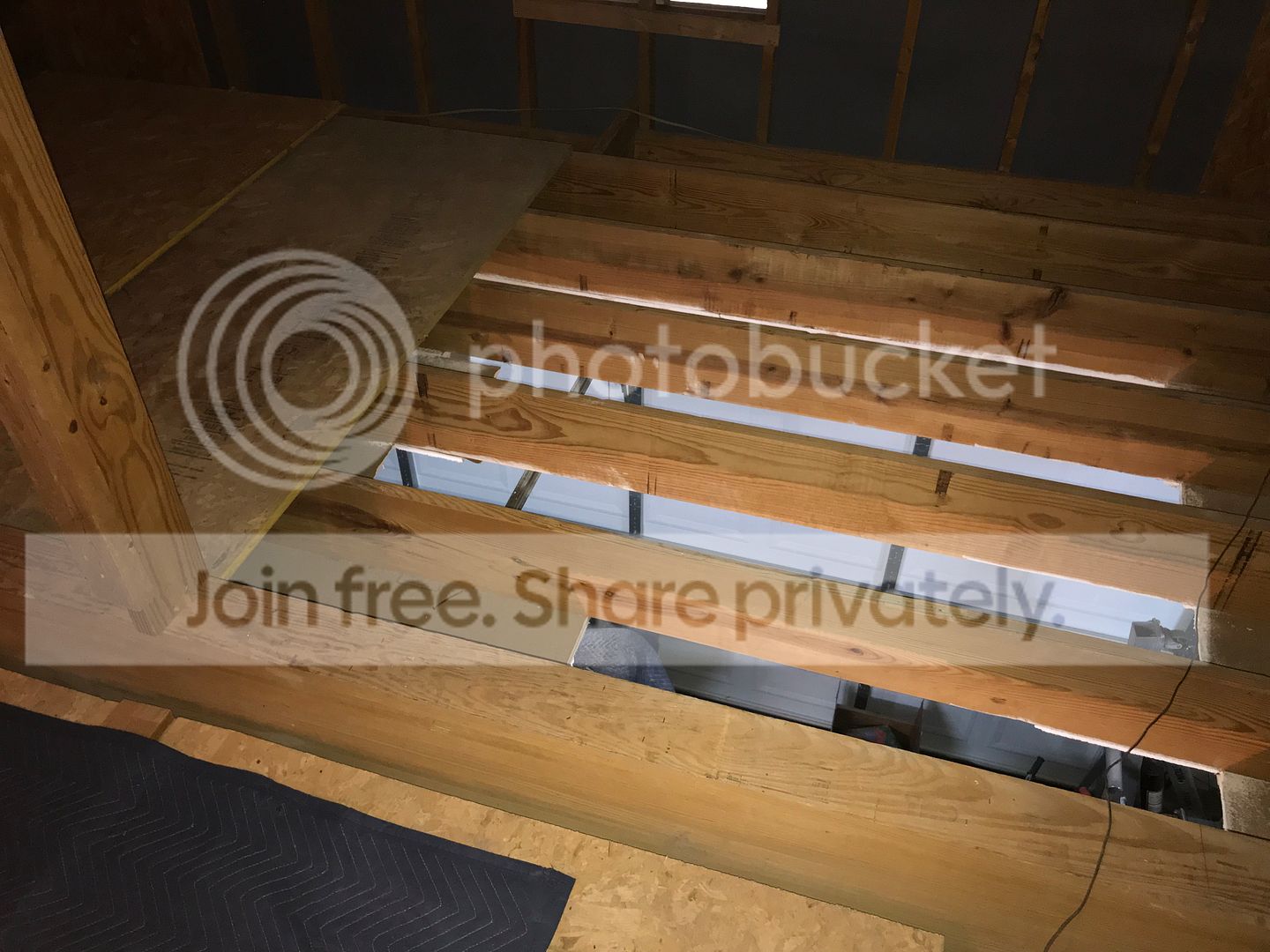
To at least "break the ice" a small exploratory hole was cut into the ceiling above the 2-bay garage area to start getting a clearer sense of how it will open up and how perimeter shelving might work (with easier access from below than a lousy fold-down ceiling ladder).

IMG_0308.jpg


Conceptually, if a 3-foot section of ceiling is left around the perimeter of the room and the center joists are removed the result will be similar to my previous workshop.... and it should be easier to get the sprayfoam guys up into that area to do their work. It was a start, but it's awfully hard to work with so much junk in the way.... it's my least favorite way to do projects. But I had to take some kind of action to at least get motivated.

There are a LOT of boxes filled with tools, bolts, metal, and parts in the way but surprisingly as I started unpacking them I was pleasantly surprised at how much more space-efficient it was. Getting rid of mountains of cardboard and packing paper actually gave me MORE room, even without any shelving to take advantage of vertical space.

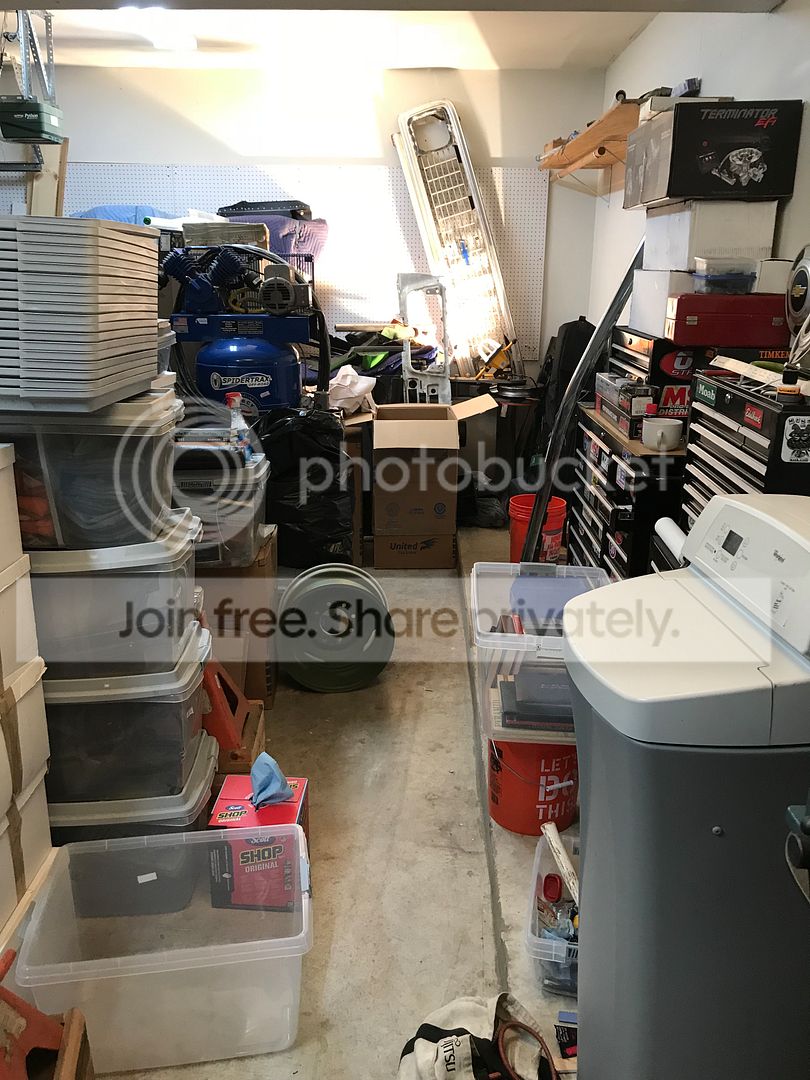
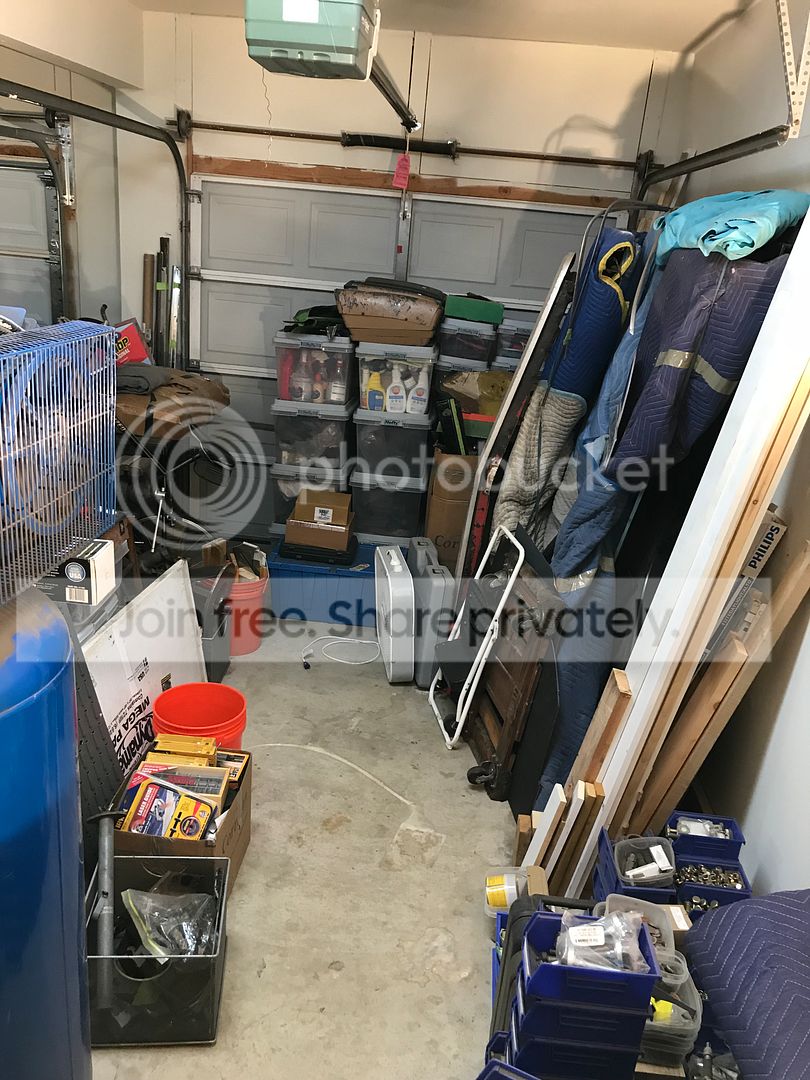
A few big items were pushed to the back wall of the garage...

IMG_0434.jpg


.....and next thing you know, there was a narrow path to walk across the garage!!!

IMG_0433.jpg


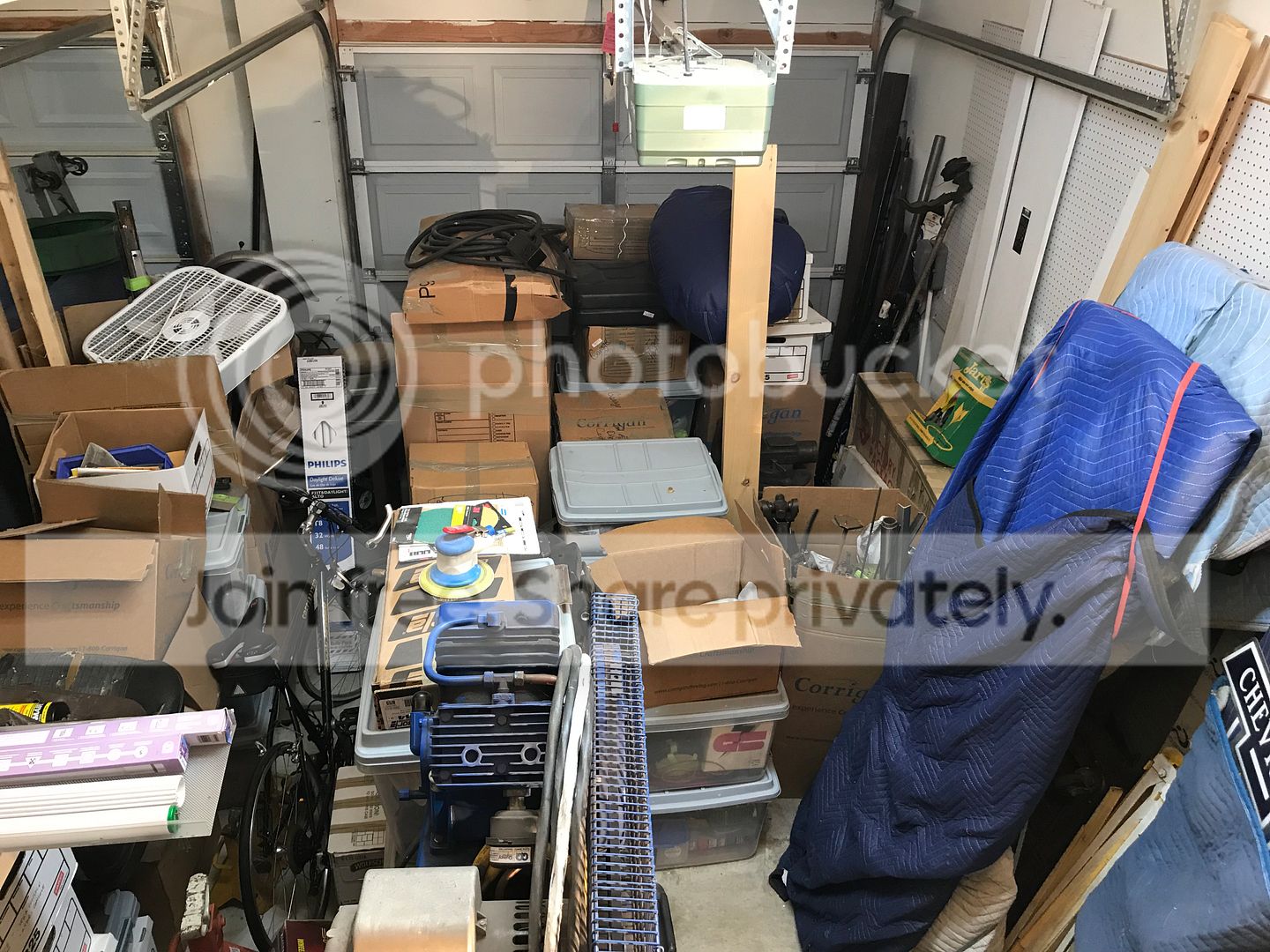
More and more boxes were attacked and opened up, all sorts of fun tools that I'd been missing were found!! :waytogo: The mess was formidable....

Single Bay side:

IMG_0438.jpg


Double Bay side:

IMG_0439.jpg


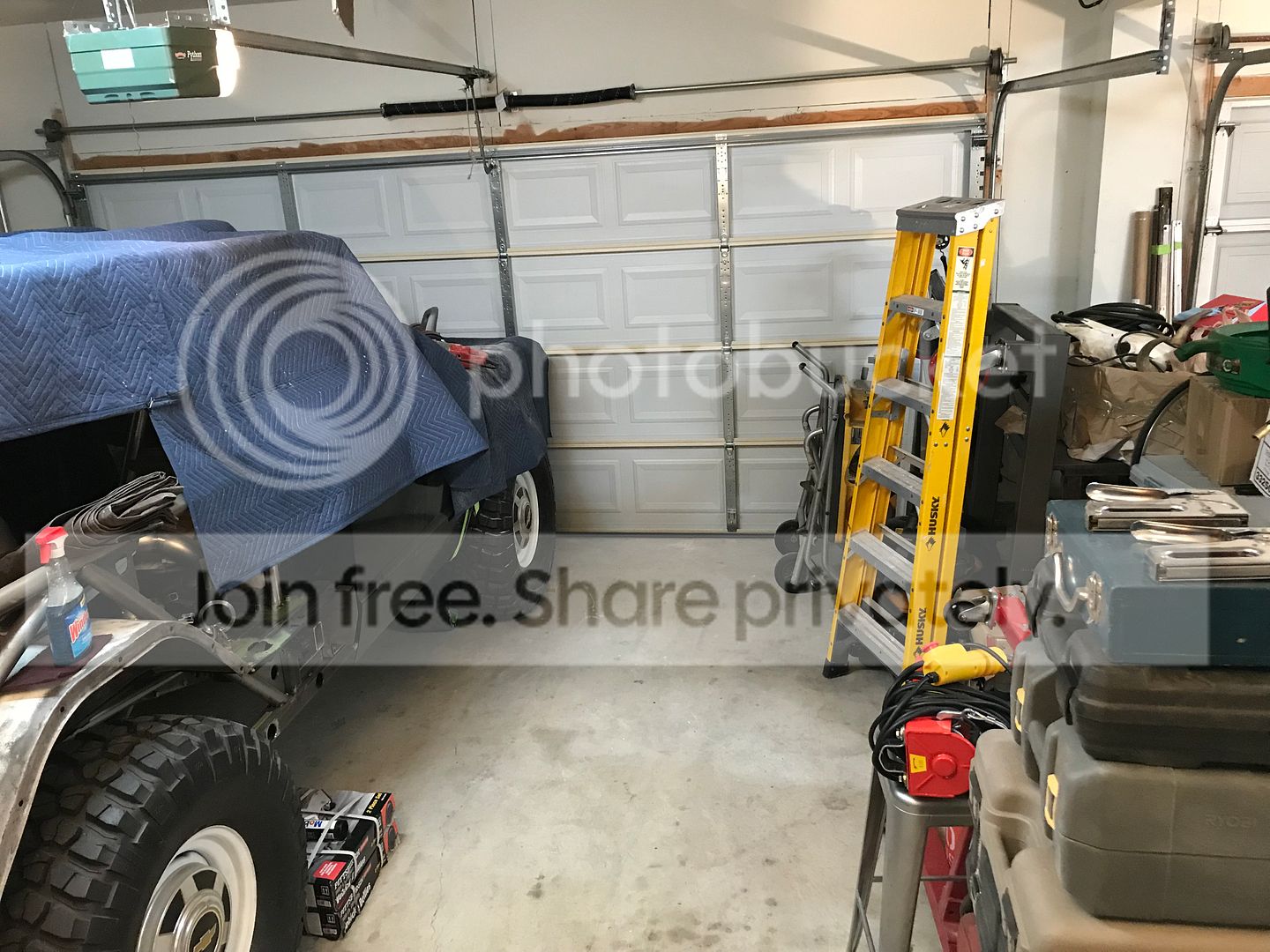
By the end of two very long days, there was a path all the way down one side and I was able to touch the rollup door (from inside the garage!) that was a major victory.

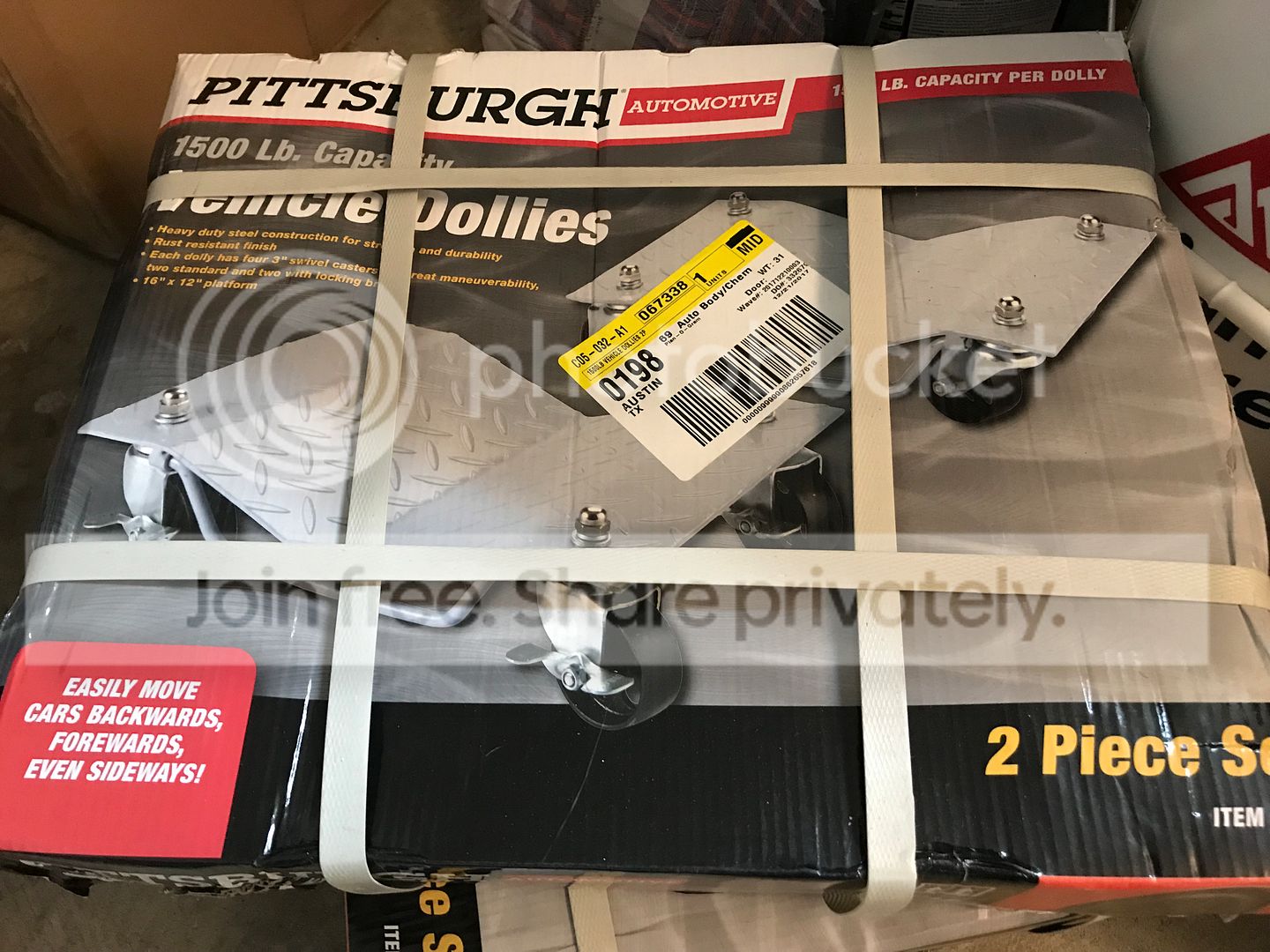
Harbor Freight was having a blowout sale, so instead of getting a $1000 set of Go-Jaks..... we went el-cheapo and will push my truck laterally around the garage with these (for around $60/set of 4)

IMG_0441.jpg


Got a few cheap 7-shelf steel freestanding units from eBay ordered. Better than having everything on the floor, and if I bolt them together (and to the wall temporarily) they should do the job for now and help reclaim much needed floor space. There is still a boatload of work ahead just to get the shop operational, but making even a small amount of forward progress recently felt really good.


-G
 
Greg,

Any previously undiscovered issues with the house now that you've been there a bit? Curious how successful buying the house without personally seeing it worked out.

Brian,

It wasn't quite that bad.... though I definitely had to risk losing some up-front $$$ to get the deal done.

Since I couldn't get there before the home inspection was due, I had to pay that money in advance of my own visit. Same for a few other costs.

The agent was awesome, and she sent me a LOT of photos of everything. After she had been working with me for a while she knew what kinds of things were important to me, and she would automatically send lots of photos of the garage, and the breaker panel, etc. :haha:

We insisted that the seller provide a full-home warranty (including the pool, spa and equipment). The "Diamond Plan" cost them over $700... but it's already paying dividends, as the warranty company had agreed to cover my 2HP pool filter pump that is leaking like a sieve at the impeller housing due to corrosion and old age. Pretty sure that's going to save me around $700 all by itself.... so anything else that fails this year puts me ahead of the game with the warranty. :waytogo:

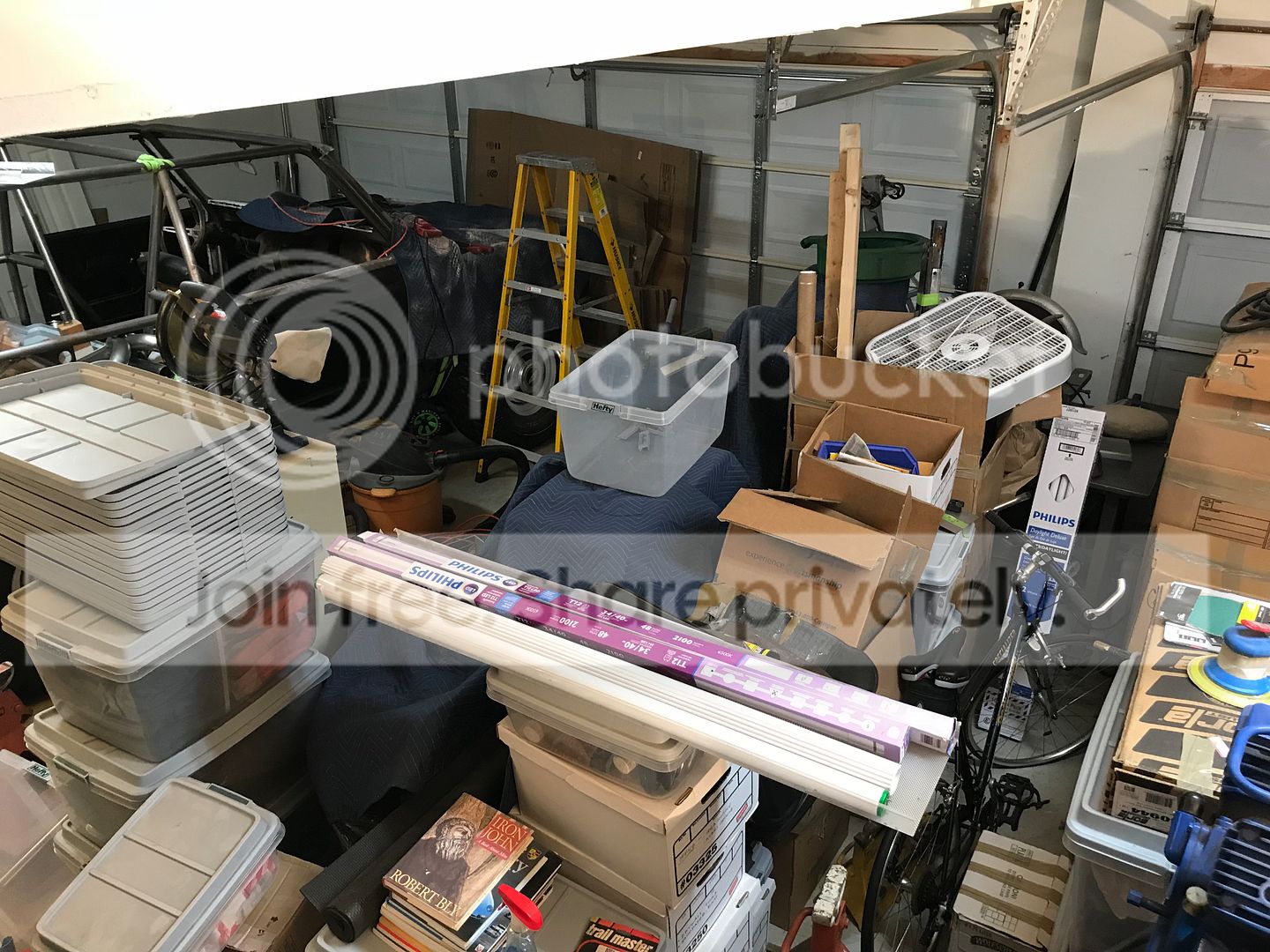
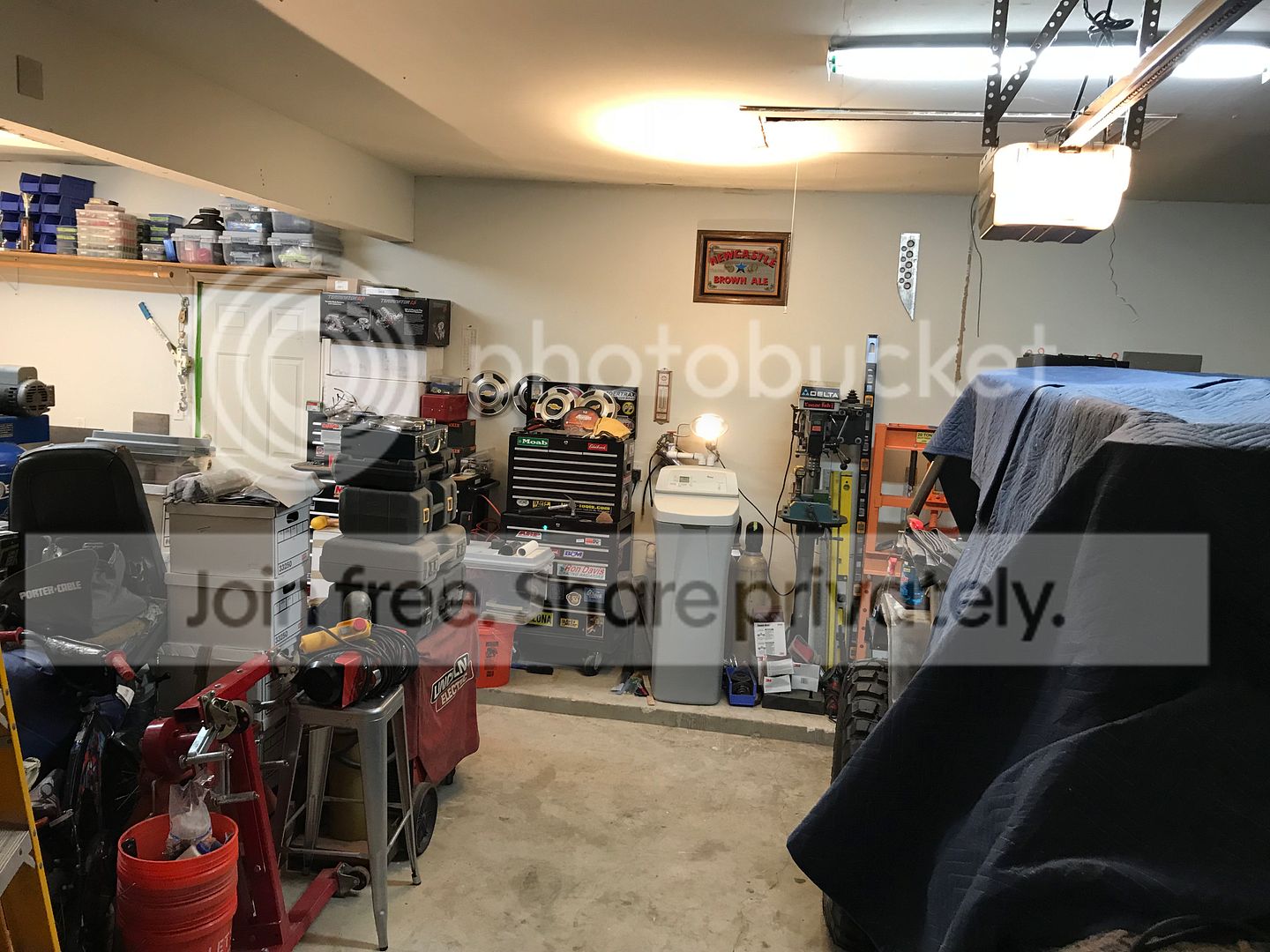
A few more hours in the shop tonight... I think I'm running out of clever ways to re-arrange the piles without actually having shelves or overhead storage, but the paths are getting wider and at least the items are getting grouped into categories, so that there's a better chance that I'll actually find something that is needed in the coming days / weeks.


IMG_0458.jpg


IMG_0471.jpg


IMG_0472.jpg


I've got the K5 covered in blankets in the hopes that it will stay cleaner when I start really demo'ing the rest of the drywall overhead. It's going to be a mess no matter what... hopefully my HF casters will let me maneuver it around a bit more to keep it out of my way as I prep the overhead areas for insulation, shelving, electrical and air lines....

-G
 
Since I always add my 2 cents.

Would it be best to rent a small storage unit for alot of that stuff. Just to get it out of the way?

Seems like alot of stuff in the way for even a minor garage remodel
 
Since I always add my 2 cents.

Would it be best to rent a small storage unit for alot of that stuff. Just to get it out of the way?

Seems like alot of stuff in the way for even a minor garage remodel

I see a couple of tarps in your future... ;)


Since I’m not it NH anymore and don’t have to deal with winter “bomb cyclone”weather.... I suppose I could pretty easily just lay a plastic tarp in my side yard....then pile a bunch of stuff outside. A few more tarps on top secured with bungees, and that would probably work fine. :thumb:

There are a lot of crates just filled with “takeoff” parts that I can easily do without for a month or more while I get the garage finished-out. At least now I know where my saws, hammers and home improvement tools are. That’s a huge new development.


-G
 

Latest Posts

Top Bottom