CK5
Register an account today to become a member! Once signed in, you'll be able to participate on this site by adding your own topics and posts, as well as connect with other members.
one step...........
Ok @kgblazerfive i threw on a flex fan... it actually helped, drove around for 30 or 45 mins down bangater and in traffic and it only hit 212, BUT it did creep up at a light from 206 to 212 pretty quick, telling me offroad it may keep going...
My flex fan is about 2" from my radiator i can push it further forward up to 1" if you guys think it would help. I tried to match the sweet spot from the mechanical fan.

Anyways, whats next? Timing? Better radiator? Plugging gaps on the shroud or between the radiator support? I did notice that the electric fan pushes a ton of air but a lot of it goes under the car between the condenser and radiator.

Btw holy sh*t the flex fan pulls a ton of air at idle! I was walking by the front and it pulled my shirt in towards the grill.

20180726_142740.jpg

20180726_142730.jpg
 
Your fan to shroud depth looks good. I'd say if it's creeping up when not driving that you are not get enough air through the radiator itself to remove the heat from the coolant. If alot of air goes out the bottom and sides then it's not going through the radiator.
 
Your fan to shroud depth looks good. I'd say if it's creeping up when not driving that you are not get enough air through the radiator itself to remove the heat from the coolant. If alot of air goes out the bottom and sides then it's not going through the radiator.

I mean my mechanical fan pulls a ton through the radiator, the secondary electric pusher fan seems to go all over.
 
Walking around the junkyard the other day all the 454 trucks I saw were from the 90s. What interested me is that I noticed they all had the 19"x34" radiators. I wondered if they did that because by then most all trucks were coming standard with AC.
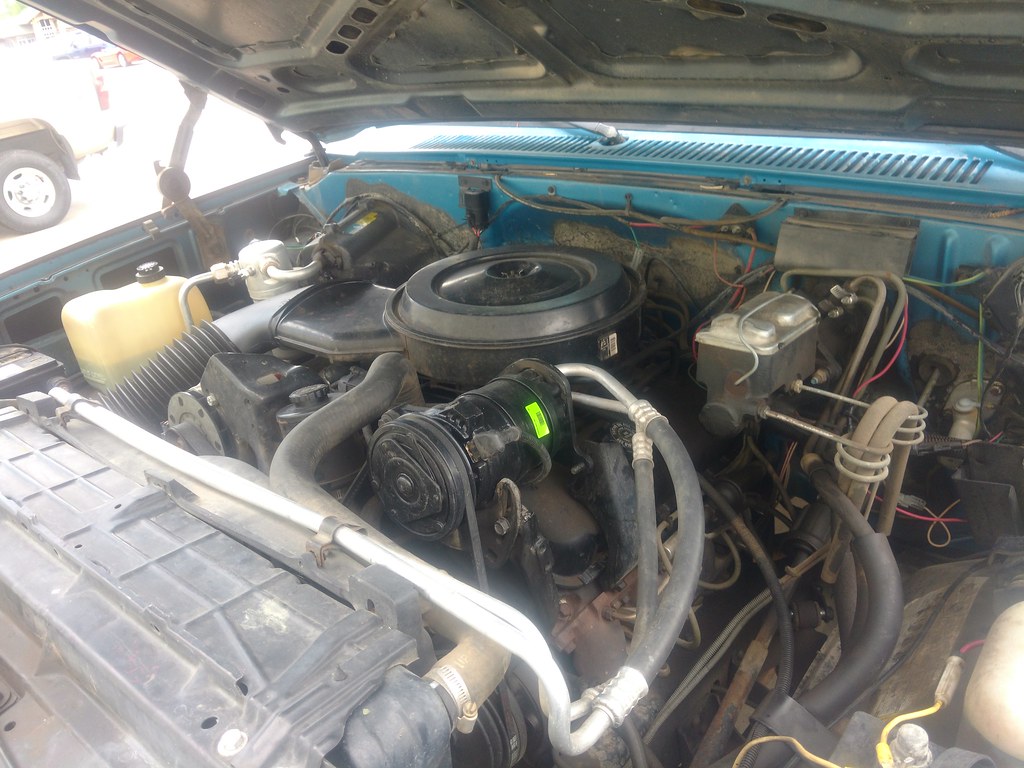
 
Dumb questions here. What are we watching in reference to the temp readings you are taking? The cluster gauge? Temp reading from your fitech controller? Where is the sensor located? In the t-stat housing? Side of the head?

Reason for asking, temp readings taken at the t-stat housing will differ from values taken at the head. I'm just wondering out loud if you are seeing elevated values based on sensor location. Food for thought.

Edit:. I can see a sensor in the t-stat housing. Is that for the gauge or controller?
 
Walking around the junkyard the other day all the 454 trucks I saw were from the 90s. What interested me is that I noticed they all had the 19"x34" radiators. I wondered if they did that because by then most all trucks were coming standard with AC.
Funny you should mention that. This truck is in my shop right now. 1988 K30 reg cab dually. 454/465. It does not have the larger 6.2 radiator. It's a solid 6" narrower than mine. But it is factory.
2877B1Z


If the pic don't work I'll fix it when I get home.
42732377365_37a9002468_b.jpg
 
Last edited:
I swear i measured 29×19 core size (not measuring the tanks on the sides.

I have the fitech in the thermostat and my mechanical in my intake manifold. The one on the intake usually reads about 5 degrees cooler but hits the high numbers.
 
Funny you should mention that. This truck is in my shop right now. 1988 K30 reg cab dually. 454/465. It does not have the larger 6.2 radiator. It's a solid 6" narrower than mine. But it is factory.
2877B1Z


If the pic don't work I'll fix it when I get home.
I swear i measured 29×19 core size (not measuring the tanks on the sides.

I have the fitech in the thermostat and my mechanical in my intake manifold. The one on the intake usually reads about 5 degrees cooler but hits the high numbers.
Yeah I think that was the standard in the 80's for 454 trucks. I think the "standard" radiator for the other gas engines was 17" tall. That's what my crew cab had with the original 350.

I would look at the 19x34 radiator next. Not sure what that will entail in a 70s truck; it's much easier in the 80s trucks.
 
I imagine id need to move my condenser lines and maybe a battery. But im willing to try just about anything
 
The depth looks about right half in and half out. Sounds like it may be working fine. Maybe a bigger one if it can fit looks like you have a lot of space from the fan to the shroud, maybe not enough room to fit but who knows.
 
I swear i measured 29×19 core size (not measuring the tanks on the sides.

I have the fitech in the thermostat and my mechanical in my intake manifold. The one on the intake usually reads about 5 degrees cooler but hits the high numbers.
Most of the time GM always took the temp reading from the head. Big block, small block, LS, all in the head. Not sure of the reasoning behind it, but that's where mine are. I've got one on the passenger side head for my gauge, drivers side head for the ECM. Even with the questionable accuracy on the stock gauges, mine are pretty darn close. It may have to do with calming the gauge down. Having the sender in the intake near the t-stat is going to allow the unit to detect the temp changing as the t-stat opens and closes. It's more "live" data, and if the t-stat is closed it's going to read the hottest. Meaning the gauge is going to be more active, going up and down as the t-stat opens and closes. On the flip side taking the reading at the head is catching the temp with coolant coming in from the radiator and pump. Yes it's gaining heat from the cylinders but the value is more steady and not as quick to change when all is working like it should. If the t-stat is stuck closed, the gauge is going to still go hot. If the radiator is dirty it will still cause that sensor to read hot. It's just not seeing the rapid changes of the t-stat opening and closing. When I had the smaller radiator in my K5, the only time the engine ran hot was low speed crawling, didn't matter if it was hot or cooler outside (except snow wheeling). With my sender in the head I could still see the temps climbing and had enough warning to kick it into a lower gear and spin the engine/pump faster to cool it back down again. My theory may be all wet though too.

Larry and I had a little text discussion over this 88 truck I had in the shop and he's seen most big block trucks with beds configured the same way as what I've pictured. He's seen enough cab and chassis models with 454's that have the same size radiators as the 6.2 diesel trucks had. Again, no logic here as to why GM did it that way, but it may have to do with a number of factors. I can say this after looking this truck over, there is no way you could have put the bigger radiator into it without relocating the charcoal canister. It's right where the tank would be on the driver's side. Plus it puts the tank on that side right up and next to the aux battery tray.
 
The depth looks about right half in and half out. Sounds like it may be working fine. Maybe a bigger one if it can fit looks like you have a lot of space from the fan to the shroud, maybe not enough room to fit but who knows.
Im not sure that i caught the comment on having space...

So i wonder if an aluminum radiator is the way to go. It would be about the same size. Also 4 core... something like this. https://www.holley.com/products/coo...iators/direct_fit_4-row_radiators/parts/FB167

Or maybe its time to mess with timing?
 
So I just looked at my stock tbi big block temp gauge. Right in the middle says 210. I assume I have a 195 thermostat. Most tbi trucks did. Mine sits just below 210 sometimes higher sometimes a bit lower. Since I am all factory and my cooling system seems to be in good shape . I'd say 210 is way normal for my engine.

See how far it goes. I wouldn't worry much till 230 ish. Cause your not really overheating. 230 shouldn't overheat it either
 
Maybe try relocating the sensor to the head too. Like @ZooMad75 said, maybe your catching fluctuations from the thermostat that don't really reflect the real engine temp
 
Top Bottom