CK5
Register an account today to become a member! Once signed in, you'll be able to participate on this site by adding your own topics and posts, as well as connect with other members.

I got my custom TPI conversion done-update- distributorless ignition

didnt intend to start a discussion, just curious as to what path you took is all. again, mad props on the project, ill probly just wind up having a chip burned and tweak it later if nessesary.

 
HarryH3 said:
Since all of the plumbing and the airbox are still exposed to underhood heat, the real temp difference that the combustion chambers see may not be much. Some high tech thermal insulation may make a much bigger difference.

Drawing air from outside HAS to be cooler, even without a lot of insulation (assuming the underhood temp is above outside ambient). The maximum temp of the intake plumbing is the same as the underhood temp. The maximum temp of the air inside the plumbing (worst-case) is the temp of the plumbing. However, the air moving through is only touching the walls for a short time, so that maximum can only happen when you turn the engine off. Then you get hot air until the engine has sucked it all through. But the underhood intake is drawing that worst-case maximum temperature all the time.

(If there was tons of heat transfer going on, the intake ducting would be cool, but it feels about as hot as everything else under the hood. Rubber is not a very good conductor - aftermarket aluminum or steel intakes are worse in this regard).

My intake temps dropped from 134 yesterday to 72 today and it's nearly the same weather. The new intake is "more restrictive", but the truck pulls harder now. With the HAI, it got sluggish as soon as the engine was warmed up.
 
and there it is, always nice when someone actually has the numbers to explain a situation. im guessing you can moniter the air temp through the megasquirt data?
 
That looks great. This comes at a great time too. I am collecting parts for my own TPI conversion right now. I have most everything, except for the intake.

That was just a stock intake tract from a TPI firebird?
 
If running the stock TPI plenum, you could probably run both an air temp sensor there, and at the air source. Compare the two, you've got your numbers.

As to the stock (Firebird) air cleaner being restrictive, I think this goes along with the TBI air intake comments...stock TPI TB is right around 500CFM IIRC, what does the stock air cleaner flow? Answered that myself: 2.0 " = 283 CFM
2.25 " = 365 CFM
2.5" = 521 CFM

So looks like right around 2.5" you'd flow more than the throttle body ever needed. (of course, those are straight pipe numbers) No idea what the runners support though.

(edit, missed the second page of posts, d'oh!)
 
Blue85 said:
Drawing air from outside HAS to be cooler, even without a lot of insulation (assuming the underhood temp is above outside ambient). The maximum temp of the intake plumbing is the same as the underhood temp. The maximum temp of the air inside the plumbing (worst-case) is the temp of the plumbing. However, the air moving through is only touching the walls for a short time, so that maximum can only happen when you turn the engine off. Then you get hot air until the engine has sucked it all through. But the underhood intake is drawing that worst-case maximum temperature all the time.

(If there was tons of heat transfer going on, the intake ducting would be cool, but it feels about as hot as everything else under the hood. Rubber is not a very good conductor - aftermarket aluminum or steel intakes are worse in this regard).

My intake temps dropped from 134 yesterday to 72 today and it's nearly the same weather. The new intake is "more restrictive", but the truck pulls harder now. With the HAI, it got sluggish as soon as the engine was warmed up.

But you moved the intake temp sensor to outside the hot zone. IIRC, you now have it mounted in front of the core support. The air there will certainly be cooler than under the hood. Just by moving the air temp sensor you can fool the ECU into adding more fuel, so the engine will indeed seem to run better. The real test would be to measure the air temp inside of the intake plenum, both before and after changing the intake. That big chunk of aluminum is a great heat sink for the engine. :(
 
even if that is the case, youre still starting off with an air charge that is 60 degrees cooler. you are correct about the intake being a big heat sink, but as was stated the air is moving through quite quickly. so while there is some heat transfer, i wouldnnt imagine that it is so severe, as to overcome that 60 degree difference and heat it up to the same temp as it was before. although its worth noting that the LS1 engines are designed with a nifty little lifter vally cover to seperate the composite intake from the engine heat and hot oil. but despite that, cold air inductions, simply routing cold air from the fender or through the hood, have been dyno'd as producing more power, the ammount depends on many variables. if nothing else, you could throw it on, do a before and after dyno pull, and if you dont get the claimed hp, you could always try sueing for false advertizing, although they usually throw in that handy "up to" disclaimer ;)
 
HarryH3 said:
But you moved the intake temp sensor to outside the hot zone. IIRC, you now have it mounted in front of the core support. The air there will certainly be cooler than under the hood. Just by moving the air temp sensor you can fool the ECU into adding more fuel, so the engine will indeed seem to run better. The real test would be to measure the air temp inside of the intake plenum, both before and after changing the intake. That big chunk of aluminum is a great heat sink for the engine. :(

This is correct, I moved the sensor. This is not to "fool" the ECU. It is to get accurate measurements. The air coming into the intake manifold is very close to ambient temperature with a CAI. I can tell when they are correct because I have a Wideband O2. When the open-loop fueling stays close as underhood temps rise, I know it is calcuating air density correctly. If I was fooling the sensor into false cool readings, my mixtures would be too rich. With the underhood intake (and therefore sensor), the open-loop mixtures went lean after hot restart. (with Megasquirt I can adjust and/or turn off the amount of feedback from the O2 sensor applied to the fuel equation)

Here is the sequence I went through:

1) I used the stock TPI plenum IAT sensor and the heat soak problem was awful. Why? That is actually a plenum temperature sensor. It is a slug of copper threaded into a mass of aluminum - way too much thermal mass to track air temperature with any quickness. Following heat soak it's practiaclly a second coolant temp sensor. Hot starts always resulted in lean mixtures and stalling.

2) I switched to the "open end" IAT sensor (little thermistor in a plastic cage)and mounted it inside the K&N throttle body filter. This was better, and resulted in mixtures that were close, but whenever the rad fans turned on or I sat at idle for a while, the performance went down. Once the temp got above 120, it never came back down.

3) CAI with IAT at the inlet. Good O2 levels and good performance.

The TPI ECU uses a clock to help deal with the heat soak problem. Megasquirt does not run at all when you turn the power off, so it doesn't know that you just shut the engine off 1 minute ago when you restart. I have seen other Megasquirters move the sensor to be a true ambient sensor and get good results. Some have also made really low thermal mass sensors out of thermocouples.


The method Dorian proposes above is interesting, but I need a better temp sensor in the plenum than the copper slug that is there now.
 
dyeager535 said:
...stock TPI TB is right around 500CFM IIRC
So looks like right around 2.5" you'd flow more than the throttle body ever needed. (of course, those are straight pipe numbers) No idea what the runners support though.

The throttle body isn't stock. It needed a rebuild so I went with one that is a little bigger. I matched an airfoil to it as well, but how much those help is a controversial topic. The plenum is opened up and the runners were matched to the intake and the plenum. The biggest restriction is probably the intake manifold, followed by the runners. I'm not sure what the heads on a Goodwrench 350 flow.

In an ideal world, a 350 flows 557cfm at 5500 rpm, so I will never need more than that. However, when we quote flow ratings, that is at a given pressure drop, meaning a measureable amount of restriction. I like to keep things "flowing" more than the engine needs to keep the total pressure drop low. But this is another topic.

EDIT: Here are some pictures of the plenum mods and larger throttle body:

PICT0067.JPG

PICT0068.JPG
 
Last edited:
Yeah, I got an airfoil too, but didn't pay enough attention to tell if there was ANY change.

Personally, I don't see how it can do anything but help, it smooths out the airflow. It doesn't physically change the throttle body opening sizes, but the stock flat/uneven surface HAS to distrupt airflow, however little.
 
I've had this little project on the back burner for a loooong time but finally got it finished up. I built this little control panel into the old ashtray position.

control panel 1.JPG

I don't know why it looks so crooked. Maybe it is and I need to adjust the mounting.

The left section is for the Wideband Oxygen Sensor controller. The lamp shows warm up (flashing), calibrating (fast flashing) or normal operation (on). The button is to calibrate the sensor, which is required from time to time. I have to jumper the WB controller to calibrate because it is wired in parallel with the fuel pump, plus the sensor needs to be in free air, so it still takes a little work.

The center is transmission torque converter clutch information. Both lamps on means the converter is locked. The switch selects lockup in 4th gear only (for performance, I guess) or normally.

The ECU lamps have no labels because their function can be almost anything. I can configure them for whatever I want through the ECU software. Since I have a touchscreen PC installed, this is pretty convenient. For example, they can show injection events, accel enrichment, rpm (shift light?) or any combination of two parameters - there are dozens to choose from. You tell it less than, equal to or greater than, then AND or OR it with another parameter, if desired.

The construction is on proto-board mounted in a little project box. There are holes in the box for the LEDs and switches. The front is plexiglass which does not have holes for the LEDs. Sandwiched in-betwen is normal paper printed in an ink jet printer to do the text and pattern.
 
Last edited:
That's a great idea. I am running a MSII TPI on my K5 too. I really like that you added the two lighter sockets in. Did the project box fit easily in the ashtray?
 
I think it's just a blue Radio Shock project box - pulled it from my bin of parts, you know. I cut away the "front" of the ashtray holder and then attached the control panel with a pop rivet on each side.

Your rig sounds cool - do you have a build thread or something?
 
Well I got tired of having a distributor, so I picked up some Ford (don't tell anyone) EDIS parts. This is a wasted spark system using 4 coils and 1 module. It determines crank position with a VR sensor and trigger wheel and does all of the sequencing internally. All it needs is a simple response from an ECU to tell it the desired advance.

So the first thing I needed was a crank trigger. I have the 8" balancer, so I grabbed an 8 1/4" 36-1 wheel from www.DIYAutotune.com

DIY trigger wheel.jpg

Of course, it's "universal", so I had to make it fit.

IMG_5126.JPG

PICT0054.JPG

PICT0055.JPG

And I had to fabricate a bracket to hold the sensor close to the wheel. I ended up using a couple of unused tapped holes in the block. The wheel has to be aligned with the missing tooth 5 teeth ahead of the sensor at #1 TDC, so it takes some planning to get everything together right.

PICT0052.JPG

And here's the final installation:

PICT0062.JPG
 
Last edited:
Dude, thats bad ass. What the major advantage vs no distibutor? you still have to have a distributor in the manifold hole correct? just with no gear?
 
He has to have a distributor base installed to run the oil pump, I don't know if there is a delete for them like a 6.2 / 6.5L diesel has....
 
I'm still looking for a distributor delete solution. The new ones seem too expensive, so I will either find a deal on a used one or cut down the distributor I have. I just don't want to do this until I'm sure the EDIS is working.

Advantages:
-more consistent and more accurate timing
-multiple spark discharge below 1200rpm (optional)
-No cap, rotor and button to wear out and replace
-module and coil available everywhere (with the Megasquirt driving the ignition coil, component failures meant digging out the ECU and soldering parts)
-Limp home mode gives a locked 10 degrees of advance if the timing signal is lost.
-In theory higher rpm since there are now 4 coils instead of 1.
-No need to re-tune timing. The tables already in Megasquirt are re-used.

Disadvantages:
-Parts under hood say Motorcraft
-Ford-proprietary spark plug wire connectors "clip" onto coil towers and have super long connectors on the plugs. Stock wires hit the header tubes, so I had to graft normal right-angle boots and terminals onto two of them. So replacement is not straight-forward
-Coil swapping opportunities are limited. Dwell and current limit are built into the module, designed for the EDIS coils.
-Module diagnostics only allow for higher-resistance type plug wires.
 
Last edited:
I saw a guy on eBay selling EDIS coil brackets for about $30 + $25 shipping. I grabbed three $0.69 plates from the hardware store and added a handful of pop rivets.

PICT0045.JPG

PICT0046.JPG

Here is the module mounted on the firewall and the temporary location of the coils. Once I have a distributor delete done, the coils will go in that space. Of course the big mess will be dealt with eventually as well.

mount 2.JPG

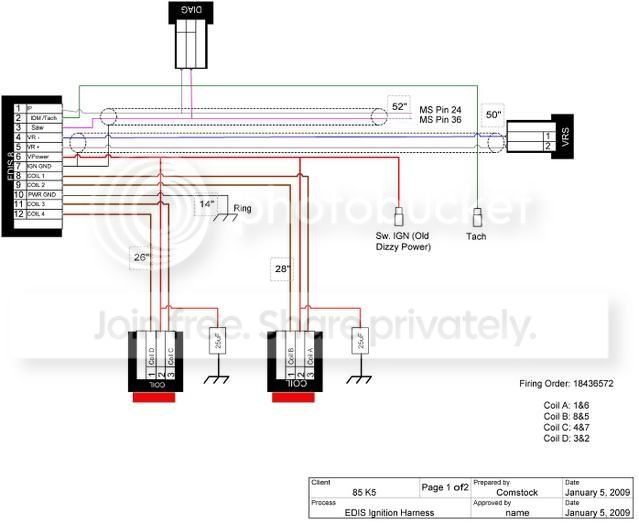
Here is the harness I built. As you can see the wiring required is minimal.

EDISHarnesssmall.jpg


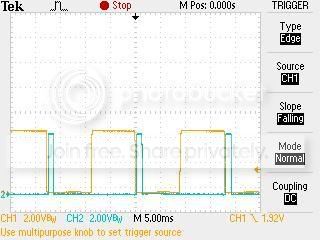
And here is how the timing works. The module sends a pulse whenever a coil is firing, called PIP (yellow). Then the ECU replies back immediately following with another pulse called SAW (blue). The width of this pulse tells the module how much advance to use. This communication also tells the ECU the speed of the engine so it knows when to fire the injectors. This shot is from the running engine last night.

TEK0008.jpg
 
Last edited:
I really have to read this whole thread:eek1:

Impressive:D
I converted my rig to MAF TPI a few years ago and love the response, power, and driveability. Not to mention the fuel mileage increase. 355 roller cam Vortec headed SBC went from 8 MPG highway (with edelbrock carb)to 13+ with the tuned port.
Im using a stock 165 ECM and PROM with a piggyback adapter to eliminate EGR and lower cooling fan temp.

Your setup was ALOT more work than mine.
Is the Megasquirt worth it?
Where do I get started:confused:
 

Latest Posts

Top Bottom