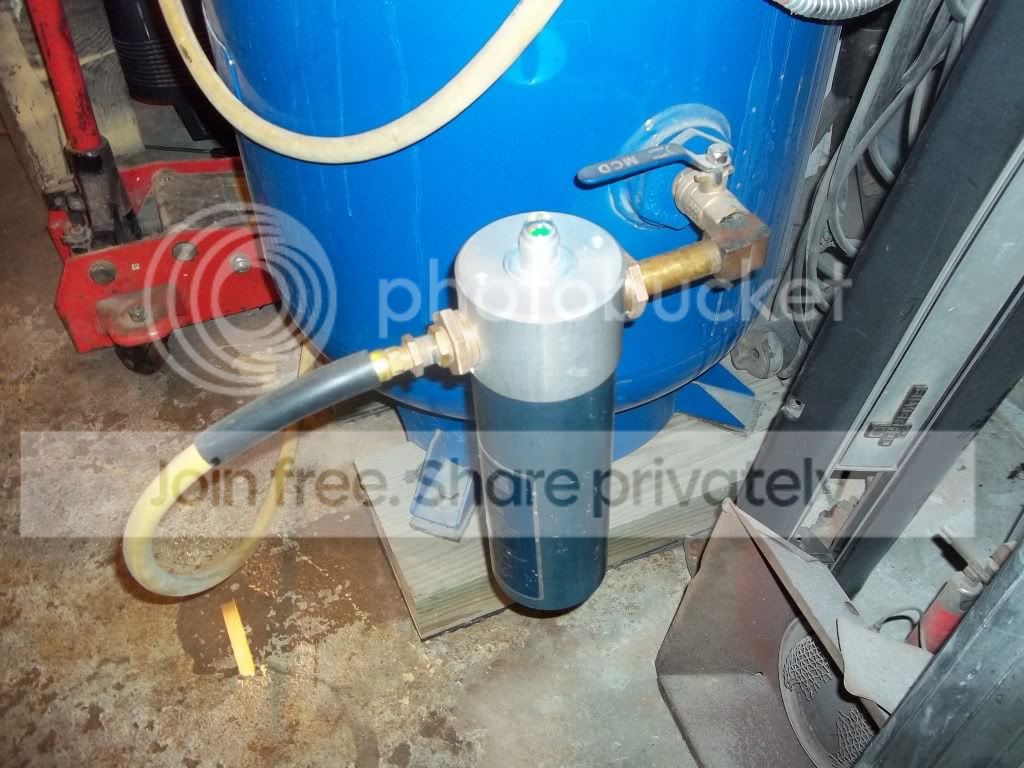
Chief, I assume you have already done all the plumbing tricks. If you are going with an actual dryer, don't forget you will have to run power to it.
The only true dryers other than desiccants, are refrigerated dryers.
And unless you are going to run a really huge desiccant, one of them is not going to help much.
They are fine for getting that last little bit of moisture out of the air, but if you run water into them, they will fill up fast.
If you are getting lots of water out the gun, you need to do some more plumbing first.
First, you need to drain the tank probably several times a day. Be sure to drain it before you start, and once or twice while you are working. Its your first line of defense against water.
This is where an automatic drain is great.
Next, always remember, gravity works.
Water is heavier than air, and if given half a chance will run out of your lines at a lowest point.
You just need to supply lots of lowest points.
For instance, come out of the tank, go up to the ceiling with the air line.
Any water that comes out of the tank or condenses in that part of the line will run back into the tank.
Go along the ceiling a little ways, go down to about waist high, put a "T" there, with the air coming off the side and the bottom to a stub pipe with a drain at the bottom.
Might want to do that a couple more times.
Grab a piece of schedule 80 or heavier PVC about 3 inches in dia. Steel would be better, but we are going cheap.
The bigger the pipe, the lower the pressure rating, so 80 is crucial. Double check the rating, 80 might not be heavy enough.
Mount it vertically on the wall. It needs to be at least 6 feet or longer, but don't let the bottom get too close to the floor, it needs to be easy to open the drain on the bottom.
Let the air come in about 3/4 from the top, and draw the air off from the top.
If possible, you want a bigger line going in than going out. Water separators work by spinning the air and letting the water go to the outside and drawing the air from the middle.
Here, we don't have a good way to direct the air flow when it comes in. I have put nozzles on water hookups like that to get out sediment, but it involved imaginative plumbing that you can't do with air because the pressure is too high unless you are threading steel.
So, we want the air to come in nice and slow so the water will fall out before it heads up.
Any liquid water should fall to the bottom and out the drain.
Finally, where your air hose hooks up to the air line, needs to be on a "T" with the bottom stubbed off to another drain.
Remember almost all the water you are getting out at the gun, is liquid before it gets to the gun, so all you have to do is give it an excuse to go downhill and it will.
If you have a piece of plywood, or an old blazer hood, you might lean it in front of that piece of 3 inch, just in case.......
BTW, you are trying to get the least moist air into that compressor right?
If there was an air conditioner vent you could aim at the intake, or even find a piece of hose larger than the intake that you could run into the house to suck air conditioned air in................
Just know that in most cases that hose is going to transmit the sound of the compressor into the house fairly well............