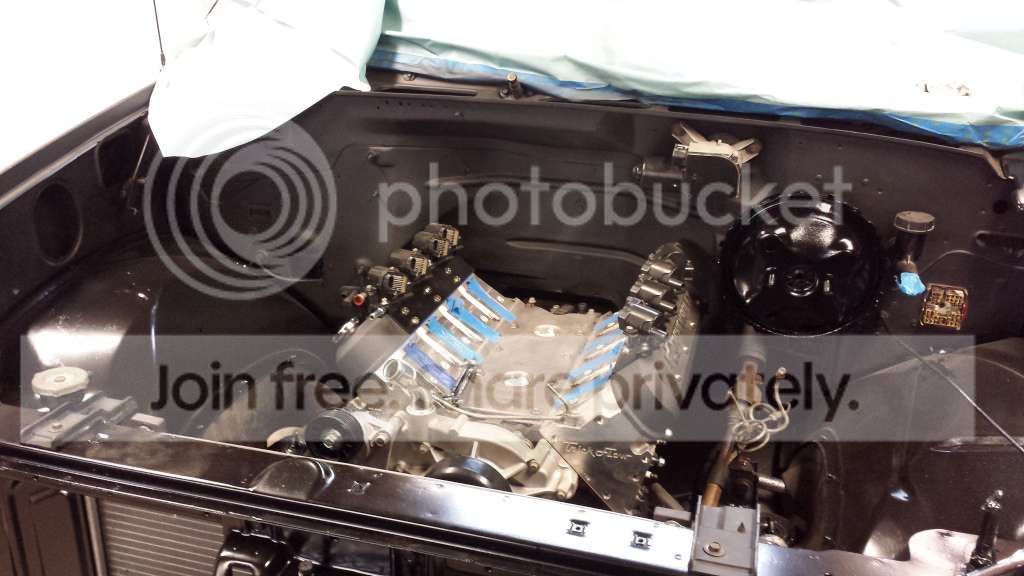
I understand what you're saying but doesn't the valve need to be set at .100 over the max lift and .080 on the exhaust and intake respectively?
I'm having a hard the understanding why I can't take a feeler gauge and shim the between the rocker and valve the respective needed clearance, rotate and check for anything hitting?
Yes, you could put .080 and .100 shims between the rocker tip and valve, however, if you don't take out the valve springs and put in checking springs it will collapse the hydraulic lifter and then when the lifter pumps up with oil it could still hit. Now, if you have a lot of excess clearance this probably won't matter as the lifter can only collapse so far. Also, without the checking springs you may damage something if the valve spring coil binds, you will have almost .700 lift with those shims in there. Watch to make sure the valve seal doesn't hit hte bottom of the retainer too.
So PTV is measured. It measured 1 mile lol. The trickflows must have the valves picked up in the casting to compensate for the angle change. What I did was take a feeler gauge at .100 and put it between the exhaust valve tip and the rocker. Then I bottomed the adjustable rocker out in the lifter so everything was a solid connection. Then I spun it over til TDC and took a look at the valve clearance with the boroscope. Still a mile to go. Same thing for the intake @ .080.
I guess theres a reason trickflow said I needed longer than stock pushrods. I am glad I checked though.
It's unlikely the heads could have such a small chamber 58 cc, and not have the valves closer, but possible. The heads we measured were stock 70 cc units. You do have a more flat valve angle so that may help a tiny bit, but not much, that angle change can affect your push rod length although with the valve length itself, rocker geometry, rocker arm, deck height, cam base circle, head style, etc.
Sounds to me like you checked the PtV clearance, but not at the spot that matters as when you are actually at TDC the valves are closed further. Bottoming the rocker out on the lifter is probably close enough if you are sure it was bottomed out. The best way to know for sure is to measure the valve opening, if the valve actually opens to .100 when the lifter is on the base circle then you should be good. You could also measure your max lift to see what it is to make sure the lifter isn't collapsing more. However, you have to be very careful with this method, because if the heads aren't setup for .100 more lift, you could damage something, which is why I like to use the checking springs and remove the valve seals, etc.
One more thing, I'm jealous you have a borescope.