Just take your channel locks and twist out the exposed cap the rest of the way
Last edited:


Everyone should have a pair of Knipex cobra pliers!Those knipex cobra pliers work good or a small pipe wrench. The caps are hard and channel locks have a hard time getting any bite on them. But yes they just need to twist out at that point.
I did this today, thanks for the tip.I like to get it spinning as freely as I can, and clean up the pipe, before I put it back together.
Martin


I think this is the most likely source of my oil leakage.I've had the back corner of the valve covers leak and cause a mess all over the engine, swap them, pressure wash and go from there.


Yep, already picked one up. I'm going to stick it in dry since I'm lazy and reviews are mixed from what I've read on past threads. Some guys dab rtv in the corners, some don't.Go with the one piece rubber one for the replacement you won't be sorry.
There's really no reason not to rig up a 150 shot at this point. She'll hold togetherFour bolt main!!! Can you hold back the power?
Martin
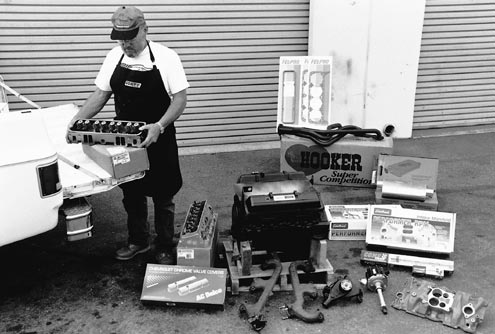
The Goodwrench 350 is unquestionably bread-and-butter basic. While all production small-blocks have employed a one-piece rear-main seal design since 1986, the Goodwrench 350 is assembled in Mexico and retains the classic two-piece pre-’86 design. This makes it an excellent choice for a basic hot rod motor for all pre-’86 cars since you don’t have to purchase a new flexplate or flywheel.
Starting with a four-bolt main cap block, the 350 employs a standard cast crank and cast-aluminum flat-top pistons with ductile-iron 5/64-inch rings. Chevy claims the compression is a wheezy 8.1:1, but after the test was over, we measured everything and came up with a slightly better 8.4:1. The good news with this low compression is that the Goodwrench engine should even run on 87-octane gas. The downside is that this low compression certainly sacrifices power. The long-block comes complete with an oil pump and pan, as well as a timing-chain cover and valve covers. The cam is a simple flat-tappet hydraulic with specs that are bone-stock tame. The 76cc chamber cast-iron heads (casting number 83417368) are fitted with 1.94/1.50-inch intake and exhaust valves and stock stamped-steel rockers.