CK5
Register an account today to become a member! Once signed in, you'll be able to participate on this site by adding your own topics and posts, as well as connect with other members.
Hmm
I found my exhaust leak today at the siamesed ports on the driver side, to the top

Pulled the whole exhaust system and completed the crossover after the layout

Smacked a new rear u joint in

205 still leaks...
 
I'm not sure about hitting like on that. Some success, but lots of work and then a persistent leak....

Good and bad both there.
 
Last time the leak was on the collector (before the Vbands were installed) This time above the siamesed ports on the left bank. Hopefully that's my ticking noise

The exhaust valves cleaned up though. When I pulled the Holley, there was a lot of carbon on the back of the valves
 
I wouldn't bother with a crossover. After seeing real dyno results with and without I was not impressed. Which mufflers are those? Flowmaster?

 
I wouldn't bother with a crossover. After seeing real dyno results with and without I was not impressed. Which mufflers are those? Flowmaster?


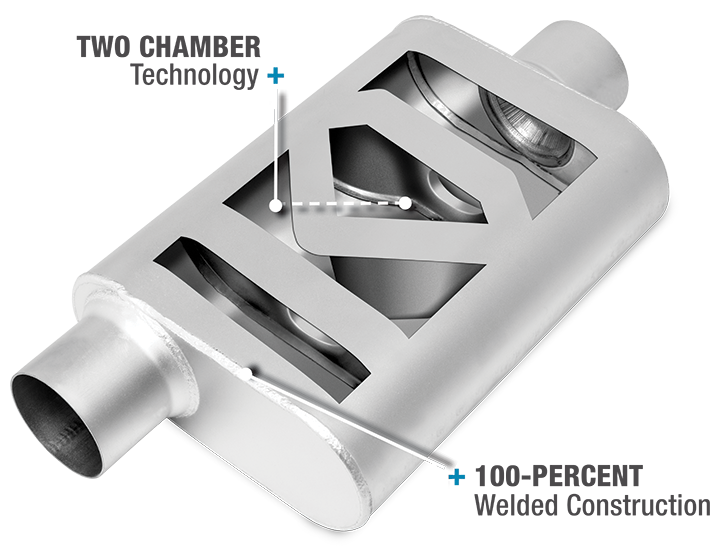
Running the Thrush Welded in 2.5"

I like those guys, they are more thorough in their research than most people who post dyno videos.
In terms of the video, engine being slightly smaller but same relative power and same pipe size, so it probably is very close to what I have
It's too bad they don't have more pipes and bends coming off the back of the muffler, you know all that fun over the axle part. That's where I have lots of back story
 
Last edited:
I bet it's very similar even with the curves in back. Looks like 4 for torque but I didn't see any peak hp gain when just looking at the H pipe. Pipe would be impossible.
 
I bet it's very similar even with the curves in back. Looks like 4 for torque but I didn't see any peak hp gain when just looking at the H pipe. Pipe would be impossible.
Yeah if you wanted more Hp, it’s not doing much

But can absolutely tell you adding the pipe from the muffler back all the way out added restrictions which changed the performance and the sound. Enough to measure on the butt dyno


It sounded “brappy” and I hated it. Also not happy with that part of the fuel injection using the open plenum. It pulled better below 3k on the dual plane and the carb
 
When I had the old engine in it and used it for towing the racecar, the mileage improved and it sounded smoother with the H pipe, which is what I was after here

Sad that most dyno pulls show nothing below 3500. That's where most engines spend 90% of their time
 
Well you can have the dyno show 1000 rpm and above. That same show did some manifold tests on dual plane vs open plenum. I meant to say x-pipe would be impossible it fit. I'm doing a full 3" stainless mandrel bend dual exhaust on mine with magnaflow. And I think they did a test on exhaust diameters too. Lots of guys like the flowmaster but here's one test comparing the 2 on an f150. The flowmaster design does not flow well.
dyno-muffler_low (1).jpg

Also, I see the Thrush muffler design is similar to Flowmaster which hurts flow causing less hp/tq. Not trying to bad talk your muffler just showing the dyno tests I have seen with this design.
landing_welded_main.png
 
Last edited:
Well you can have the dyno show 1000 rpm and above. That same show did some manifold tests on dual plane vs open plenum. I meant to say x-pipe would be impossible it fit. I'm doing a full 3" stainless mandrel bend dual exhaust on mine with magnaflow. And I think they did a test on exhaust diameters too. Lots of guys like the flowmaster but here's one test comparing the 2 on an f150. The flowmaster design does not flow well.
View attachment 309711

Also, I see the Thrush muffler design is similar to Flowmaster which hurts flow causing less hp/tq. Not trying to bad talk your muffler just showing the dyno tests I have seen with this design.
landing_welded_main.png
The H pipe is supposed to help with scavenging by giving more room for the gasses to go out when the firing order has to cylinders firing on one side.
Technically it's only relieving back pressure and making the sound smoother, the fact it adds any power is a bonus.
As for flow, yes all dual chamber or baffle design type mufflers will have less flow than a straight through.
But if you're like me and want a quiet muffler with a deep rumble when you push it and don't have to worry about packing materials degrading in time these mufflers are the ticket
 
Well you can have the dyno show 1000 rpm and above. That same show did some manifold tests on dual plane vs open plenum. I meant to say x-pipe would be impossible it fit. I'm doing a full 3" stainless mandrel bend dual exhaust on mine with magnaflow. And I think they did a test on exhaust diameters too. Lots of guys like the flowmaster but here's one test comparing the 2 on an f150. The flowmaster design does not flow well.
View attachment 309711

Also, I see the Thrush muffler design is similar to Flowmaster which hurts flow causing less hp/tq. Not trying to bad talk your muffler just showing the dyno tests I have seen with this design.
landing_welded_main.png
Here's a muffler shootout they did
Short answer was both Borla and Black Widow made more power on the lower end of the dyno pulls than the Magnaflow or the Flowmaster.
Always good to know
 
The H pipe is supposed to help with scavenging by giving more room for the gasses to go out when the firing order has to cylinders firing on one side.
Technically it's only relieving back pressure and making the sound smoother, the fact it adds any power is a bonus.
As for flow, yes all dual chamber or baffle design type mufflers will have less flow than a straight through.
But if you're like me and want a quiet muffler with a deep rumble when you push it and don't have to worry about packing materials degrading in time these mufflers are the ticket
This was the exact reason I went with the Thrush. Truck had Dynomax Super Turbos on it at the time I bought them (06-08 time frame)
The K5 had Flowmasters, the Thrush mufflers were $39 where as the FM were $89
Done deal
 
Couple fun things to see:
First listing is my engine as tested with a carb and other injection systems (all using dual plane)
Second is essentially what I have now using the PF4, the system supplied on the ZZ6 EFI
Third is my engine as tested with the factory open plenum

Notice the shift of the peak torque up 1000 RPM

SP350/385
Power: 385 HP @ 5600 RPM, 405 ft. lbs. of torque @ 3600 RPM

ZZ6 EFI
Power: 420 HP @ 5800 RPM, 408 ft. lbs. of torque @ 4500 RPM

ZZ6 carb
Power: 405 HP @ 5600 RPM, 406 ft. lbs. of torque @ 4600 RPM
 
Some more dyno data I found

Muffler Comparision Thread.

The results in HP order:
1.Flowtech Warlock (open) 374.2 hp/ 333.1 tq
2.Bassani Real Street 373.7 hp/ 333.8 tq
3.Hooker Maxflow 373.5 hp/ 333 tq
4.Borla XS 373.3 hp/ 332.6 tq
5.Magnaflow 372.8 hp/ 332.5 tq
6.MAC 372.3 hp / 331.5 tq
7.Flowtech Afterburner 372.3 hp/ 330.1 tq
8.Hooker Aerochamber 372.1 hp/ 330.4 tq
9.Bassani 372 hp/ 333.5 tq
10.Spintech 371.6 hp/ 332.2 tq
11.Edelbrock Performer RPM 370.9 hp / 331.3 tq
12.Borla XR1 370 hp/ 334 tq
13.Flowtech Terminator 369.5 hp / 331.3 tq
14.Dynomax Ultra Flo 369.4 hp/ 333.2 tq
15.Flowmaster 369.4 hp / 331.8 tq
16.Flowtech Warlock 366.3 hp / 325.3 tq
17.No muffs 365.2 hp / 330.1 tq

Sound Off in Quietest to Loudest (Decibels):

1.Borla XS, 80db at idle, 90db at 2,000 rpm, 110db at WOT.
2.Hooker Maxflow, 80db at idle, 90db at 2,000 rpm, 120db at WOT.
3.Magnaflow, 82db at idle, 91 at 2,000 rpm, 114db at WOT.
4.Flowmaster, 82db at idle, 93 at 2,000 rpm, 115db at WOT.
5.Flowtech Warlock, 83db at idle, 92 at 2,000 rpm, 112db at WOT.
6.Dynomax UltraFlo, 83db at idle, 94 at 2,000 rpm, 113db at WOT.
7.Borla XR1, 83db at idle, 96db at 2,000 rpm, 118db at WOT.
8.Bassani Street, 83db at idle, 96db at 2,000 rpm, 120db at WOT.
9.Edelbrock RPM, 84db at idle, 93db at 2,000 rpm, 118db at WOT.
10.Bassani Real Street, 84db at idle, 96db at 2,000 rpm, MAX. (120+db).
11.Flowtech Afterburner, 86db at idle, 94db at 2,000 rpm, 115db at WOT.
12.Flowtech Terminator, 86db at idle, 94db at 2,000 rpm, 119db at WOT.
13.Hooker Aerochamber, 87db at idle, 94db at 2,000 rpm, 114db at WOT.
14.SpinTech, 87db at idle, 97db at 2,000 rpm, 116db at WOT.
15.MAC, 87db at idle, 98db at 2,000 rpm, 119db at WOT.
16.No Muffler, 91db at idle, 103db at 2,000 rpm, MAX. (120+db).


And I have listed here a muffler shootout test done by CAR CRAFT, they show the best bang for the buck, and show the db's

The Mufflers
MAKE MODEL Part No. COST
SUMMIT Turbo 630125 $14.75
THRUSH Magnum Glasspack 24214 $16.50
THRUSH Boss Turbo 17718 $23.95
HOOKER Competition 21006 $25.95
DYNOMAX Super Turbo 17733 $28.50
DYNOMAX Race Magnum 24215 $31.95
HOOKER Super Competition 21106 $35.95
SUMMIT Fully Welded 630325 $38.69
FLOWTECH Afterburner 50322 $39.95

MUFFLER FLOW TEST

MUFFLER Flow at 28-in H20
DynoMax Race Magnum 528.64 cfm
Thrush Magnum Glasspack 507.40 cfm
Summit Fully Welded 343.38 cfm
Flowtech Afterburner 342.20 cfm
DynoMax Super Turbo 333.94 cfm
Hooker Competition 232.46 cfm
Hooker Super Competition 320.96 cfm
Summit Turbo 331.16 cfm
Thrush Boss Turbo 297.36 cfm

MUFFLER Idle dB WOT dB
DynoMax Super Turbo 89 123
DynoMax Race Magnum 94 133
Flowtech Afterburner 92 124
Hooker Competion 92 122
Hooker Super Competion 90 125
Summit Turbo 89 124
Summit Fully Welded 92 125
Thrush Boss Turbo 90 123
Thrush Magnum Glasspack 92 128

DYNO TEST
All mufflers were dyno-tested on a 355-cube SBC with 10.0:1 compression, Air Flow Research 190 aluminum heads, a CompCams 292 hyd. a Victor Jr. intake, a Holley 750-cfm double-pumper, and 1 5/8 Headman headers.


MUFFLER HP TORQUE 2,500-6,000rpm Average
Hooker Competition 397.4 381.1 286.8hp/351.9 lb-ft
Thrush Boss Turbo 407.1 384.9 292.1 hp/357.5 lb-ft
DynoMax Race Magnum 409.5 394.3 298.8 hp/366.9 lb-ft
Flowtech Afterburner 409.7 391.2 294.8 hp/361.7 lb-ft
Thrush Glasspack 409.5 389.8 297.7 hp/365.3 lb-ft
Summit Turbo 411.5 386.3 291.5 hp/357.4 lb-ft
DynoMax Super Turbo 412.7 387.2 292.6 hp/358.6 lb-ft
Hooker Super Comp 413.8 387.2 292.8 hp/359.0 lb-ft
Summit Fully Welded 415.4 390.7 295.6 hp/362.4 lb-ft


i have another test here on my computer but i don't know how to upload it onto this site because it is in a adobe pdf file.


more numbers for ya'll who like numbers.

All tests via an independent lab
All tests @ 15” wc

2 “ Straight Pipe 283 CFM
2 ¼ “ Straight Pipe 365 CFM
2 ½ “ Straight Pipe 521 CFM

2 ¼” Typical Bent tailpipe 268 CFM
2 ½” Typical Bent Tailpipe 417 CFM

2 ¼” Inlet/Outlet_ Glass Pack Tips- No Louvers- Smooth 274 CFM
2 ¼” Inlet/Outlet- Glass Pack Tips-Louvered 133 CFM
Same as above set for reverse flow 141 CFM
2 ¼” Cherry Bomb 239 CFM
2 ½” Cherry Bomb 294 CFM

2 ½” Inlet/Outlet Dynomax Super Turbo 278 CFM
2 ½” Inlet/Outlet Ultraflow Bullet 512 CFM
2 ½” Inlet/Outlet Gibson Superflow 267 CFM
2 ½” Inlet/Outlet Flowmaster ( 2 Chamber) 249 CFM
2 ½” Inlet Outlet Flowmaster ( 3 Chamber) 229 CFM
2 ¼” Inlet/Outlet Thrush CVX 260 CFM
2 ½” Inlet/Outlet Maremount Cherry Bomb 298 CFM
2 ½” Inlet/Outlet Hooker Aero Chamber 324 CFM
2 ½” Inlet/Outlet Hooker Max Flow 521 CFM
2 ½” Inlet/Outlet Borla Turbo 373 CFM
2 1/2" Inlet/Outlet Magnaflow 284 CFM


Standard OEM 2 ¼” Inlet/Outlet 138-152 CFM
Standard OEM 2 ½” Inlet/Outlet 161-197 CFM

and some real world testing to back up some numbers
http://www.pontiacstreetperformance.com/psp/exhaust.html

"Recommendations:

1. Always use a crossover of one kind or another. Our tests indicate that the X type gives additional improvements over the H type.

2. Mount the mufflers as far to the rear of the chassis as possible. An important characteristic of the exhaust system (behind the headers) is its ability to dissipate heat energy. Heat loss brings with it, gas volume reduction, enabling smaller mufflers and pipes to be used without penalty.

3. Always us the largest case muffler that you can fit under the chassis possible. The larger internal volume allows additional acoustical energy to be absorbed ,dissipated and eliminated.

4. Unless an engine is in the 500+ horsepower level or run at very high RPM, the maximum tailpipe size required for minimal power loss is probably 2.5" diameter. When the exhaust pipes and mufflers drop the temperature significantly, the volume of the exhaust gas is reduced and tailpipe sizes is not as critical.

5. When you must adapt various pipe sizes, always use long tapered cone reducers, such as, those available from Flowmaster. You can also use a crossover that has reduced pipe sizes built into it."
 
Last edited:
Some more dyno data I found

Muffler Comparision Thread.

The results in HP order:
1.Flowtech Warlock (open) 374.2 hp/ 333.1 tq
2.Bassani Real Street 373.7 hp/ 333.8 tq
3.Hooker Maxflow 373.5 hp/ 333 tq
4.Borla XS 373.3 hp/ 332.6 tq
5.Magnaflow 372.8 hp/ 332.5 tq
6.MAC 372.3 hp / 331.5 tq
7.Flowtech Afterburner 372.3 hp/ 330.1 tq
8.Hooker Aerochamber 372.1 hp/ 330.4 tq
9.Bassani 372 hp/ 333.5 tq
10.Spintech 371.6 hp/ 332.2 tq
11.Edelbrock Performer RPM 370.9 hp / 331.3 tq
12.Borla XR1 370 hp/ 334 tq
13.Flowtech Terminator 369.5 hp / 331.3 tq
14.Dynomax Ultra Flo 369.4 hp/ 333.2 tq
15.Flowmaster 369.4 hp / 331.8 tq
16.Flowtech Warlock 366.3 hp / 325.3 tq
17.No muffs 365.2 hp / 330.1 tq

Sound Off in Quietest to Loudest (Decibels):

1.Borla XS, 80db at idle, 90db at 2,000 rpm, 110db at WOT.
2.Hooker Maxflow, 80db at idle, 90db at 2,000 rpm, 120db at WOT.
3.Magnaflow, 82db at idle, 91 at 2,000 rpm, 114db at WOT.
4.Flowmaster, 82db at idle, 93 at 2,000 rpm, 115db at WOT.
5.Flowtech Warlock, 83db at idle, 92 at 2,000 rpm, 112db at WOT.
6.Dynomax UltraFlo, 83db at idle, 94 at 2,000 rpm, 113db at WOT.
7.Borla XR1, 83db at idle, 96db at 2,000 rpm, 118db at WOT.
8.Bassani Street, 83db at idle, 96db at 2,000 rpm, 120db at WOT.
9.Edelbrock RPM, 84db at idle, 93db at 2,000 rpm, 118db at WOT.
10.Bassani Real Street, 84db at idle, 96db at 2,000 rpm, MAX. (120+db).
11.Flowtech Afterburner, 86db at idle, 94db at 2,000 rpm, 115db at WOT.
12.Flowtech Terminator, 86db at idle, 94db at 2,000 rpm, 119db at WOT.
13.Hooker Aerochamber, 87db at idle, 94db at 2,000 rpm, 114db at WOT.
14.SpinTech, 87db at idle, 97db at 2,000 rpm, 116db at WOT.
15.MAC, 87db at idle, 98db at 2,000 rpm, 119db at WOT.
16.No Muffler, 91db at idle, 103db at 2,000 rpm, MAX. (120+db).


And I have listed here a muffler shootout test done by CAR CRAFT, they show the best bang for the buck, and show the db's

The Mufflers
MAKE MODEL Part No. COST
SUMMIT Turbo 630125 $14.75
THRUSH Magnum Glasspack 24214 $16.50
THRUSH Boss Turbo 17718 $23.95
HOOKER Competition 21006 $25.95
DYNOMAX Super Turbo 17733 $28.50
DYNOMAX Race Magnum 24215 $31.95
HOOKER Super Competition 21106 $35.95
SUMMIT Fully Welded 630325 $38.69
FLOWTECH Afterburner 50322 $39.95

MUFFLER FLOW TEST

MUFFLER Flow at 28-in H20
DynoMax Race Magnum 528.64 cfm
Thrush Magnum Glasspack 507.40 cfm
Summit Fully Welded 343.38 cfm
Flowtech Afterburner 342.20 cfm
DynoMax Super Turbo 333.94 cfm
Hooker Competition 232.46 cfm
Hooker Super Competition 320.96 cfm
Summit Turbo 331.16 cfm
Thrush Boss Turbo 297.36 cfm

MUFFLER Idle dB WOT dB
DynoMax Super Turbo 89 123
DynoMax Race Magnum 94 133
Flowtech Afterburner 92 124
Hooker Competion 92 122
Hooker Super Competion 90 125
Summit Turbo 89 124
Summit Fully Welded 92 125
Thrush Boss Turbo 90 123
Thrush Magnum Glasspack 92 128

DYNO TEST
All mufflers were dyno-tested on a 355-cube SBC with 10.0:1 compression, Air Flow Research 190 aluminum heads, a CompCams 292 hyd. a Victor Jr. intake, a Holley 750-cfm double-pumper, and 1 5/8 Headman headers.


MUFFLER HP TORQUE 2,500-6,000rpm Average
Hooker Competition 397.4 381.1 286.8hp/351.9 lb-ft
Thrush Boss Turbo 407.1 384.9 292.1 hp/357.5 lb-ft
DynoMax Race Magnum 409.5 394.3 298.8 hp/366.9 lb-ft
Flowtech Afterburner 409.7 391.2 294.8 hp/361.7 lb-ft
Thrush Glasspack 409.5 389.8 297.7 hp/365.3 lb-ft
Summit Turbo 411.5 386.3 291.5 hp/357.4 lb-ft
DynoMax Super Turbo 412.7 387.2 292.6 hp/358.6 lb-ft
Hooker Super Comp 413.8 387.2 292.8 hp/359.0 lb-ft
Summit Fully Welded 415.4 390.7 295.6 hp/362.4 lb-ft


i have another test here on my computer but i don't know how to upload it onto this site because it is in a adobe pdf file.


more numbers for ya'll who like numbers.

All tests via an independent lab
All tests @ 15” wc

2 “ Straight Pipe 283 CFM
2 ¼ “ Straight Pipe 365 CFM
2 ½ “ Straight Pipe 521 CFM

2 ¼” Typical Bent tailpipe 268 CFM
2 ½” Typical Bent Tailpipe 417 CFM

2 ¼” Inlet/Outlet_ Glass Pack Tips- No Louvers- Smooth 274 CFM
2 ¼” Inlet/Outlet- Glass Pack Tips-Louvered 133 CFM
Same as above set for reverse flow 141 CFM
2 ¼” Cherry Bomb 239 CFM
2 ½” Cherry Bomb 294 CFM

2 ½” Inlet/Outlet Dynomax Super Turbo 278 CFM
2 ½” Inlet/Outlet Ultraflow Bullet 512 CFM
2 ½” Inlet/Outlet Gibson Superflow 267 CFM
2 ½” Inlet/Outlet Flowmaster ( 2 Chamber) 249 CFM
2 ½” Inlet Outlet Flowmaster ( 3 Chamber) 229 CFM
2 ¼” Inlet/Outlet Thrush CVX 260 CFM
2 ½” Inlet/Outlet Maremount Cherry Bomb 298 CFM
2 ½” Inlet/Outlet Hooker Aero Chamber 324 CFM
2 ½” Inlet/Outlet Hooker Max Flow 521 CFM
2 ½” Inlet/Outlet Borla Turbo 373 CFM
2 1/2" Inlet/Outlet Magnaflow 284 CFM


Standard OEM 2 ¼” Inlet/Outlet 138-152 CFM
Standard OEM 2 ½” Inlet/Outlet 161-197 CFM

and some real world testing to back up some numbers
http://www.pontiacstreetperformance.com/psp/exhaust.html
http://www.mustang50magazine.com/te...rd_mustang_muffler_comparison_test/index.html

"Recommendations:

1. Always use a crossover of one kind or another. Our tests indicate that the X type gives additional improvements over the H type.

2. Mount the mufflers as far to the rear of the chassis as possible. An important characteristic of the exhaust system (behind the headers) is its ability to dissipate heat energy. Heat loss brings with it, gas volume reduction, enabling smaller mufflers and pipes to be used without penalty.

3. Always us the largest case muffler that you can fit under the chassis possible. The larger internal volume allows additional acoustical energy to be absorbed ,dissipated and eliminated.

4. Unless an engine is in the 500+ horsepower level or run at very high RPM, the maximum tailpipe size required for minimal power loss is probably 2.5" diameter. When the exhaust pipes and mufflers drop the temperature significantly, the volume of the exhaust gas is reduced and tailpipe sizes is not as critical.

5. When you must adapt various pipe sizes, always use long tapered cone reducers, such as, those available from Flowmaster. You can also use a crossover that has reduced pipe sizes built into it."

And this get alot of folks in trouble..the back pressure myth.
http://my.prostreetonline.com/forums/showthread.php?t=1639
Cliff notes lol

Was that 512 cfm the dynomax Ultra flow?

Interesting to see in the first list, less than 3 lb/ft change on torque, but up to 10 on the HP


I’ve used the dynomax race magnums on the street. They are loud AF

The first link showed the Dynomax 17749 on an actual application, and provided the best overall result on that platform. That is the Super Turbo in 2.5”
Same muffler was 334 cfm and 278 cfm on those 2 charts (diff in wc) but flowed roughly the same as the Magnaflow, appx 10% better than the Flowmaster 2 chamber


2nd and 3rd links
:sign10:
 
Sorry that was long but lots of good data. Just copied and pasted
I'll remove the broken links
 

Latest Posts

Top Bottom