CK5
Register an account today to become a member! Once signed in, you'll be able to participate on this site by adding your own topics and posts, as well as connect with other members.

2000 Buick Sleeper build - 2nd engine trashed!

any time oil is mixed with coolent it can be a bad thing . this is info that has been around for years .

hope you can flush it / rebearing it and be good.

 
Sucks to put all that work into something just to have it fail in short order. Hoping you get it going easily and cheaply.

In a related story, my buddy spent a long time and a lot of money putting together a big block 468. It's first failure was during first start up and break in. The cam snapped, stopped valves, damaged pistons. Almost catastrophic, but repairable. The next 2 failures were almost as bad but I don't remember the details. 5 years or so and 3 rebuilds, that motor never saw the street or a full run down the strip. (wait, there may have been a 2 or 3 week period where it was driving. I remember driving it once, on the street, maybe a week before it's final failure) The block was deemed cursed and unceremoniously scrapped. The good parts left were parted out. He probably spent a good $10k in that motor from start to demise.
 
I knew a guy with a "good running" 350 like that.
It wasn't anything special but he just never could get it to run right and it kept breaking stuff. He ended up putting an unknown 350 in and that ran perfect.
 
Anybody know anything about swapping pistons? I keep thinking about the fact I have 4 3800s. I've read that just swapping bearings in the bottom end doesn't last long in these engines. But the 2000 block that came in the car is quite clean inside, with good bottom end, just chipped pistons. What would it take to get good wrist pin/bearing setup on the con rods already in there? Is this something I should get a quote from a machine shop to do?

In the meantime, I'll for another good short block, but all I find are complete engines for $1200 or 200,000+ mile ones.
 
Anybody know anything about swapping pistons? I keep thinking about the fact I have 4 3800s. I've read that just swapping bearings in the bottom end doesn't last long in these engines. But the 2000 block that came in the car is quite clean inside, with good bottom end, just chipped pistons. What would it take to get good wrist pin/bearing setup on the con rods already in there? Is this something I should get a quote from a machine shop to do?

In the meantime, I'll for another good short block, but all I find are complete engines for $1200 or 200,000+ mile ones.

Stroker time. Fresh bottom end and bore and hone...


Ive never heard of an engine being "dirty" and killing it.
 
Ive never heard of an engine being "dirty" and killing it.

I actually think this is what got our suburban engine. All the residue from the leaky intake gasket broke free when the engine started getting up to temp again, clogged the oil filter and starved the front of the engine.


If you have other 3800s, why not just pull a set of rods and pistons out of one of them and put them in your engine. Just check bearing clearances and run a set that's already assembled. No machine work for a beater!
 
Don't be afraid to just swap pistons around.

My best friend drives an 05 Tacoma. He blew the headgasket on it a year and a half ago and kept driving it until it got bad enough that the truck was beginning to become undriveable.

Since he doesn't have a lot of spare money for machining and stuff we didn't want to pull the head off and re-machine the block. I picked up a used engine out of a truck that got intimate with a tree and had a bunch of damage to the front but a good block and heads for a couple hundred bucks. Once I started tearing it down I realized that the crank snout was badly damaged in the replacement engine and couldn't be used. So I ripped the crank out of the old engine, measured all my tolerances and put it back together with the best parts of both engines to get the best tolerances I could get. I did all this without removing the heads on the new engine so I could avoid installing new head gaskets. I wound up mix and matching pistons as well due to a damaged skirt on one in the new engine presumably from sharapnel tossed in from the timing cover during the accident.

After re-assembling everything the engine runs perfect and sounds just like new. The compression is within 5psi per cylinder and the oil pressure is just like stock. He has been daily driving it for 3 or 4 months now without any worries and trusts it completely again.

Just take the time to measure everything and use whatever parts you need from the old block. GM did a pretty good job of keeping everything within pretty tight tolerances and I doubt you'll have any issues.
 
So I would pull a donor piston and its rod to swap in? Or keep rods on the crank they've been running on? Or do new bearing? Everything I read says that 3800s are very finicky in the bottom end set up. A factory build = 300,000 miles, bearing swap = 300 miles. I think I would dive right in for a 250HP small block, but I'm asking a V6 to make over 400 ft-lbs. Actually I don't know if the power level is relevant. 1000HP has been done on stock bottom end, but there are many stories of rebuilds failing quick.
 
As long as your clearances are in spec, I can't see how that could be. I'd say there was a lot of half-assery at play there. The bottom end in my 7000 rpm Camaro motor is a hodgepodge of used parts (excluding pistons because of excessive wear on what I had). Heck, the oil pump is the stock pump out of a 1976 C10 and the rods are miss matches from three different engines.

I'd check your balancer too. Make sure it's not cracking out or the outside ring had moved.
 
Tolerances are tolerances and oil is oil. No engine that can go 300k on the stock bottom end should be worse off with a rebuild done with quality parts and accurate measurements.
 
Shouldn't the rods be resized? What about balance?
 
Shouldn't the rods be resized? What about balance?

Never had either done myself. Resizing isn't that pricy, but you might well have them shot peened, new pistons, rod bolts and resized if you do that. But I wouldn't worry about them. You are not going to have this thing turned up over 5k for hours on end. Plus, you already have spares on hand!
 
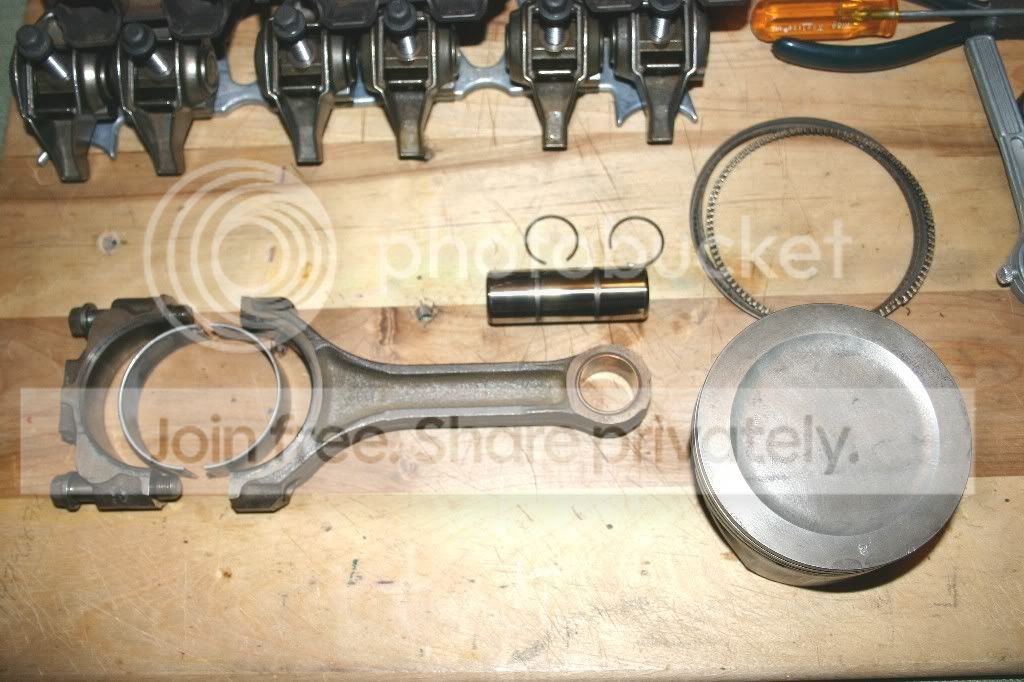
Are the piston pins a press fit or held on with c-clips?

If c-clips they are easy enough to swap different pistons onto those rods, keeping the "stock" bottom end intact.

Ideally, I'd want to keep as many parts original to the replacement engine as possible. Swap the damaged pistons out but keep the rods and rings if possible.

If they're press fit, swap piston/rod assemblies. Measure the big end of the rod ID on the old and the new. If they're the same, swap the original bearings to the new rod. Again I'd want to keep the rings original to that cylinder bore and I'd want to swap the original rings to the new piston.

I'd have no issues mixing/matching parts from one engine to another to make one good one. In fact, I did that with the replacement engine that went into my car. It had early style thin rods. I had another engine with the later thick rods in it. Pulled all the piston/rod assemblies and lined them up on my bench and set up a little assembly line and swapped rods/pistons/bearings (Volvo uses a c-clip style piston pin retainer). Been running that engine a while now with 15psi of boost and it compression tests out to 180psi per cylinder.
 
They are like this:

PISTON_1.jpg
 
Easy.

Swap new pistons to existing rods, provided they (piston bore size) are the same size it should be no big deal. This leaves your big end bearings untouched except to r and i them.
 
Yeah, the spiral lock pistons are super easy to deal with. I'd still check the clearances on the bearings if I thought I was having bottom end issues.
 
The real question is what caused the bearing to melt down in the first place. You mentioned something about boost retard (Im on my phone, so this is a PITA to go back and reread) or lack of one, is it possible it detonated to the point of muffin topping the bearings out of the rods? Certain bearings have a better ability to withstand this than others, trading off other qualities in order to do this. Federal Mogul has a huge description of these different traits somewhere on the web. Its quite interesting to read actually.
 
The tuner claims no knock recorded in the logs (knock sensors were tested earlier). Usually it's the pistons that go when knock happens. I was at 145% stock power when this happened, but only at stock boost levels. There are L67s with 28PSI on them and even better airflow. Check out the ZZP twin turbo GTP running 8.65s on stock bottom end:


While we're on Youtube, I have to link the "Sleepers" video. You can skip to 6:30 or 7:00 to see the Regal:

 
Last edited by a moderator:
Iv seen pistons damaged from knock, but when it knocks it beats down on the rod bearings hard too. Sometimes it just takes them out first. I could be wrong, but it was worth a second thought. It would really suck to knock them out again from the same problem.

The 8.1 I built last year, spark knock is what pounded the rod bearings out of it.

And them videos are ridiculous, and I need one of them as a work car stat.
 
Has anybody here rebuilt a 3800?

What exactly would you replace and recondition?


I see that my other block has formed a little surface rust in the bores. If this cleans up with just some oil, I'm OK, right?
 
Top Bottom