CK5
Register an account today to become a member! Once signed in, you'll be able to participate on this site by adding your own topics and posts, as well as connect with other members.
My ECM dosent like having an led MIL. I dont think it has enough resistance and registers as a popped bulb so I get a code. You have a resistor in there so maybe it will be enough? Also aftermarket tachs sometimes need an added resistor to run off the ECM, My VDO gauges needed a 1K.
 
My ECM dosent like having an led MIL. I dont think it has enough resistance and registers as a popped bulb so I get a code. You have a resistor in there so maybe it will be enough? Also aftermarket tachs sometimes need an added resistor to run off the ECM, My VDO gauges needed a 1K.

I had heard that some circuits in these trucks didn't like LEDs because of the lack of resistance so I made sure to add the resistors to "tune" the resistance for a 12v power source. If my calculations are correct my LEDs should be showing the same resistance as a bulb so I should be ok there.

I hadn't heard that about the tach though. I'll check in with autometer to see if I'm going to have any issue.
 
I was just about to start building my connection between the engine wiring harness and my gauges and I think I'm missing something. I have a wire out for my tach signal and speedometer but no temp gauge.

Does the PCM not supply a signal to run a temp gauge? I can't find anything in the documents I have. :dunno:

I am at the same point... not trying to hijack your thread or anything but trying to sort out gauges on my own swap!

tach and speedo will come from the wiring harness, and they are shared between the ECM and the gauges.

Oil Pressure, coolant temp, volts - there's sensors already on the engine, and they are all hard wired into the ECM - is there no way to use the ECM info to run a gauge? Do you really need to add a secondary sensor for a gauge to run an in-cab gauge?

How are gauges run on a stock LS truck? They don't have two sensors to run their gauges.
 
I never got an answer to how the stock gauges are wired, but the short answer seems to be that, yes, you have to run a separate sending unit for oil pressure and water temp. :dunno:

The PCM doesn't need an oil pressure reading for anything so you can just remove that sending unit and install the aftermarket unit in it's place.

The PCM does need water temp evidently so you'll have to leave the stock sending unit and run a separate unit for your gauge.

voltmeter just needs any positive lead so you can run any acc. or ignition positive wire to it and be fine.

I posted my solutions to these a few posts back.

*edit*
I just looked through the thread and realized I never posted pics of my oil pressure sending unit install. From what I've been told, aftermarket sending units don't like engine vibrations so I mounted it to the firewall and ran a line down to where the stock sending unit was located. There are lots of ways of doing it but if you would like I can post pics of mine.
 
Crossed another item off the list today. With the wiring done it was time to get the PCM mounted up.

First up was mocking up a mounting bracket in poster board:
Pcm_mount1.jpg


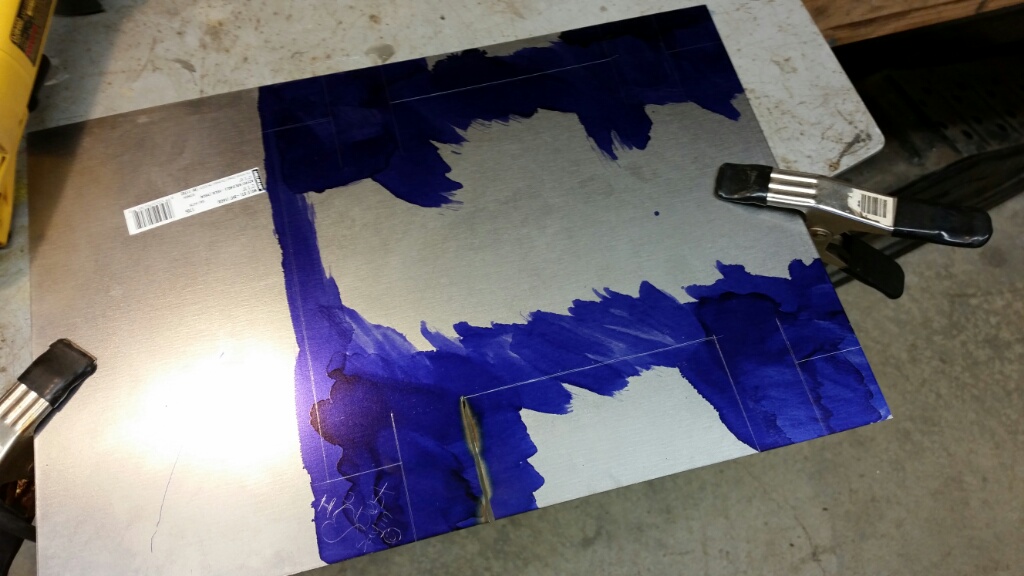
Transfer the lines to sheet metal:
Pcm_mount2.jpg


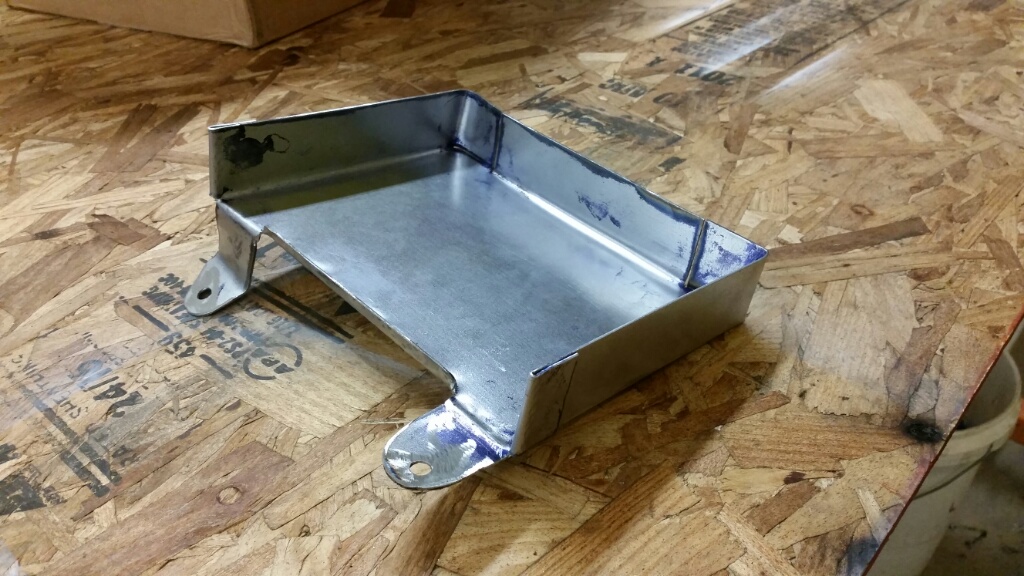
All bent up and ready for paint:
Pcm_mount3.jpg


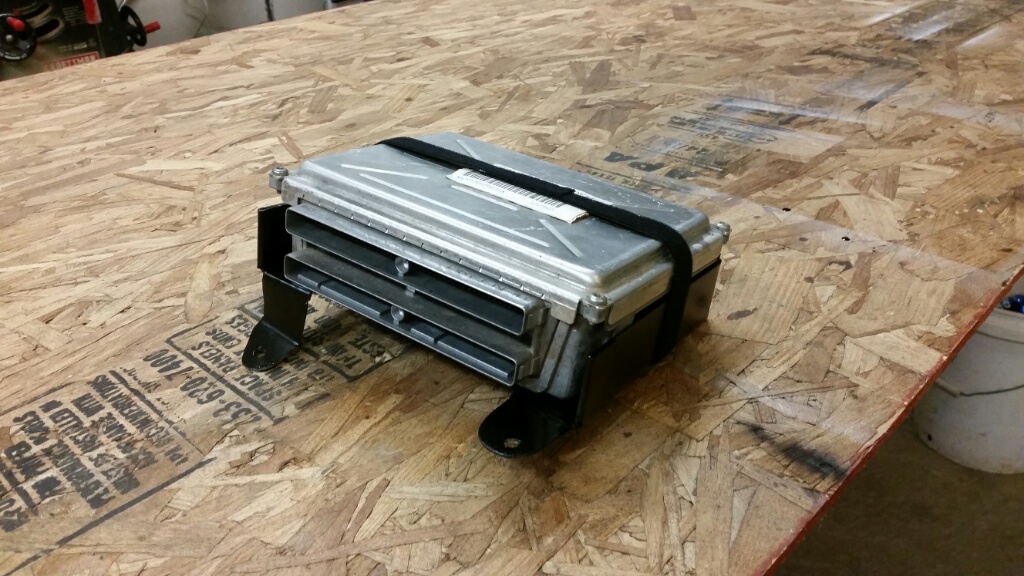
PCM on the bracket:
Pcm_mount4.jpg

Although it's not visible in the pic there is a small lip on the front to hold it in place. There is a 1/4" of dense foam rubber at the back as well so it presses in nice and tight. With the strap across the top it feels very secure.

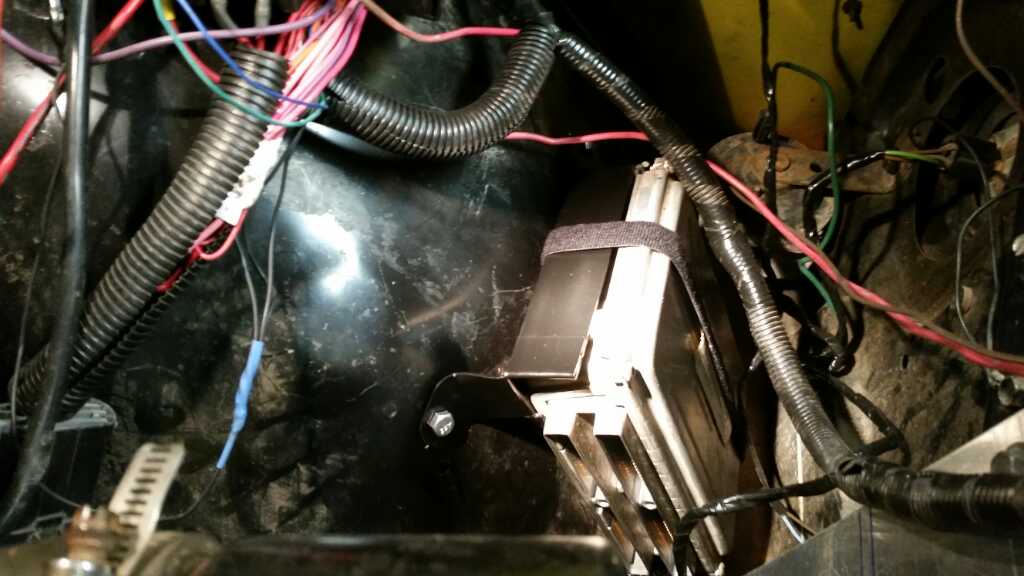
Mounted to the front of the drivers side wheel well.
Pcm_mount6.jpg


All the wires dangling in the pic make it look like a mess but most of that will be cleaned up once I'm ready to actually drop the engine in.

The PCM ends up sitting right under my battery box similar to the way it is in the stock trucks. Initially I was looking at mounting it on top of one of the wheel wells but that was taking up way too much real estate for something that doesn't need to be accessed with any frequency. Unfortunately in order to get it out I have to remove the battery tray (which also requires me to partially remove the radiator :rolleyes: ) but hopefully once it's programed it won't need to come out any time soon. I did check to make sure I can plug in the harness without issue at least. :D
 
Seeing blue Dykem on other peoples projects warms my heart..... :)

-G
 
scribed lines are soooo much easier to follow and more accurate. I did slather the stuff on a little thick though so it was a bit of a pain to get off. I'll use a lighter touch next time.

What are you using to remove it? I just used rubbing alcohol.
 
Maybe try brake cleaner, seems to work on stuff that is hrad to get off.
I've heard some horror stories about brake cleaner on anything you plan on welding on. Don't want to get myself killed. :laugh:
 
scribed lines are soooo much easier to follow and more accurate. I did slather the stuff on a little thick though so it was a bit of a pain to get off. I'll use a lighter touch next time.

What are you using to remove it? I just used rubbing alcohol.


Crimson Scotchbrite pad (or Rolocs) will remove most of it.... leaving only a faint blue stain behind. I try not to use solvents for cleaning of parts that I know will be welded in the near future.


-G
 
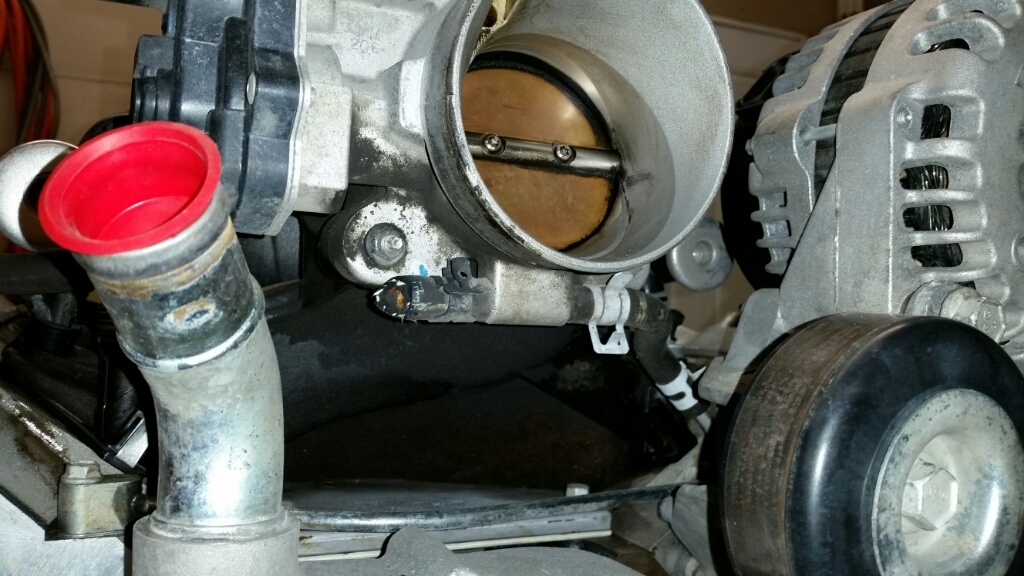
What should I do about the cut hose in the pic below?
Steam_vent1.jpg


I seem to recall that it's supposed to go to the radiator but Obviously my radiator doesn't have a connection for it.
 
You can connect it to the upper radiator hose with an adaptor, or weld a fitting in your radiator, or drill and tap the water pump and put it in there. It needs to go to the low pressure(inlet) side I think. Its a vent to allow steam/coolant out of the highest point in the engine since the outlet isn't in the intake any more.
 
You can connect it to the upper radiator hose with an adaptor, or weld a fitting in your radiator, or drill and tap the water pump and put it in there. It needs to go to the low pressure(inlet) side I think. Its a vent to allow steam/coolant out of the highest point in the engine since the outlet isn't in the intake any more.
Thanks. I'll look into tapping the water pump.

I'm working on getting my fuel lines done and the shear number of fittings is killing me! I'm looking at over $70 in fittings and hose just for the high pressure portion of the supply line and that's with reusing (hopefully) a stock line from the filter to the engine.

Right now I have a stock line with the fuel rail fitting on one end and a metric bump fitting on the other. I think if I'm careful I can re-bend it and use it to get me from the fuel rail down to the fuel filter on the frame rail.

After that it gets expensive. On the other side of the filter I need a
male bump to an -6 adapter
an -6 hose and
10mm x 1 to an -6 adapter
just to get from the filter to the pump.

Between the tank and the pump and on the low pressure return line I think I can get away with fairly cheap hose barb to inverted flare fittings and standard fuel lines.

Is there any cheaper way to do this, or simpler? It just seems needlessly complicated.

 
I run one of these in my upper line for that steam line, seems to work well. http://www.steigerperformance.com/PRODUCTS/sp40001.html There is some debate over tapping the water pump and hot spots due to steam pockets.

The fuel fittings do add up quick and are needlessly complicated and the best part is you will probably have to mess with expensive fittings again for the power steering box. I would have about $100 in mine if I did it right the first time
 
I run one of these in my upper line for that steam line, seems to work well. http://www.steigerperformance.com/PRODUCTS/sp40001.html There is some debate over tapping the water pump and hot spots due to steam pockets.
I'll look at that, thanks. I'm going to price having spot for it welded onto my radiator too just to see.

The fuel fittings do add up quick and are needlessly complicated and the best part is you will probably have to mess with expensive fittings again for the power steering box. I would have about $100 in mine if I did it right the first time
Luckily I already swapped everything on my power steering over to the correct style fittings when I added hydroboost last year so I should be good to go with that.
 
Lucky for me my truck was already tbi so the lines coming out of the tank and all the way up the back of the motor were already high pressure stuff. All I did was got barbed adapters for the fuel rail on the motor, and put a flare in the hard line from the burb behind the motor and ran short piece of high pressure fuel injection rubber hose to connect the two. My buddy did it the same way in his burb.
 

Latest Posts

Top Bottom