2013.10.02 - UPDATE! - ANTI-SQUAT?.....SURE, WHATCHA WANT?
More good progress on the monolith last night.
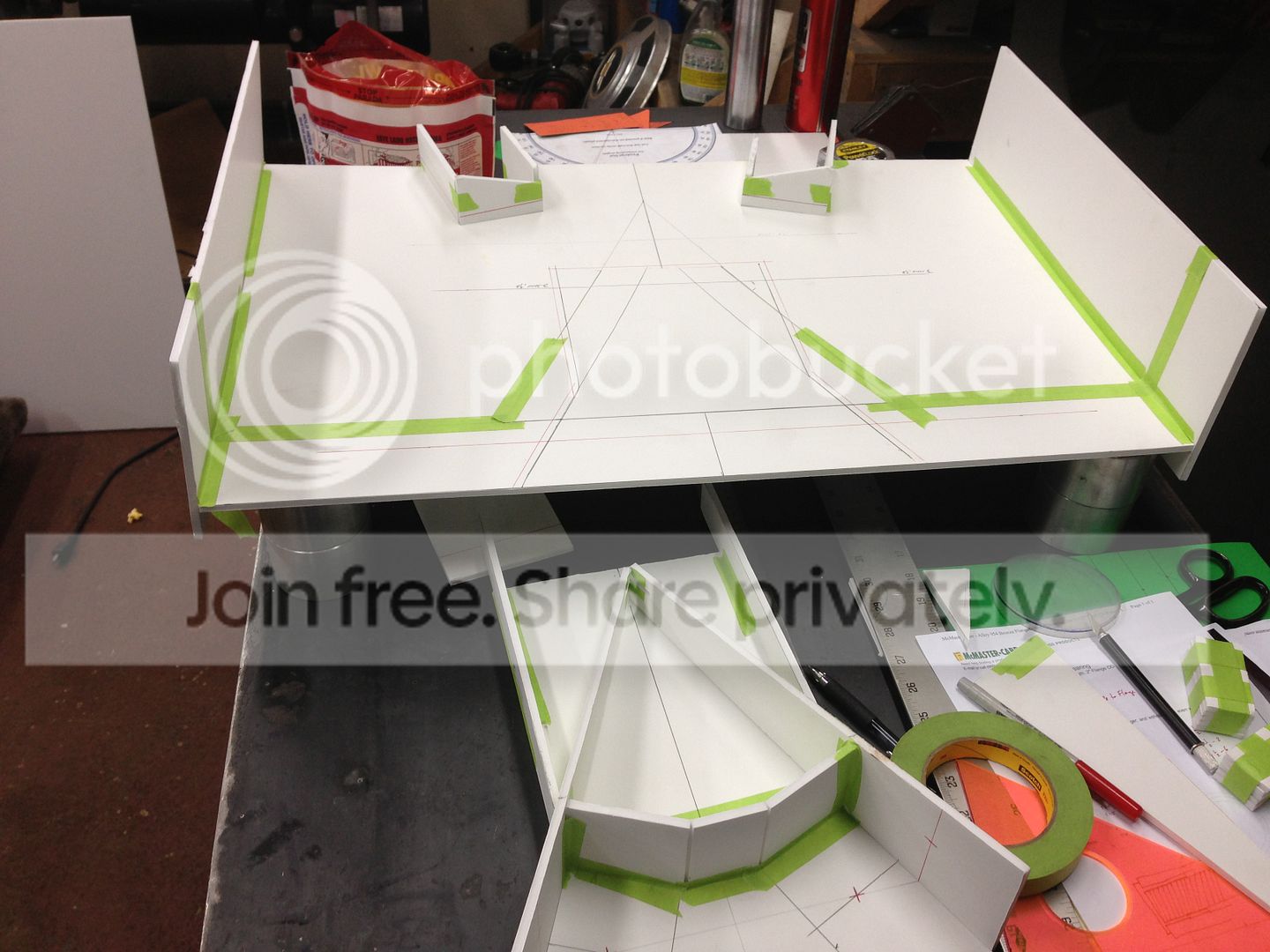
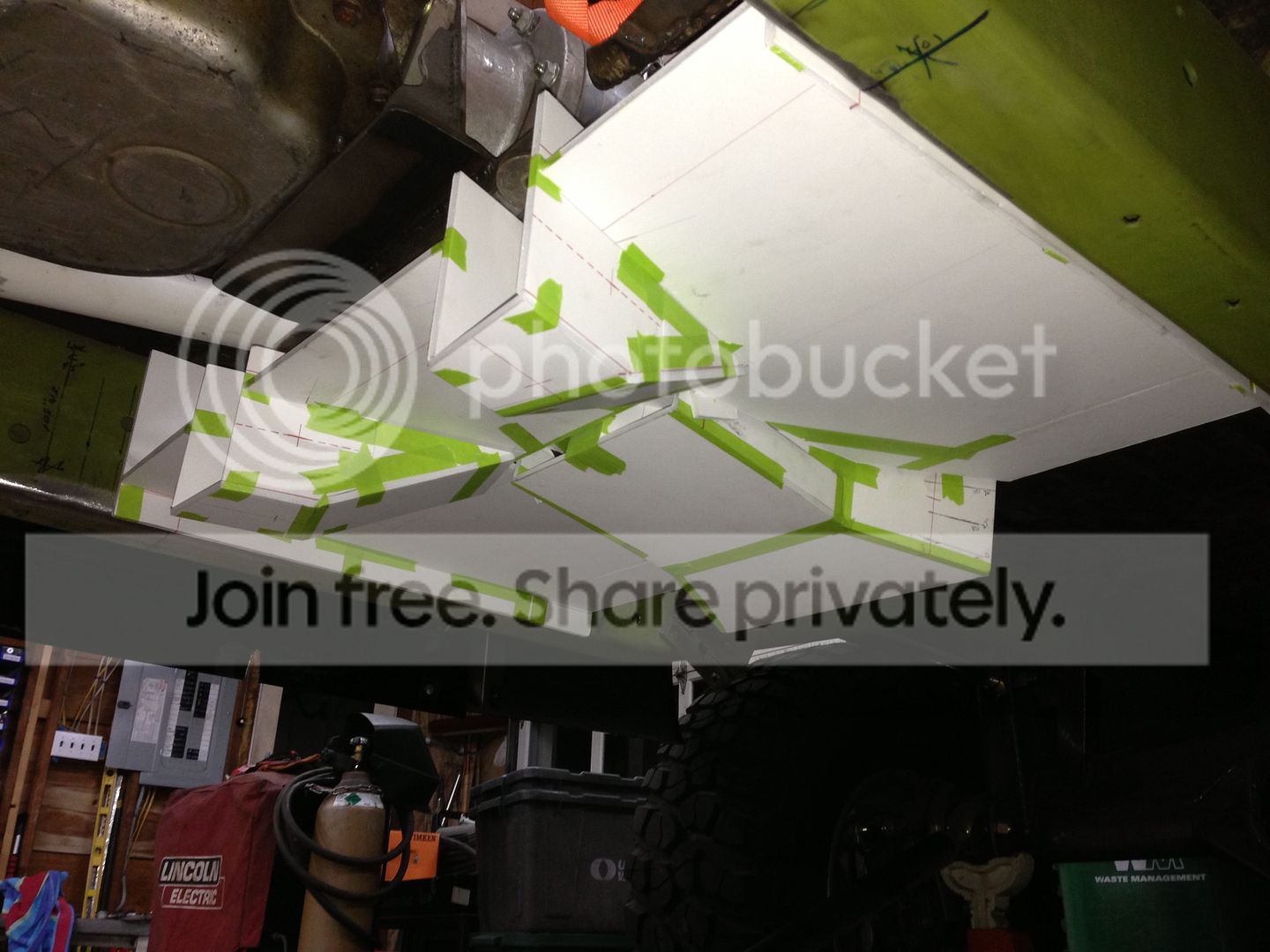
As I did my test fitting, it became clear that the rear link hanger needed to move back about 3" further than I'd originally planned. Not a big deal... so I stretched the entire crossmember (by taping on more foamcore) and came up with a new cutout shape for the rear hanger in the process.
Here is it on the workbench:
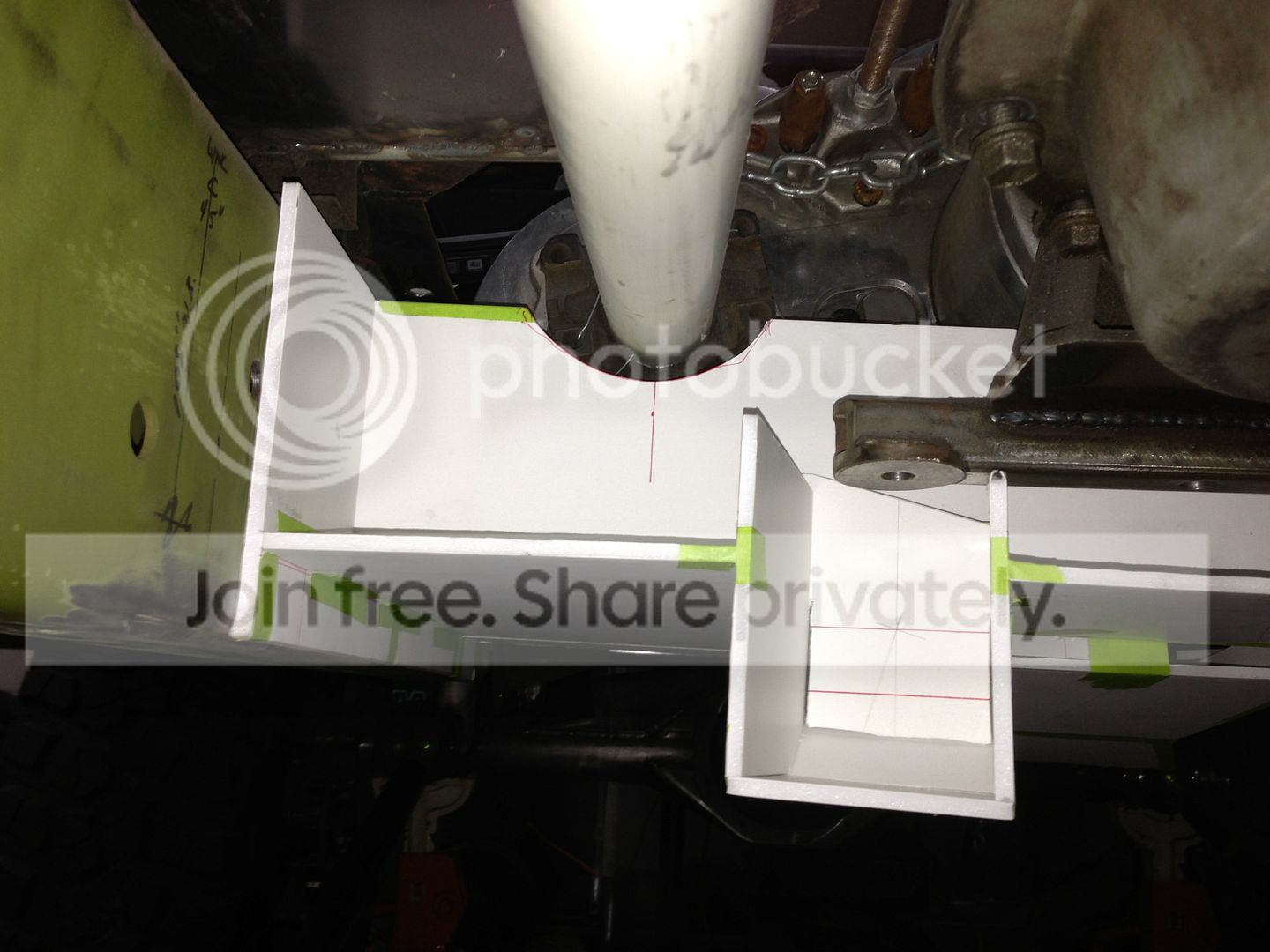
Part of the process was also to try to come up with some prelimnary bracing for the crossmember so that it wouldn't sag in the middle. I taped-in a nice 5" tall vertical support that runs the full width of the crossmember which worked nicely, except that it hit the underside of the front driveshaft output and the underside of the Atlas where the planetaries are housed.
.
A couple of quick notches took care of those interferences. At the same time, I also discovered that the new, longer crossmember was hitting a large 3/4" through-bolt on both sides of the frame. This bolt is the anchor bolt for my beefy rear upper link mounts (the ones that mounted outboard of the frame on both sides). This means that the final design of the monolith will actually have a through hole to match and I will be able to run the bolt through both sets of parts and "lock" them both together, forming a larger and stronger stucture. I like that.

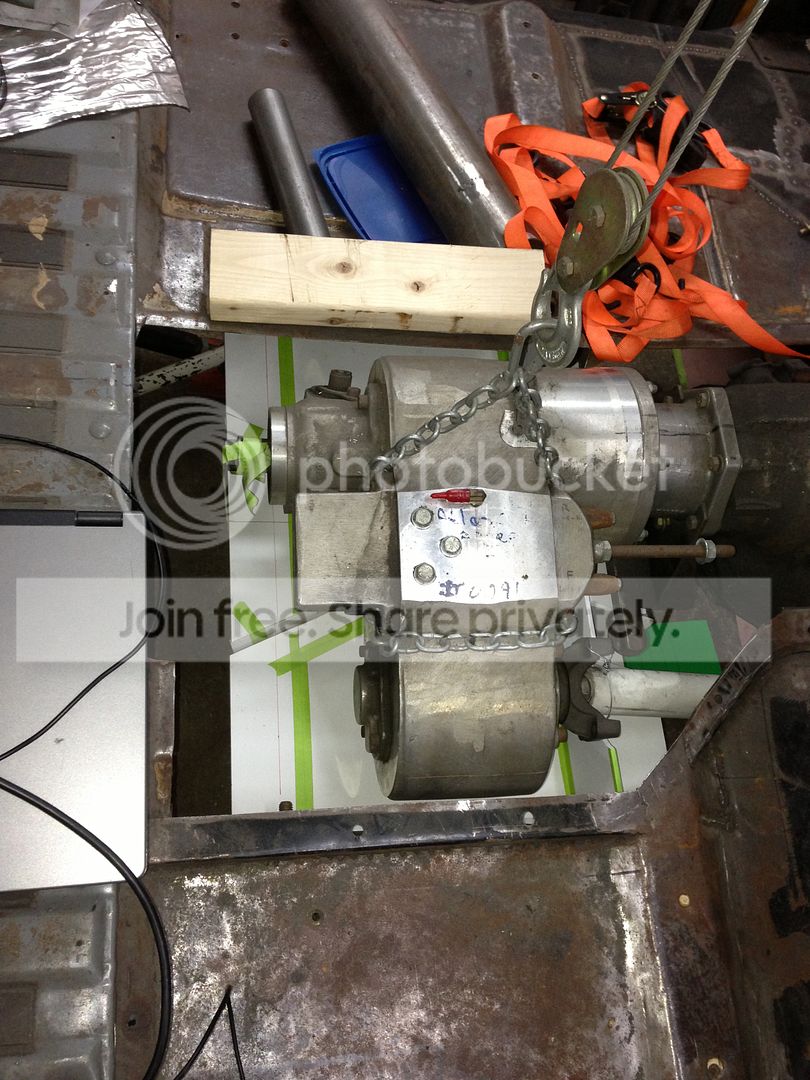
Once I finished those tweaks, the crossmember could be installed up into position fully. Here is a shot from the transmission tunnel that gives a good sense of just how large this part is, and how much area it covers.
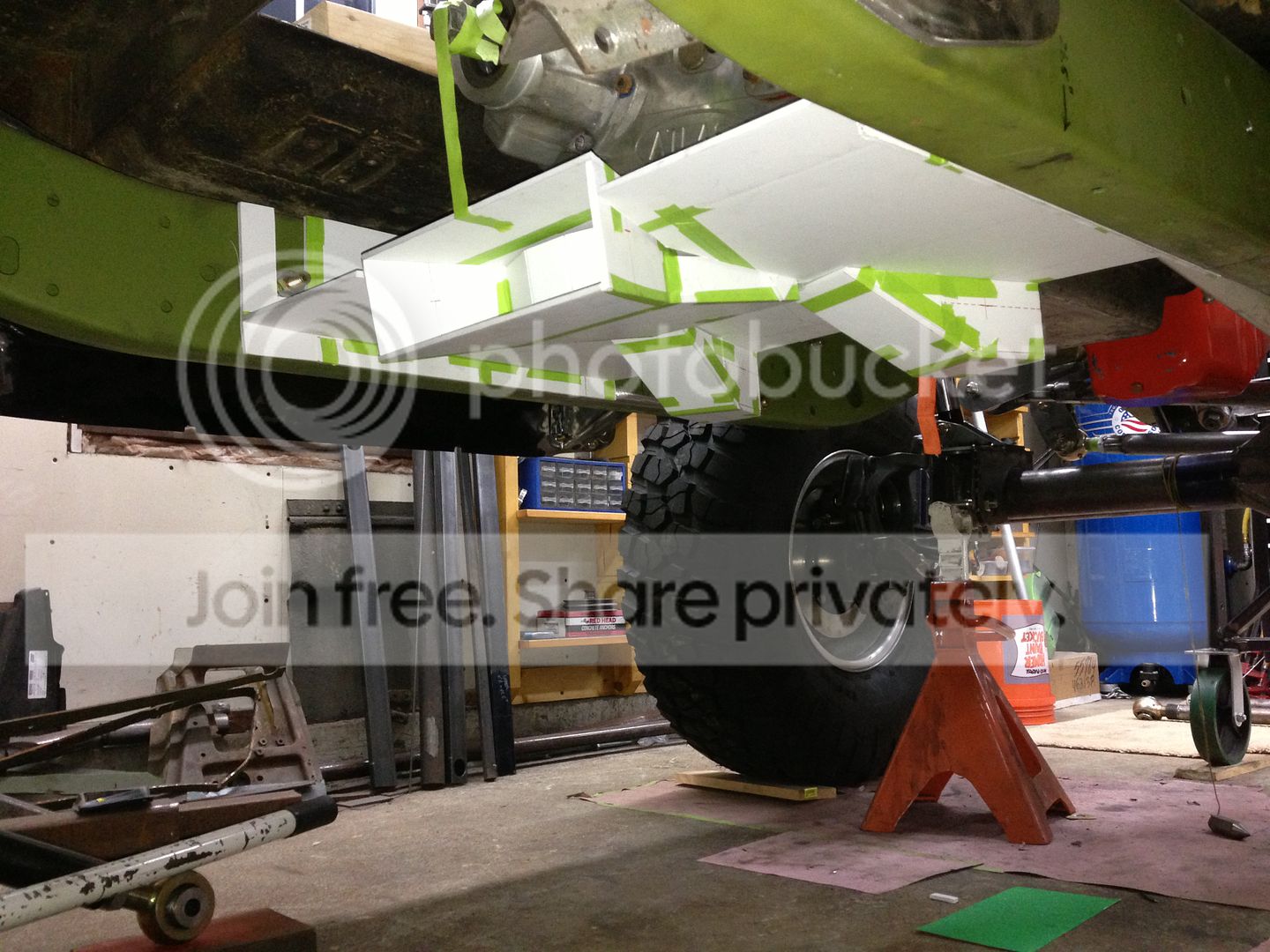
Now for the fun part..... Here's a shot of the crossmember from the rear of the truck (passenger side) facing the front of the truck. This gives a good overall sense of the part as it has evolved over the last couple of nights.
Some of you have probably been looking at these last few shots and are wondering why the rear hanger appears to be a separate unit from the monolith and not simply tacked-on like the front hangers.....

I can explain.
About 3 years ago, as I was working on the rear suspension design for this truck I was trying to come up with a good, low anti-squat (AS%) value with my design.... 75% A.S. seemed like a good target based on what I'd read and learned, but I also noticed as I played with my 4-link calculator that I could very easily change that value (and pretty dramatically) just by changing the vertical position of my frame-side lower link mounts by a few inches.... in fact, I could drop my AS% down to 46% by lowering the mount by 1" and could raise the AS% to over 100% by raising the mount by only 2" from my target value.
As I thought about it, the idea came to me that instead of having a few different sets of mounting holes that would allow me to unbolt and move the links for fine-tuning, it would be MUCH more awesome if there was a way to adjust my AS% "on-the-fly" with some sort of lever or crank inside the truck. In this way, I could experiment with different AS% values on the trail in real-time. If I was trying to climb an obstacle and was getting too much "hop" (an indication of a high AS%), I could simply stop.....crank the AS% down maybe 10% or 20% and then try the obstacle again!
That sort of real-life experimentation and capability on the trail was just too exciting a challenge to ignore, so I've been mulling over how I would accomplish it cleanly (and safely) for a long time now.
The answer turned out to be quite simple. The converged links area (the triangular shaped part of the assembly) is built with a pivot roughly 8" back from the heim centerline (toward the front of the truck) so that both of those heims and their assocated bracketry are free to move up or down a few inches. Look closely at the following photo and you can see the markings on the bracket for different settings:
My initial height (as shown in the photo above) for those heims is set at 26" off the ground, which gives me a working AS% value of 64%. But since I have a few inches of travel to work with, I can also achieve the following values as well (and all values in-between):
25" = 46% A.S.
26" = 64% A.S.
27" = 84% A.S.
28" = 105% A.S.
It's generally accepted that anything over 100% A.S is pretty useless since it causes excessive suspension "hopping" so I didn't see much value in building the pivot for higher values. Likewise, I'm not sure that A.S% values into the 20% - 30% range are all that useful either, so I set my range to accomodate the A.S. values between 50% and 100%.
So basically, the foamcore template that I tested last night accomplishes that goal. The rear hanger has swing 3"+ of vertical swing without interference to the Atlas so I will be able to set my rear AS% to any value I want, whenever I want.

The next challenge is the pivot iteself. Obviously, I am taking loads from two heims that are each fastened with 3/4" bolts and concentrating those forces into a single pivot point. That bolt is truly the "kingpin" of the rear suspension and CAN NOT be allowed to fail. My plan is to install a 10" long, 1-1/2" diameter bolt through a secton of DOM tubing that's been sleeved with bronze bushings at either end. There will be a small amount of room between the bolt and the sleeves, so I should also be able to install a grease zerk and keep the whole thing well-lubricated and keep debris and water from finding it's way in.
Once that's built, the final step will be to build a long lever off the opposite side of that pivot so that I will have good leverage to move those links from an in-the-cabin control of some kind... I've got some ideas in my head but that will have to wait for another day when I can cut up some more foamcore....
My short-list for the weekend:
- Pick up a couple more sheets of 1/4" flat steel
- Purchase a nitrogen bottle and regulator to pressurize the ORIs
- Hope that my bolt/bushing order from McMaster-Carr arrives on Friday like they claim.
-G