CK5
Register an account today to become a member! Once signed in, you'll be able to participate on this site by adding your own topics and posts, as well as connect with other members.
I would think that getting the center "flat" in the wheel would be much more crucial than having some runout on the outer. I would think balancing could take care of that.

 
I would think that getting the center "flat" in the wheel would be much more crucial than having some runout on the outer. I would think balancing could take care of that.

Maybe, but since I have to mess around to get the centers to fit the hoop dimensions anyway.... there is no reason NOT to spend a few extra minutes to get it right.

I haven't read that article that BARRAZA just posted, but skimming it quickly there seems to be an argument for fixing runout in both axes, not just the lateral axis.


-G
 
Wasn't saying don't try and get it close... I just think you could get away with runout on that axis a little easier than the other.


Definitely a cool endeavor. :popcorn:
 
Greg, how much interference is there if you try and push the centers back in the factory hoops? And what if you rotate the center so it goes in the spots that were empty before? I would think enough to make a friction fit so you can true it before tack welding would be good enough. Pressing something with 4 curved "sides" in a sheetmetal hoop is probably not going to make a huge difference in regards to strength, it may start distorting the hoop so the gaps become more straight and less curved.

And I was thinking just one roller on the jig would be good enough, then you can rotate the wheel against the one contact point to check for wobble and/or runout. If you make multiple contact points then you have to be sure they are perfectly square to the axis of rotation, which could be more time consuming.

Another option is, if you know your exact backspacing, and you had a flat surface (like a welding table). You could have a spacer machined out of pipe or bar stock or something, even PVC. Then you set the wheel center on that, and then the rim will go flat on the weld table being flat by the table and being centered by the fitment of the two pieces. Put a tack in 4 places and then bolt it to the hub and check runout.

And I think the radial runout (perpendicular to the rotation axis) is more important than the wobble, but obviously you want both to be as close as you can get them. If you have a wheel with backspacing almost in the center, it may wobble noticeably and you'll likely not feel it. But if its got radial runout you will feel it. Of course your wheels will be a little more sensitive to that because of the offset.
 
Any quesses as to how much larger the center should be than the hoop to get a good interference fit? :dunno:

You had mentioned that a "few thousandths" across a 14+" wheel center is probably not enough..... maybe .010"??? .020"???


:thinking:


-G

And it looks like I was wrong. A few thousandths may be plenty. After a quick search, I cant find any interference fit calculators that are not concerned with the interference being the only thing holding the components together. All you really need is enough interference fit so the parts don't move around while you are doing the fit check and welding. Probably easiest to figure the size increase of the hoop by adding 150degrees F and going from there.
 
I wonder if you could heat up the center section and cool the hoop to temporarily create some interference? Enough time for some tack welds? Wouldn't leave much time to true it up though.
 
BOTH. what IS acceptable runout for a steel wheel anyway? G


As far as this goes it WILL be what it is. You're only going to have so much control over what you can. You won't be able to correct everything on an old formed steel wheel. It's of course not a machined precision thing and not meant or necessary to be. So in reassembly, don't over think it or put more into it then needs to be. I'd check what runout you have on all work/mating surfaces in question. If tweaking will yeild better results. Tweak till satisfied. I'd find out if at all possible what industry standards are and go with that regarding safety standards.

Personally, I'd make it as perfect as possible. Within .010 runout IF possible. I've never checked runout on a steel wheel. I can't imagine they run even that true, but I'd sure like to think so. Who doesn't like the term dead nuts :D.


Any idea what qualifies as an "interference fit"? :dunno:


Answer:


I was guess maybe a few thousandths maximum would be enough.... Basically tight enough that you would have to heat the hoop with a torch slightly to expand it....the center would drop down into place. As it cooled (assuming the fit wasn't too tight) there wouldn't be any distortion of the parts.... Just a nice tight fit that is ready for the welding and bolting processes.

Paging Rob!! ... :bow:


-G

You answered your own question after asking it :D :waytogo:. Not an exact science. NOT so tight you end up wanting to kill something because you faught it so hard to get it to where it was ready to weld! :haha:. A little less then that is perfect! :thumb: Kick ass seeing it rollin!
 
I'll add, About .0005 IF it was true round, which I highly doubt it is. Thats alot of surface area and a tight press fit and you don't want to be pounding HARD on it, even with dead blows. Still could warp things, especially under such tention. You want it to move with a decent wrap of a dead blow. You may be suprised on how hard it is to bump into place under even that much tention. If you heat it and put it in it had better be perfect with more then a thou. Thats a hella grip fit I call it. I got .004 on my Ti Aluminum shackles I machined so many years ago. Took a special freezer to cool the Titanium enough. It was a one shot installation. They would never be gotten apart if I got it wrong. These could be heated and moved easily though if not what you wanted.
 
2014.09.11 - UPDATE! - ......SQUIRREL.....!!!!!!

:D

Not really a "squirrel phenomenon" in the traditional sense. The 17" white wheel project is still a front-burner activity but the remaining wheel hoops will be arriving tomorrow, and I need to schedule some time with my machine shop contacts to do the cleanup cuts on the wheel centers and hoops to do some experimenting.

All the recent suggestions and cautionary tales for fitment, etc are appreciated and I will apply all of that information soon enough. :bow:


In the meantime, there was no reason to lose a perfectly good evening in the shop so I decided to at least start the process of installing my rear ORIs and figuring out how the mounting was going to work... I'm not sure if the later model Blazers are the same way, but in this 1972 version the wheeltubs are a 100% bolt-in affair. Apart from a little penetrating fluid on the nuts, getting a wheeltub off was completely effortless.

IMG_0747.jpg


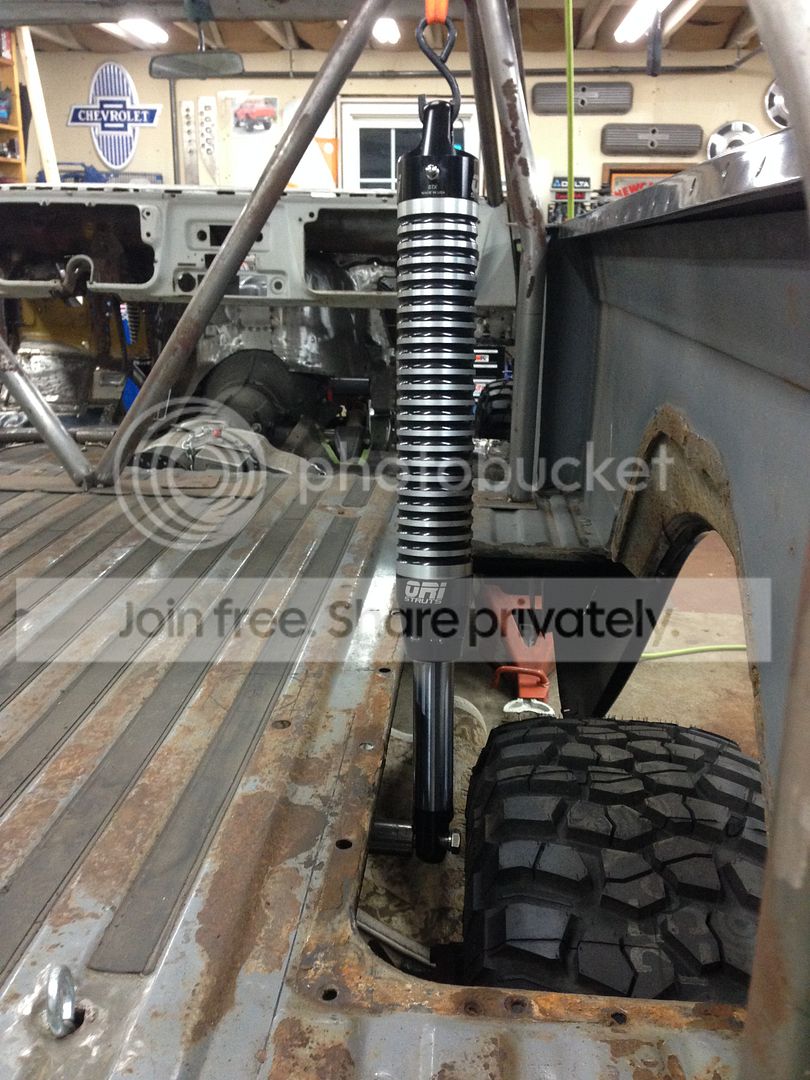
The challenge with the rear strut mounting is to locate it so that it the tall upper link mounts don't collide with the strut body. There was no such issue up front with the 3-Link since the only tall link was inside the framerails. So, the trick is to either: Mount the strut off the back of the axle housing by several inches, so that the upper link swings and articulates in front of the strut body..... OR..... install the lower strut mount at the TOP of the upper link so that there is no way for it to interfere during articulation.

I chose the latter.

It actually gives the rear kind of a cool, funky look....


IMG_0756.jpg


I raked the strut forward 8*, which is the same amount that I raked the front struts backward. The symmetry looks nice, and it will square-up the strut to the arc of the link travel.

You can see that the upper strut mount actually sticks up above the bedrail so it will be visible from outside the truck... Not super-obvious, but it does give that little "hint" that things on this truck are not exactly as they first appear either....

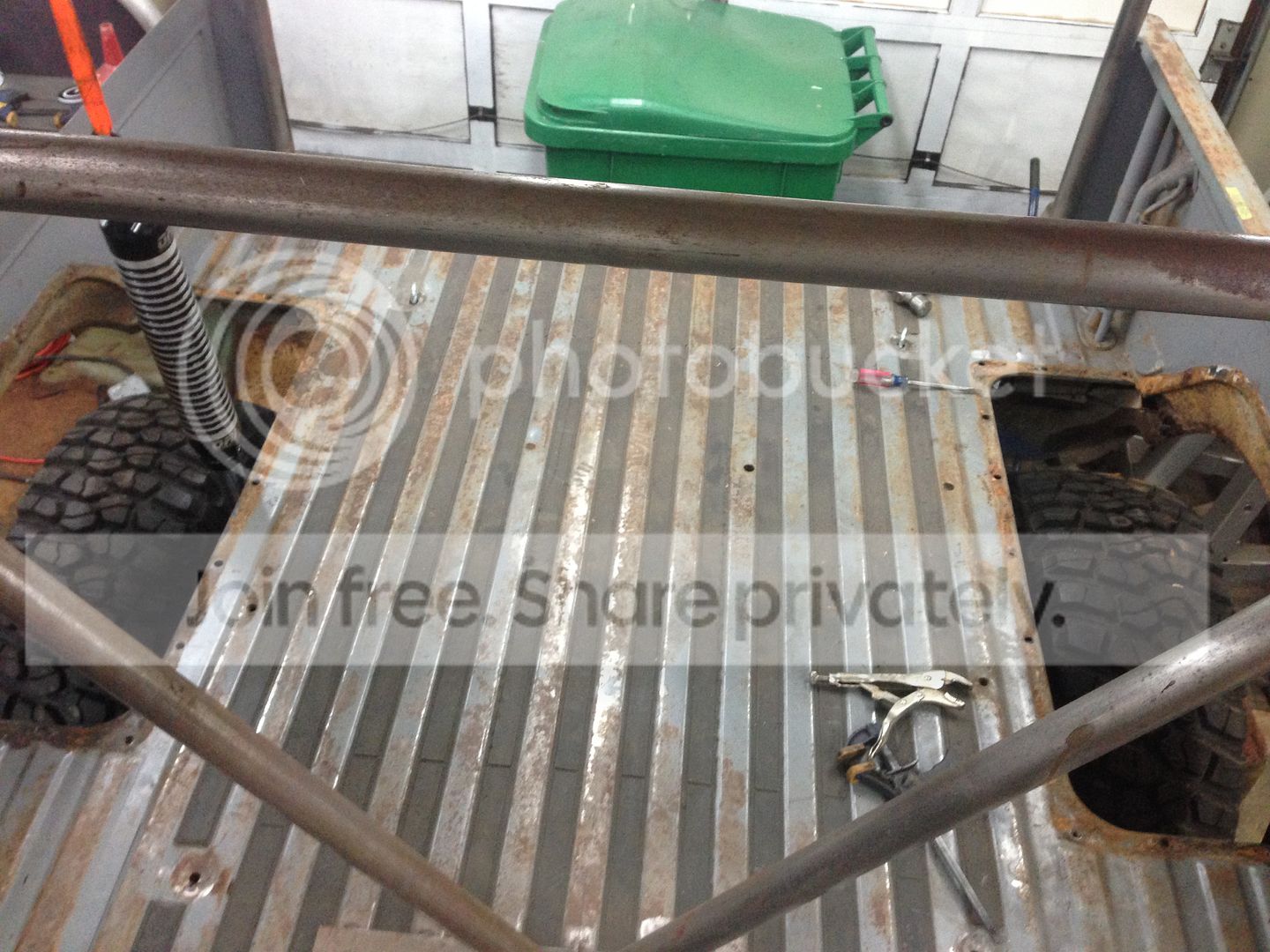
Here's the rear view shot... looking forward from the passenger side toward the dash area.

IMG_0765.jpg


The strut will need to be angled inward as well to give it proper tire clearance, but since I didn't feel like chopping up the bed floor last night I just left it like this for now.

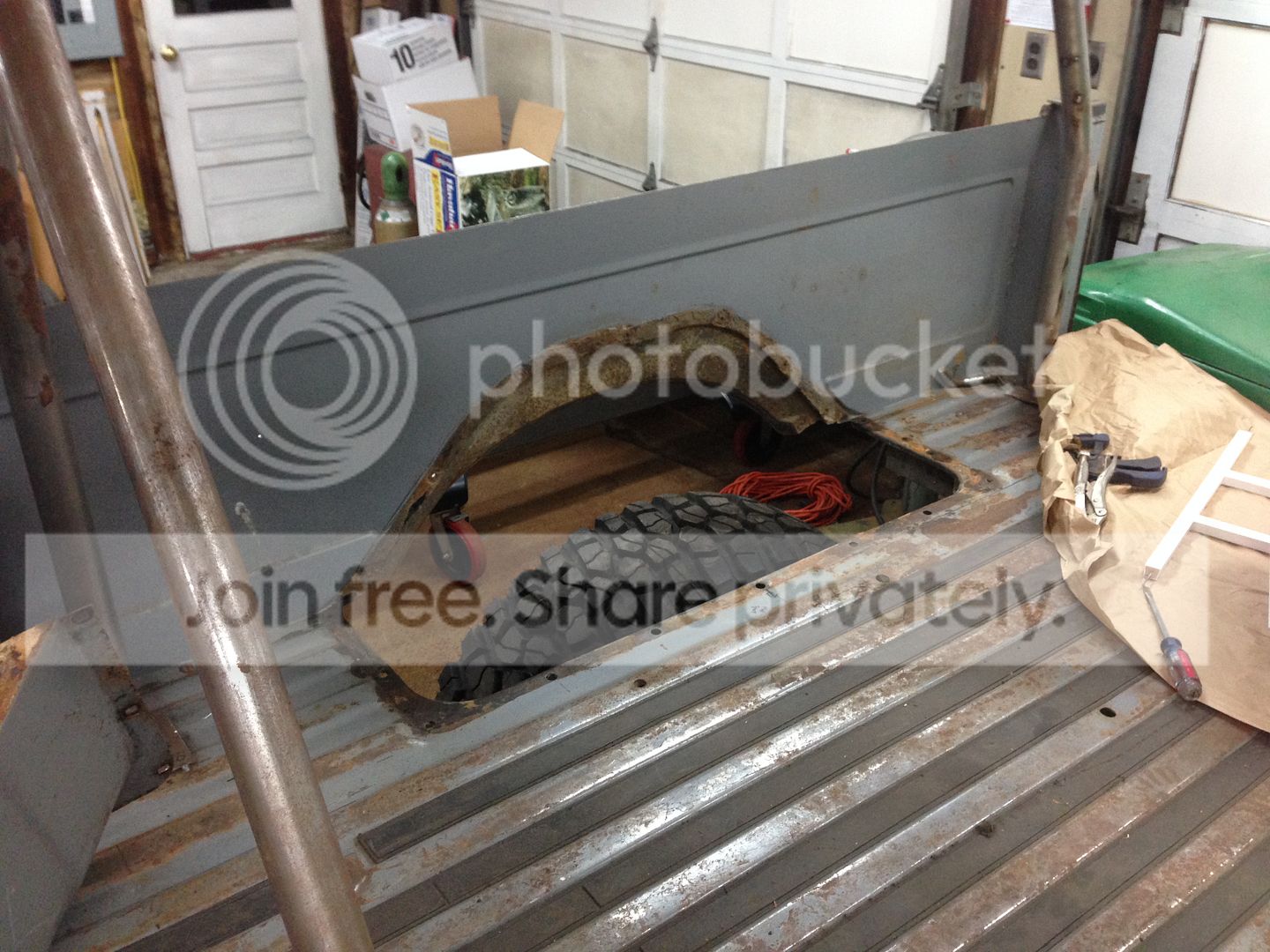
There was a little time remaining before midnight... so I decided that if one big gaping hole in the floor was good......then TWO gaping holes would be even BETTER!!!!


IMG_0775.jpg


What is fascinating about the rear section of this truck is that not only are the wheeltubs a "bolt in" design, but the inner bedsides are mostly all bolt-in as well.... it wouldn't take too much effort to take out a few more bolts and cut a few spot welds and completely remove BOTH bedsides completely! :D From there, it would only be a few bolts more to disconnect the rear upper floor area from the lower front seat pan area and completely lift out the bedfloor as well......

Given the costs associated with acid-dipping or media blasting rusty metal....then the tedious process of fixing millions of rust pinholes, etc. I am having one of those "Might As Well' moments about just buying a completely new reproduction rear floorpan, and maybe even a new 1-piece seat floor area as well. :doah::whistle: Basically, the only original part left would be the upper 1/2 of the firewall and the windshield frame..... all the other metal would be 100% new and rust-free. In the long run, it could end up saving me a massive amount of time and money on bodywork and paint prep..... we'll see. :thinking:


FUN SHOT OF THE EVENING......

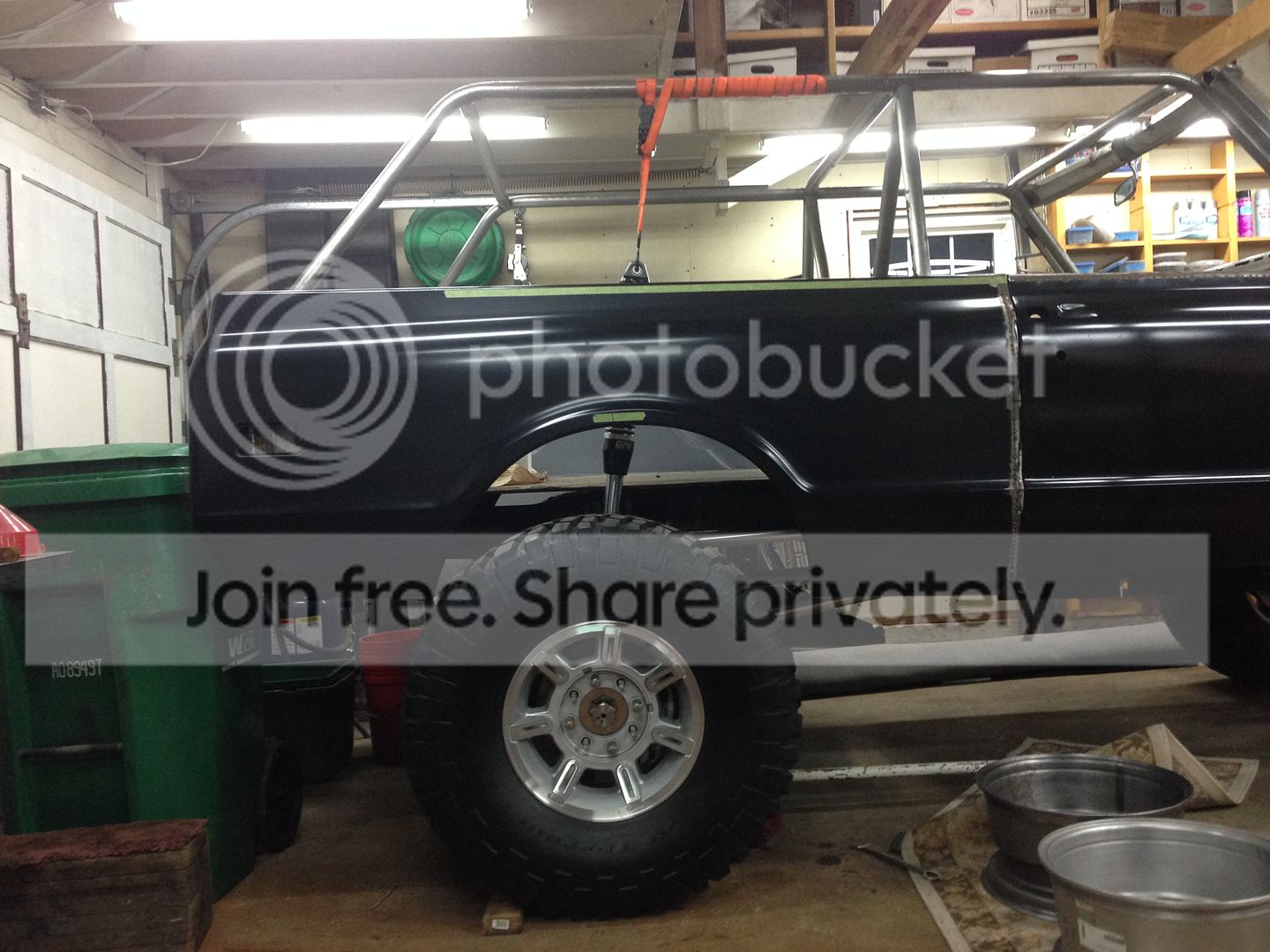
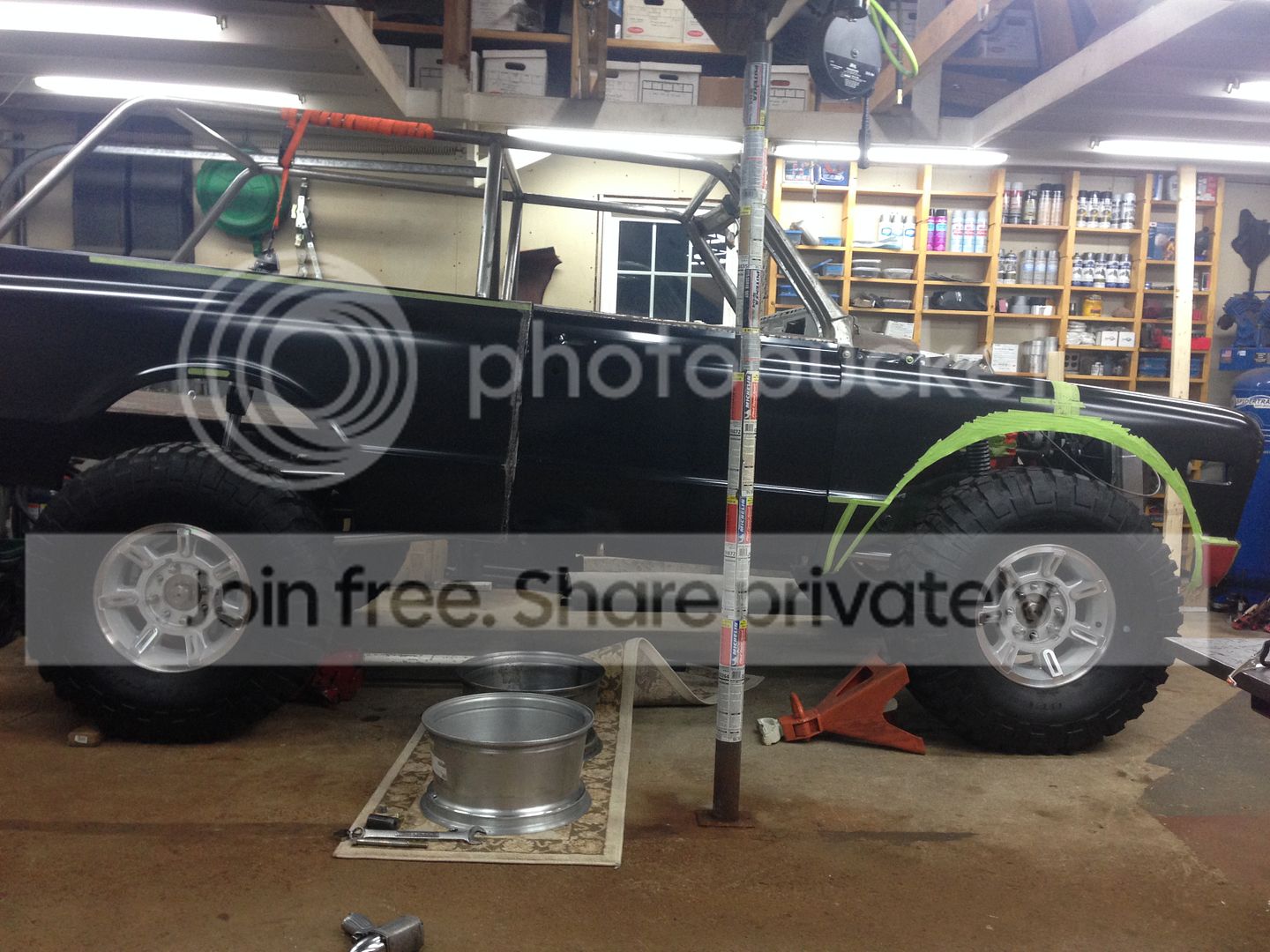
Remember last week how I was talking about how easy it would be to play around with ride height using nitrogen pressure in the ORIs? Well last night for fun, I dumped the pressure up front and put the truck on the bumpstops just to see how low it would get.

The results are pretty funny.


IMG_0774.jpg


The rear is sitting at my target ride height, and the front is completely laid-out..... keep in mind, this is still at street tire pressure (~36psi). If I aired-down to say, 10psi the whole thing would sit another 2 - 3" lower than that.... :haha:


Stink Bug stance for sure.


-G
 
Looking at how low the front is reminds me of another benefit. Once all the front sheet metal is on, working in the engine bay is a PITA when the truck has some lift to it. Being able to dump the pressure in your ORI's and lower that to a reasonable work height is a pretty sweet bonus imo.
 
Do they make a one-piece rear floor Greg? Last time I looked, it was only the front and rear separately. My rear floor still needs replaced, and my initial plan was some diamond plate, but I would consider stock if it was available.
 
Do they make a one-piece rear floor Greg? Last time I looked, it was only the front and rear separately. My rear floor still needs replaced, and my initial plan was some diamond plate, but I would consider stock if it was available.

I've heard rumors that there's one coming for the Blazers in the next few months....

Since I have to stretch the wheel tub openings up a bit anyway, I might be better off buying it in pieces anyway.... Maybe a longbed pickup truck version would give me more material to play around with? :thinking:


-G
 
That would probably do it! I might need to play with the rear tubs too, and I'm sure the diamond plate will be significantly cheaper... Who knows what route I'll go.

The long bed patches sound like a solid idea for you though. How are your cross sills?
 
The rearmost one (under the tailgate) is pretty bad.... the rest are OK.

It really just comes down to spending the time/money/effort to restore and repair what is there vs. just unbolting the whole mess and replacing it with new...... there is something VERY attractive about "instantaneous rust repair".... :D

-G
 
What are your plans for exhaust? Are you going to run it all the way out the back? I would imagine that clearance around the links, ORIs, etc, is going to make that tricky.

Love the build!
 
What are your plans for exhaust? Are you going to run it all the way out the back? I would imagine that clearance around the links, ORIs, etc, is going to make that tricky.

Love the build!

As far as I can tell at this point, the headers go outboard of the framerails......the collectors squeak past the front cab support mount and into the torsion box area where I will have to locate the mufflers. The exhaust will continue outside the framerail in that small compartment until just before the rear tires...... where it will either dump out, or magically find room to cross back to the inside of the framerails and continue to the back of the truck to dump out in a more conventional spot under the rear bumper.

Not 100% sure yet how that is all going to play out.... :D


-G
 
Exit the exhaust through the rear quarters? Don't loose any ground clearance that way.
 
Last edited:

Latest Posts

Top Bottom