
CK5

You are using an out of date browser. It may not display this or other websites correctly.
You should upgrade or use an alternative browser.
You should upgrade or use an alternative browser.
'72 K5 - Greg's @MightAsWellK5 Build
- Thread starter Greg72
- Start date
This is the build description. I will improve this later. (GB)


Ooopsss..... Welcome to Page 277!!!
Guess you'll have to click back a page (or two) to see the relevant photos!!

-G
(ps. The serious answer is that the wheelbase is stretched to 107" from 104" so the wheeltubs were in the wrong place)

Because it's Greg...I saw the pictures, just couldn't figure out why you were hacking on the floor already. lol

bp71k5
3/4 ton status
Oh, I get the idea now. Curious how that works out.Brian,
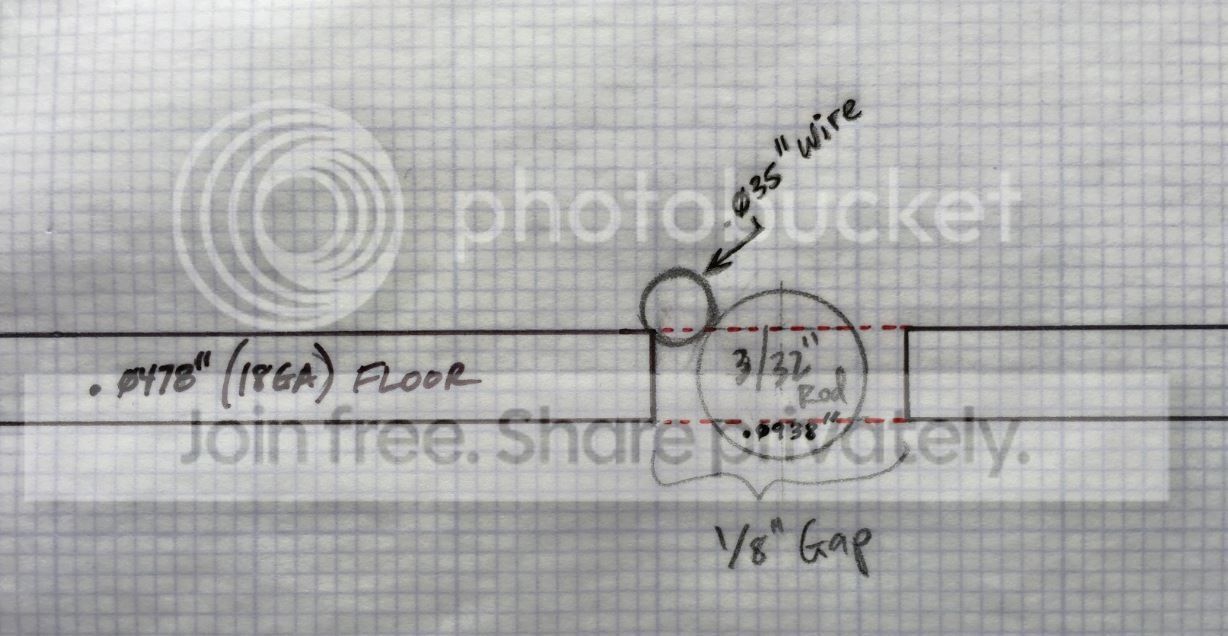
That's why I'm kind of intrigued by the idea of using round filler rod.
The rod just gives you more material in the gap to absorb heat without blowing through, and it seems like you might end up with a more solid weld (with fewer pinholes) than just trying to bridge-the-gap with weld.
EDIT:
Here's the idea (drawn to scale)...
-G

I saw the pictures, just couldn't figure out why you were hacking on the floor already. lol
Getting ready for his foot print gas pedal

Greg, the 3/32 filler is a valid theory, and I have used that method on thicker material with some success. Unfortunately, on thin sheet like this you will find it to be nearly impossible to make work. Here is how it'll go...you'll tack on one side of the filler, it will mostly melt as it also pulls real hard. Now the rest of the filler has been pulled and twanged out of the gap.You'll roll your eyes, try to re-fit the filler and try the next tack. It will continue to pull and tweak itself...Multiply this by eleventy and you'll end up with a boogery humped up mess. The copper spoon is probably the ideal 'helper' for your particular problem.
Your other option is a 1" wide backer strip underneath made of similar gauge sheet steel.
Your other option is a 1" wide backer strip underneath made of similar gauge sheet steel.

I like the back up strip. I have used the method on a couple Jeep floors I have modded.
I drill holes 6" apart alternating on each side. Fill the gap. Then use seam sealer or silicone on the edge of the backer to prevent rust
I drill holes 6" apart alternating on each side. Fill the gap. Then use seam sealer or silicone on the edge of the backer to prevent rust
Greg, the 3/32 filler is a valid theory, and I have used that method on thicker material with some success. Unfortunately, on thin sheet like this you will find it to be nearly impossible to make work. Here is how it'll go...you'll tack on one side of the filler, it will mostly melt as it also pulls real hard. Now the rest of the filler has been pulled and twanged out of the gap.You'll roll your eyes, try to re-fit the filler and try the next tack. It will continue to pull and tweak itself...Multiply this by eleventy and you'll end up with a boogery humped up mess. The copper spoon is probably the ideal 'helper' for your particular problem.
Your other option is a 1" wide backer strip underneath made of similar gauge sheet steel.
Sounds familiar now that you mention it....
I remember bending lovely wheel arches out of small-diameter solid rod, and when I went to lay the first hot tack weld in the middle of that arch.........it melted, lost all tension in the curve and just ended up looking like a partial-curve with a big "point" where I'd welded it.
Guess I'll try the copper spoon trick instead. I can't do the steel backing strip.... the concours judges would knock-off major points for the way that would look underneath!!!
-G

That's funny, I was going to suggest a backing strip but I figured you would shoot it down due to underside aesthetics.
I'd do the backer strip and seam sealer, if there is ever a Concours judge under your truck wrinkling his nose...drive over him! 

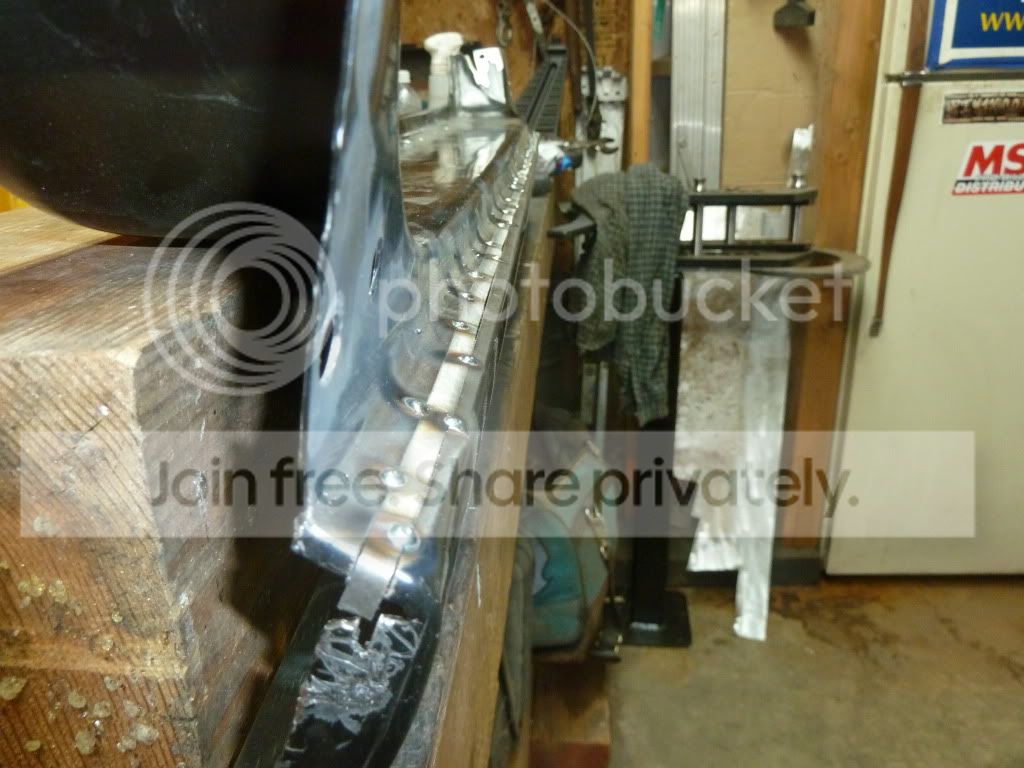
What's the problem with doing whatever method you used to tack it together in the pic? Just a few hundred more of them.
What's the problem with doing whatever method you used to tack it together in the pic? Just a few hundred more of them.
No problem really. It's just that bridging a weld across an 1/8" gap is probably going to be pretty inconsistent and I'm bound to have lots of pinholes and thin spots once I grind it all down flush.
-G

Solution?No problem really. It's just that bridging a weld across an 1/8" gap is probably going to be pretty inconsistent and I'm bound to have lots of pinholes and thin spots once I grind it all down flush.
-G

That's funny, I was going to suggest a backing strip but I figured you would shoot it down due to underside aesthetics.
Hence my suggestion for the rosettes they look like spot welds. It looks just like an added brace. If you fully weld on the underside it's obvious what you did
No problem really. It's just that bridging a weld across an 1/8" gap is probably going to be pretty inconsistent and I'm bound to have lots of pinholes and thin spots once I grind it all down flush.
-G
True! You will.
But you will get that no matter what you do.
I like Steve's Red Green idea!

Lay a thin strip in the gap on edge/perpendicular to the panel with the edge of the strip being flush with the underside and the top side about an 8th or so above the floor and tack tack tack it in. Probably not the right way to do it but it works and grinds down good.
What's the problem with doing whatever method you used to tack it together in the pic? Just a few hundred more of them.
Big tacks like that shrink hard...

Fill it with metal as is and weld it, or cut it just a tad bigger and fill it with a bit more metal so it doesn't blow through to make it easier and weld it.


Been reading through this build thread from the beginning. Found a couple of post sorta humorous. Perspective on how long he's been 'engineering' this - this isn't simply a 'build'...
________________________
2010.02.08 - UPDATE! - 9TH ANNIVERSARY....
I'm a few days late. I bought this K5 on Feb 4th, 2001 but I figure it's close enough to still mark the occasion. Nine years and countless dollars later, and I've managed to transform a completely driveable $7000 truck into a motionless sculpture costing many multiples of that number! With any luck, it will be driveable by the 10th anniversary....
_____________
Well i'm assuming he is doing a little more "behind the scenes" work than he is posting about. If he stopped to update us on every little thing he did Greg would be lucky to make Moab by 2018.
4X4HIGH, Mar 2, 2010 Report
_____________
________________________
2010.02.08 - UPDATE! - 9TH ANNIVERSARY....
I'm a few days late. I bought this K5 on Feb 4th, 2001 but I figure it's close enough to still mark the occasion. Nine years and countless dollars later, and I've managed to transform a completely driveable $7000 truck into a motionless sculpture costing many multiples of that number!
With any luck, it will be driveable by the 10th anniversary.... _____________
Well i'm assuming he is doing a little more "behind the scenes" work than he is posting about. If he stopped to update us on every little thing he did Greg would be lucky to make Moab by 2018.
4X4HIGH, Mar 2, 2010 Report
_____________
Latest Posts
-

-
$200 K5 (454 K5 now) *too much junk in the trunk
- Latest: 83ChevyK5Blazer
-

-
-


