CK5
Register an account today to become a member! Once signed in, you'll be able to participate on this site by adding your own topics and posts, as well as connect with other members.
Exactly right.

Oznium sells red LEDs too.... I was going to pick up a couple to experiment with map lights in the front of the cage. They even sell a UV (Blacklight) version if you really want to harken back to the 60's era with the build.

The pure white LEDs seem cool (pun intended) at first, but brighter (and bluer) doesn't necessarily give you better quality light. It feels really fatiguing on the eyes and I think I'd hate it in the long run.

The installation into the cage will make it relatively easy to swap out LEDs in the future so there's no reason to obsess much more about a specfic brand / model of LED at this point. I'll grab a handful of the Oznium ones for now and change them out later if I find something I like even more at some later date.


-G

It's neat that you picked up the the light color and fatigue, when we were working with Baja Designs their claim to fame was having the correct color Lighting. It's important to get your lights right, like you'v noticed with these small LED's if the light is too blue it's not actually usable to the human eye and can cause fatigue. There's a difference between expensive well designed and strictly controlled lights and the cheap LED bars everyone is getting. In the recreational world you will probably never notice the wrong color of light but when you plan on being behind those lights at high speed for 12+ hours you want them to be right. I love my Baja Designs stuff for that reason. 5500 K is where you want to be if I remember right.
 
Took the advice of @AgDieseler (IIRC) and picked up a nice Hutchins 3500 D/A.
That's a nice piece of gear. Good snag.

Here's my method for dressing butt welds, whether on 1/4" or 18ga:
  • 40 grit 4 1/2" flap disc to knock down the main variations in the weld profile - I usually skip this step for low profile welds
  • 36 grit 2" on angle die grinder brings the weld to within a couple mills of the joined surfaces - be aware of heat in the panel when working on 16ga and thinner
  • 80 grit 2" on angle die grinder gives enough control to take the weld down very close to even
  • 3M scotchbrite 2" medium coarse (brown) brings the weld to even
  • 36 grit 6" on my DA for the final blend among the two surfaces and the weld - this is the first time an abrasive tool touches the surfaces on either side of the weld; especially important on thin material
I have only used 80+ grit for sanding down filler material. With the above, you'll work your QT54, but the results will be worth it.

David
 
Last edited:
That's a nice piece of gear. Good snag.

Here's my method for dressing butt welds, whether on 1/4" or 18ga:
  • 40 grit 4 1/2" flap disc to knock down the main variations in the weld profile - I usually skip this step for low profile welds
  • 36 grit 2" on angle die grinder brings the weld to within a couple mills of the joined surfaces
  • 80 grit 2" on angle die grinder gives enough control to take the weld down very close to even
  • 3M scotchbrite 2" medium coarse brings the weld to even
  • 36 grit 6" on my DA for the final blend among the two surfaces and the weld - this is the first an abrasive tool touches the surfaces on either side of the weld; especially important on thin material
I have only used 80+ grit for sanding down filled material. With the above, you'll work your QT54, but the results will be worth it.

David


Thanks David! :waytogo:

What color is that Scotchbrite in Step 4? I think I've got browns, medium gray and crimson in 2" Rolocs but I never thought of them as aggressive enough to remove metal.... mostly for dressing sharp edges or softening large diameter holes (though drum-style flap wheels also work well)....

-G
 
What color is that Scotchbrite in Step 4? I think I've got browns, medium gray and crimson in 2" Rolocs but I never thought of them as aggressive enough to remove metal.... mostly for dressing sharp edges or softening large diameter holes (though drum-style flap wheels also work well)
Brown is medium, and my go-to when I know I'm following with the DA. They will surprise you, and really show their worth on that last mil of material.

David
 
Brown is medium, and my go-to when I know I'm following with the DA. They will surprise you, and really show their worth on that last mil of material.

David


I will pick up some 36G discs and report back with photographic results....


-G
 
I am not a body man but I do like using the brown 2" roloc disc for metal prep when I can't get a normal size grinder in tight areas. I also like the 2" 80 grit roloc sanding disc too for more aggressive metal removal.
 
3M 60 grit gold DA rules.. burly, live by it for rough flat-padding... ya pay for it tho...


and Hutchins makes nice stuff..... i really need to pop for a new Hutchins longboard, but it sits at priority #61 at the moment on the $$$$ list..
 
oh, and of course being a 3M pension-fund baby, been using Rolocs since their inception, prior actually... and live by ALL variations at the marina, 2", 3", 24 grit thru surface conditioners...... the green corp discs definitely make a dif over knock-offs.... not that i haven't bought bags of cheapies on eghey tho when desperate...
 
QUICK UPDATE!!!

I tried the Roloc Browns... and they DO work pretty nicely after all. That brought down the tall part of the welds so that I could get it to a profile that the DA can handle effectively.

Ordered up the "Chase Tube" material, a few different Oznium LEDs and a collection of rubber grommets, to move the dome light project along. That stuff should be here tomorrow.

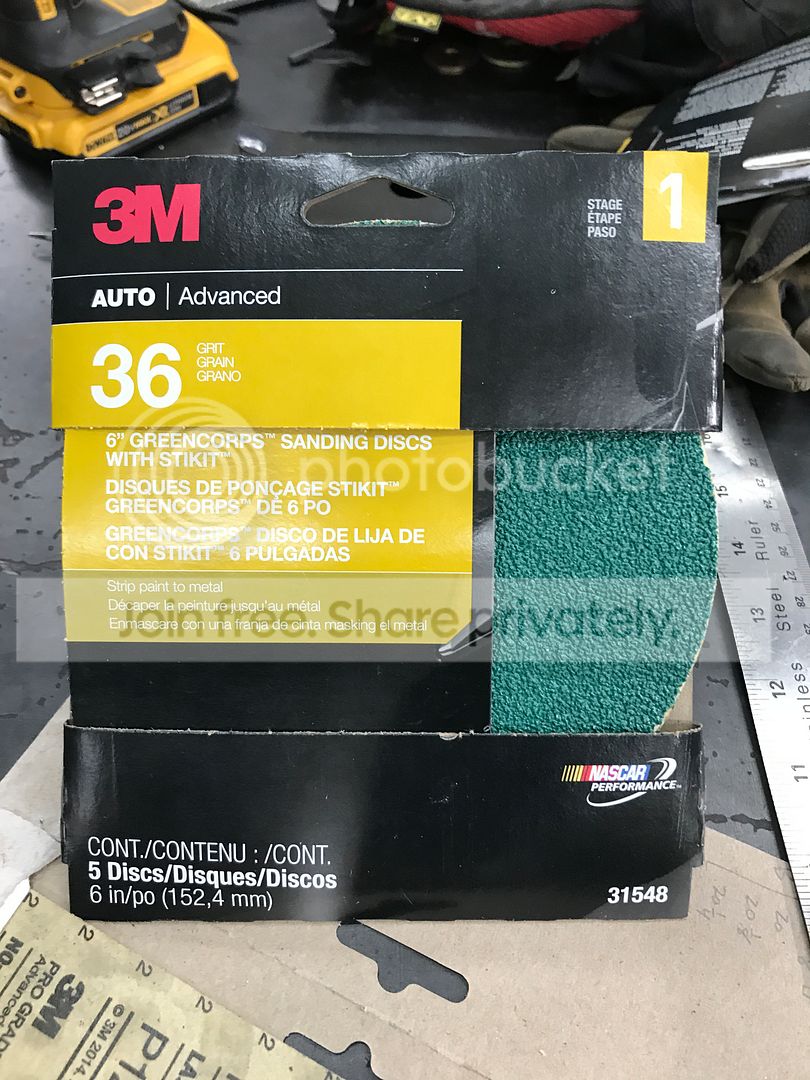
As luck would have it, my local autoparts store can get the 3M 36G discs (p/n #31548) I wanted more easily than Amazon.com

Ordered them in the morning and picked them up on the way home from work. The only complaint is that the 3M stuff is literally 3X more expensive than their "generic" store brand. ($3 each vs. $1 each). I expect that the durability of the 3M will make it the better value however.

IMG_6659.jpg


I was surprised at how rough the 36G felt initially (though I probably shouldn't have been)....and I was reluctant to start laying into my bedfloor with it. I messed around on some thicker frame stuff for a couple of minutes and the pad got a LOT more reasonable. I think that's the idea.... nobody really WANTS to use a 36G pad.... what they really want is the roughness that you get from a slightly-broken-in 36G pad..... which is probably more like a fresh 60G or 100G in reality. In any case, it feels like it's going to strike a nice balance between removing metal effectively and not being too aggressive and destroying my workpiece.

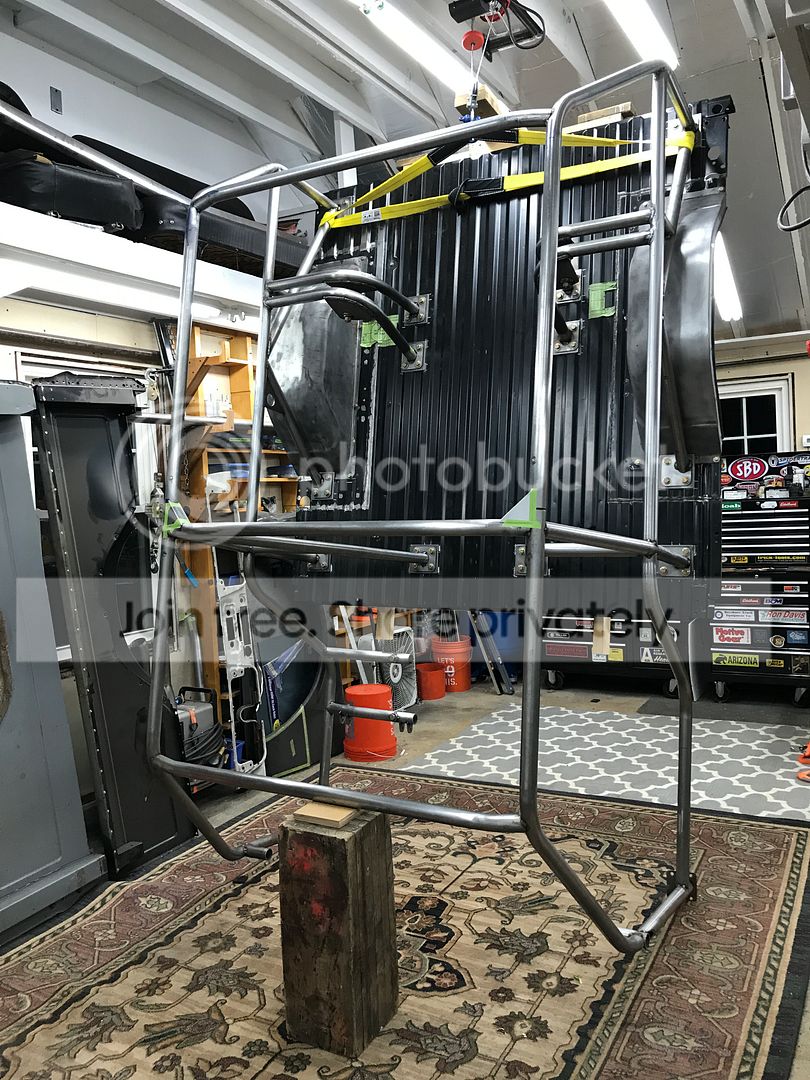
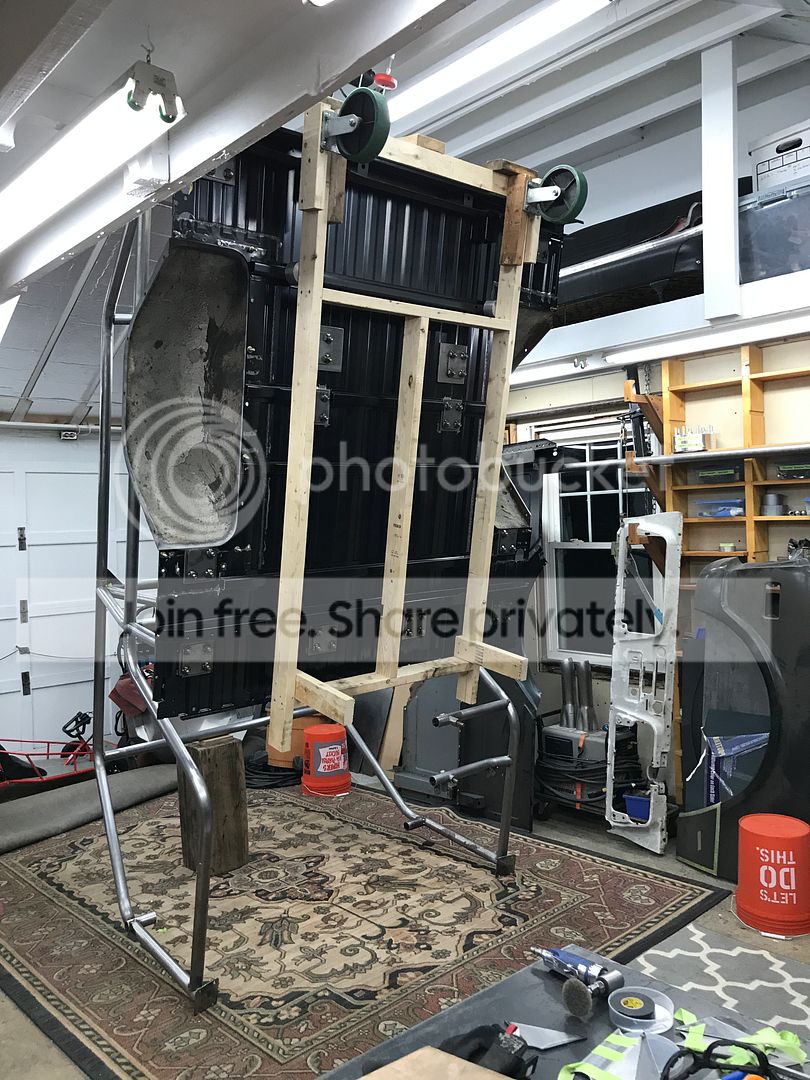
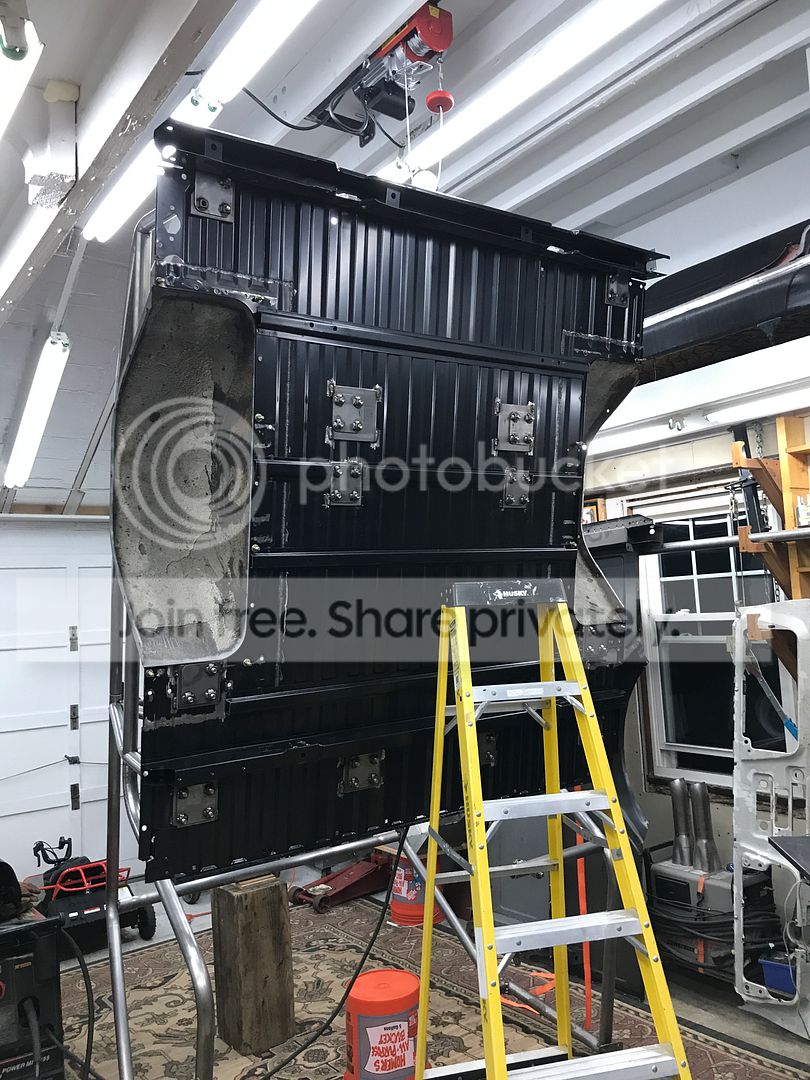
Used the ceiling hoist to flip my cage/floor assembly to get access to the underside:

IMG_6650_1.jpg


I'm glad all the welds held up!!! The cage is now fully tacked to the new cageplates and each location was squared-up and hit all the index marks that I'd scribed... so it is a very satisfying feeling to see how nice and symmetrical everything turned out. I still need to do all the final welding on the cage, but that will come in the next couple of weeks after I get it all pre-wired for the dome lights, backup camera and anything else that I can think of to "future proof" this 50-year old truck for the next 50 years! :)

The real motivation for the odd positioning was to get access to Body Mount #5 on the back side.

IMG_6652.jpg


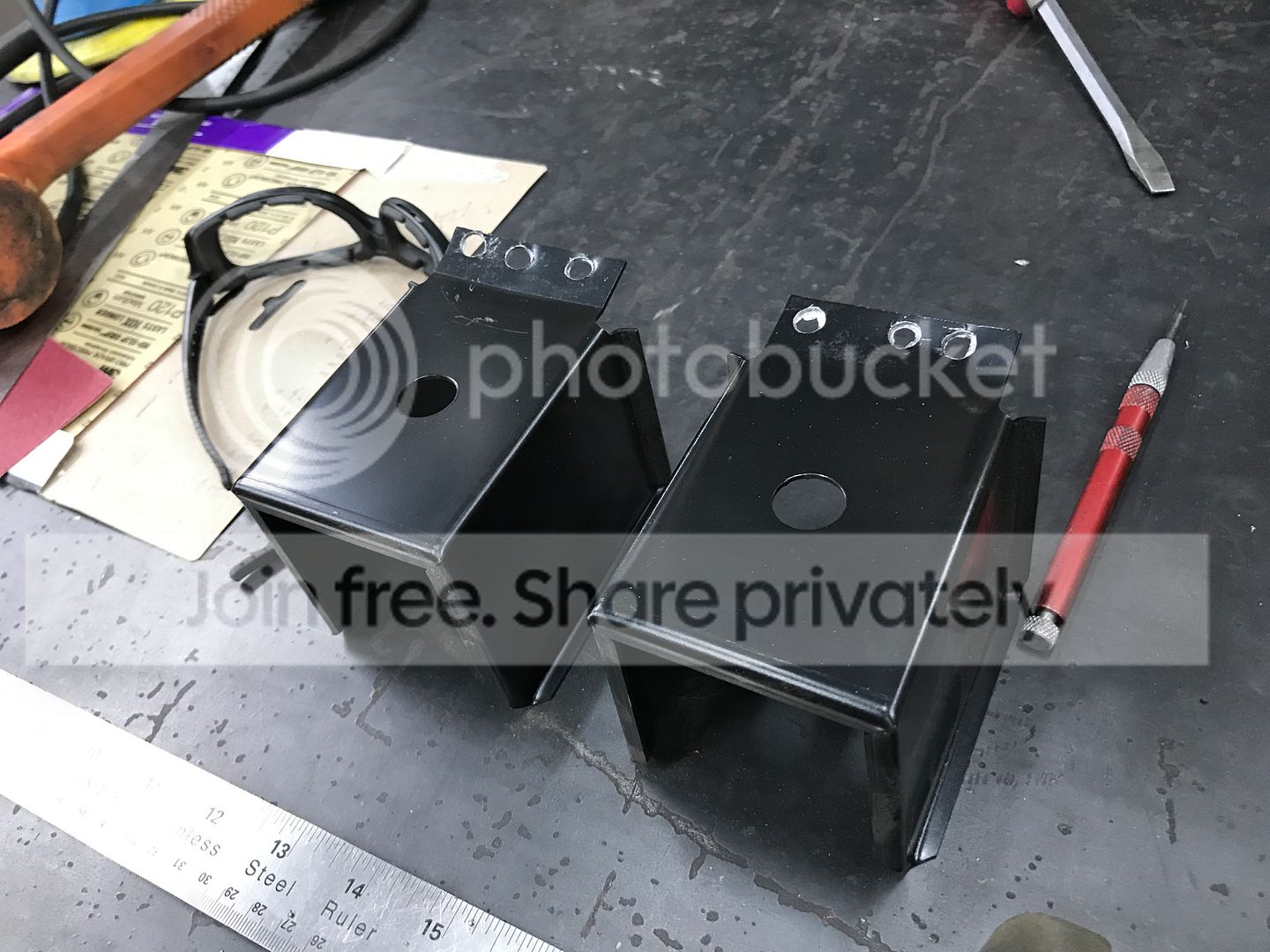
The #5 position is very close to the rear cross sill and with the new frame and custom cross-sill design the small "box structures" on the factory floor are actually going to be in the way... so the spot welds are being carefully drilled-out so they can be removed cleanly. Some other 1st Gen guy may end up needing these....so there's no point in destroying them.

IMG_6654.jpg


So..... a bit more frame cleanup with the DA... some quick plating of the strut mount pads and everything should be ready when the weather is nice again. The truck can roll out of the garage and snuggle back underneath the rollcage/bedfloor assembly... and it can be joined back together to confirm that everything fits properly. :waytogo:

Then..... weld in the small spuds from the top of the framerail to the underside cageplates, and cut the through-holes for the rear struts so that they can finally be re-installed to support the weight of the truck.


-G
 
Good to see progress again on this.


Also.... I set 5 mousetraps with peanut butter around the garage, since I had a visitor run right across the floor in front of me a couple nights ago.

Forgot to share that part initially.


-G
 
I still need to do all the final welding on the cage, but that will come in the next couple of weeks after I get it all pre-wired for the dome lights, backup camera and anything else that I can think of to "future proof" this 50-year old truck for the next 50 years! :)

Any concerns about pre-wiring before final welding? Seems like you'd be running the risk of melting wires. :thinking:
 
Any concerns about pre-wiring before final welding? Seems like you'd be running the risk of melting wires. :thinking:

Not really.... the chase tube goes in before the final welding and I'll push the wires through just to confirm that it will be easy to get everything routed....then pull the wires back out. It will be better not to have dangly wires hanging out all over the cage when it's being painted anyway.... less stuff to tape up and try to keep out of the wet paint.

-G
 
gotcha. I thought you were planning on leaving the wires in.

It's nice to see you talking about final welding and paint. Getting closer!
 
For the lighting, the 4000k area gives you the most useable light. 5000 has an odd grayer quality that is only noticable if you go from an area lit with one color to the next. And a little hint that eludes most all LED light manufacturers is a frosted lens takes the bright BITE out of the bulb, and distributes the light way better. We've frosted a bunch of the ones we installed in our plant. You end up with a whole area lit instead of super bright in one spot and fading fast from there out.

those stikit discs...... I get those super cheap.... Overstock sales:waytogo:

IMG_20170504_000331.jpg
 
2017.05.08 - UPDATE!! - PREPARING TO MERGE...!!!


It's getting closer and closer..... :waytogo:

The objective in the next few days (as weather permits) is to get the truck moved back over to the left side of the garage and position it underneath the bedfloor / rollcage to merge the two parts back together.

That leaves a whole host of small(ish) tasks that need to be completed, so this weekend those got tackled and the results were quite gratifying.

Step 1: Frame Tweaks - There was a mysterious discrepancy in the rear most cross-sill that I could never figure out. For some reason, the cross sill seemed slightly "off" dimensionally, and visually there just seemed to be something not quite 100% square about the way it lined up with the framehorns. It took a while and a bunch of measurements but eventually the issue was discovered.
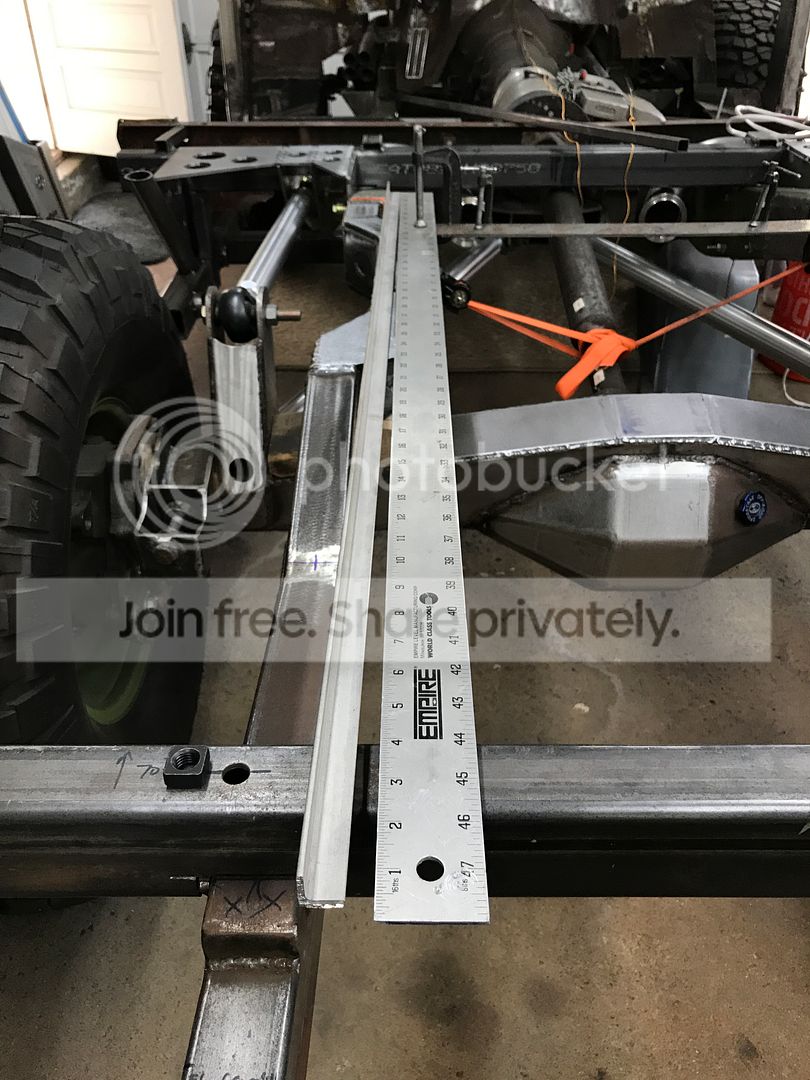
IMG_6697.jpg


The fabricated driver's side framerail had a small dimensional error where it was sleeved to the original factory frame. It's not clear whether this was due to the fitment in the sleeve itself, or perhaps some slight "puliing" of all the welded seams on the fabricated framerail, or even just slight error during the cutting and fitment of all those angled box sections. Clearly, even a very small error becomes a rather noticeable one when it is extended 4 feet down the framerail. By the time the frame and cross-sill intersected, the error was 1/2" which explained why the rear cross-sill never seemed to fit well.

The solution was obvious, but unfortunately was a rather big PITA.... A vertical slice was needed in the first bend joint to allow the framerail to be pulled inward by 1/2" where it could then be re-welded to make the rear framerails 100% parallel. The problem was that the vertical joints had all been fishplated with a full-perimeter weld (and a large interior hole for an extra plug-weld), so the repair would require that the entire plate be removed first....
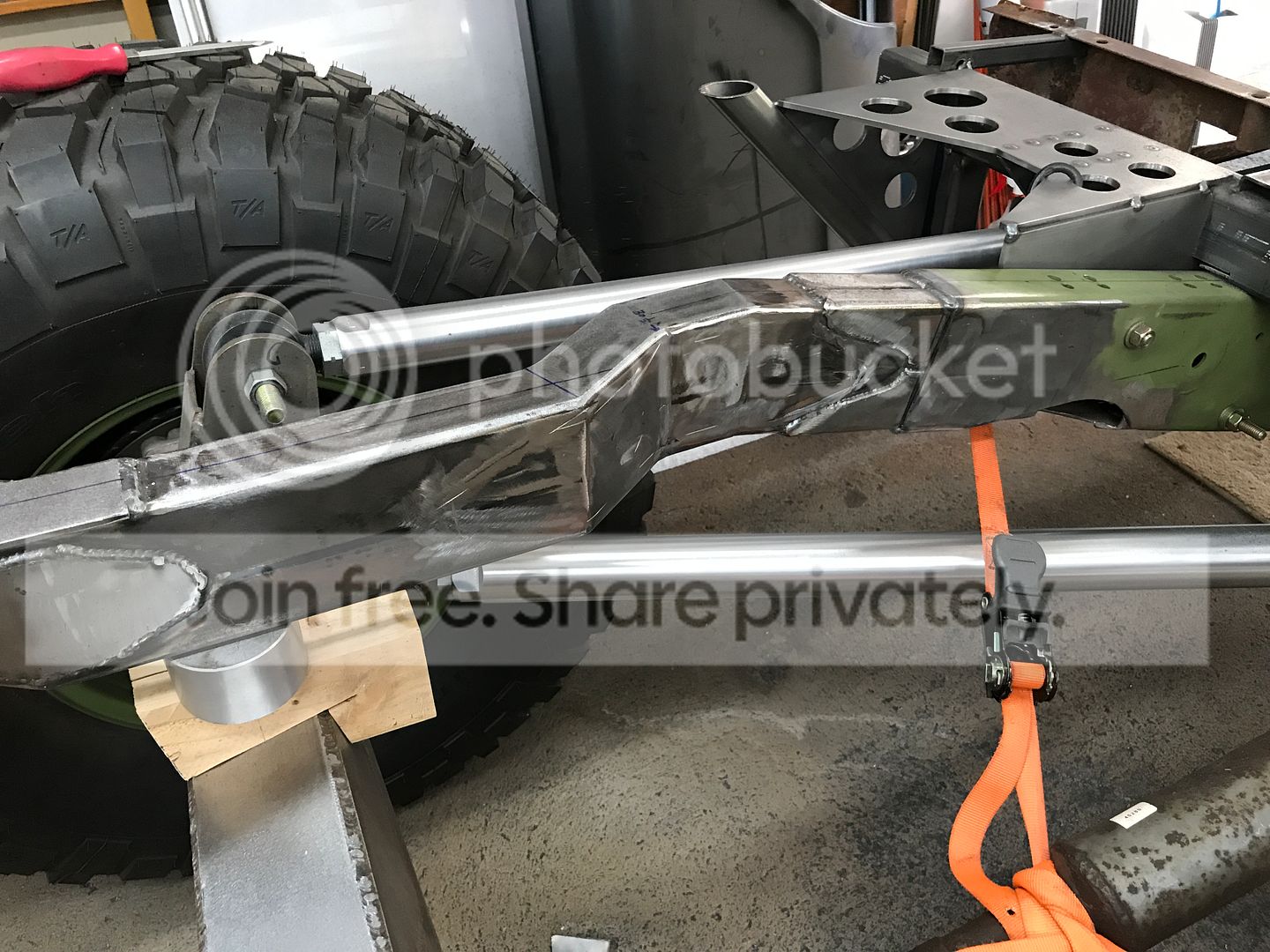
IMG_6700_1.jpg


What a pain. Cutoff wheel all the way around the fishplate, roughly 1/4" inside of the original welds allowed the plate to be separated slowly and carefully....leaving behind a massive amount of old weld to be flapwheeled down flush again. Once that was complete, the vertical cut was made and the framerail was gently guided into the new correct position and the seam was welded back up. Now the only thing left is an "I.O.U" for a new fishplate... (fortunately, I have a LARGE plastic bin full of all my original paper templates, so making a new plate won't take much time) :)

The resulting opening is nice, square and the rear cross-sill finally fits the way it was always supposed to. :waytogo: Time to move on.

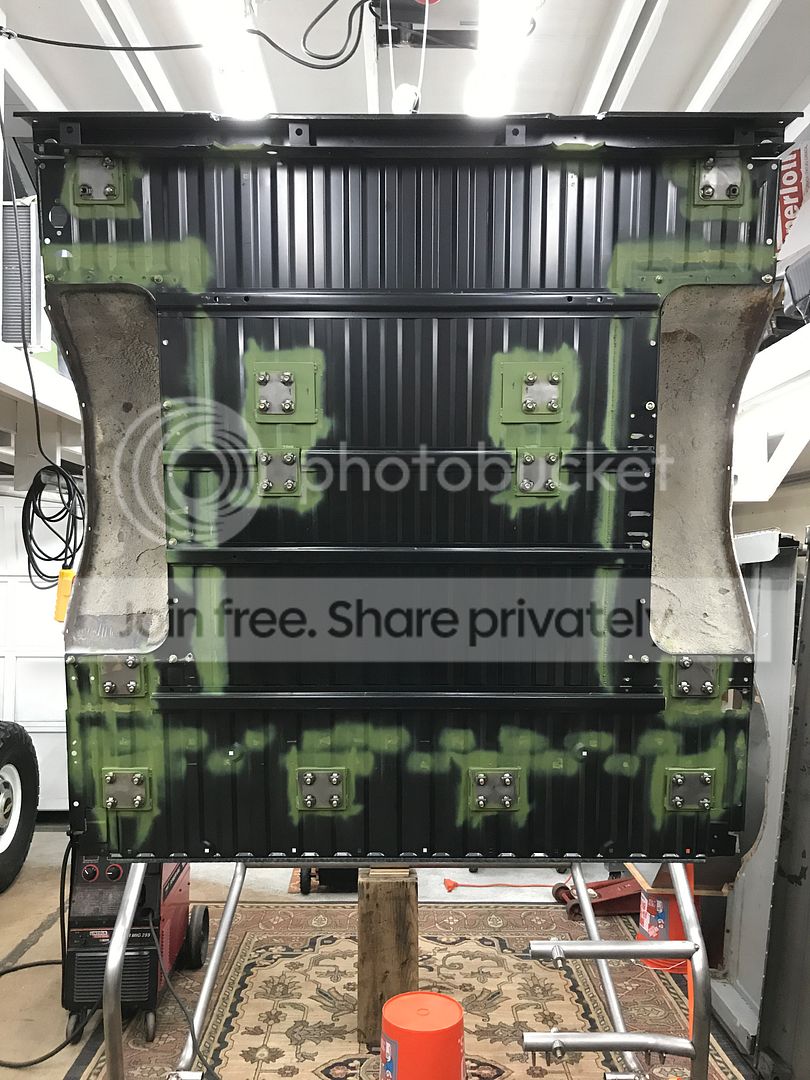
The bedfloor needed some work on the underside, mainly to have all of the permanent convoluted plates stitch-welded to the bedfloor so that they will stay in place when things are unbolted. Unfortunately, when they were first installed, I neglected to clean off the EDP paint and I knew it would contaminate any welding that I tried to do... so systematically each plate was unbolted, then the area around the plate (and slightly underneath each edge) was carefully cleaned to bare metal... then the plates were reattached and welded up. Lather, rinse, repeat, 12 times. :yikes: As part of this process the familiar wooden dolly and large green casters were unbolted from the bedfloor to give better access to the various plates... and it served as a good reminder that this assembly isn't going to be rolled around and stored in the corner anymore (it HAS been almost 1 year since it was purchased)

IMG_6703.jpg


A lot of time is spent comparing the two large pieces of this build lately. During that process last night, I noticed an important interference that wasn't previously an issue. When the new rear frameside upper link mounts were built to provide clearance for the exhaust routing.... the large speedholed top plate encroached in the area where the #3 Body Mount cross-sill would normally land. With the original link mount this area was wide open... but now clearly it was not going to work. So all the the spot welds were marked and centerpunched... then carefully drilled-out to remove the cross-sill.
IMG_6705.jpg


As it turns out, there is plenty of support for the bedfloor directly next to this location anyway. All four of the B-pillar cage points land on a new cross sill in that same area, so having the factory cross-sill wasn't doing anything useful in that area anymore. With the cross-sill removed, it was time to dress down the sharp edges and give all the exposed metal a quick mist-coat of Ryoken Green to keep everything rust-free.

(In this image, you can see all the paint touchups near the bottom where the crosssill was removed, and the lower 4 plates where the B-pillar tubes are landing)

IMG_6709_1.jpg


So..... That just about wraps up the bedfloor prep for now. Tonight the next process steps will be to fab-up that fishplate and at least get it tacked into place.... then add a couple of small vertical supports under the frameplates where the rear strut tubes land. (Those tabs will probably also end up being great locations to add exhaust hangers to support the rear section of the exhaust)... Re-install the fuel tank to confirm that I didn't just screw up the clearances by re-squaring the framerails (fingers crossed!!!)..... and if the rain holds off, maybe get the truck re-assembled and see what it looks like for the first time with a complete rear bedfloor!! :waytogo:


-G
 
No word on the mouse hunt?....I also noticed one of the above picts didn't have a HD bucket in it..I hope they don't drop your sponsorship because of it.
 
The bedfloor needed some work on the underside, mainly to have all of the permanent convoluted plates stitch-welded to the bedfloor

corrugated? I don't think anything on this build could be described as convoluted.... perhaps how you arrive at a design, but not as its finished product.
 

Latest Posts

Top Bottom