CK5
Register an account today to become a member! Once signed in, you'll be able to participate on this site by adding your own topics and posts, as well as connect with other members.
You're definitely venturing into new skill territory. This is stuff I'd never really considered before. Can't wait to see more!


For sure.... it takes a lot of patience to slow down the build (again) to learn a new skill but ultimately, the MAW build is really as much about the journey as it is the final destination.

I've admired the old-school metalworking guys and their skills for along time but never really had a compelling enough reason to dive into it until now.... this gives me a chance to learn something completely new, develop some new skills and hopefully create some fun content here at CK5.com that people will enjoy seeing.


-G
 
2021.02.08 - UPDATE - !! WELCOME TO THE METAL DOME !!

School is in session in the MAW garage, and the tuition has been hard....

This update started last weekend, but there was so little progress that it was embarrassing to even post the photos. Today was a bit better and it appears that when it comes to metalshaping, I've finally paid enough "tuition" to understand how to make things happen.

Here's how it started and what I've learned so far....

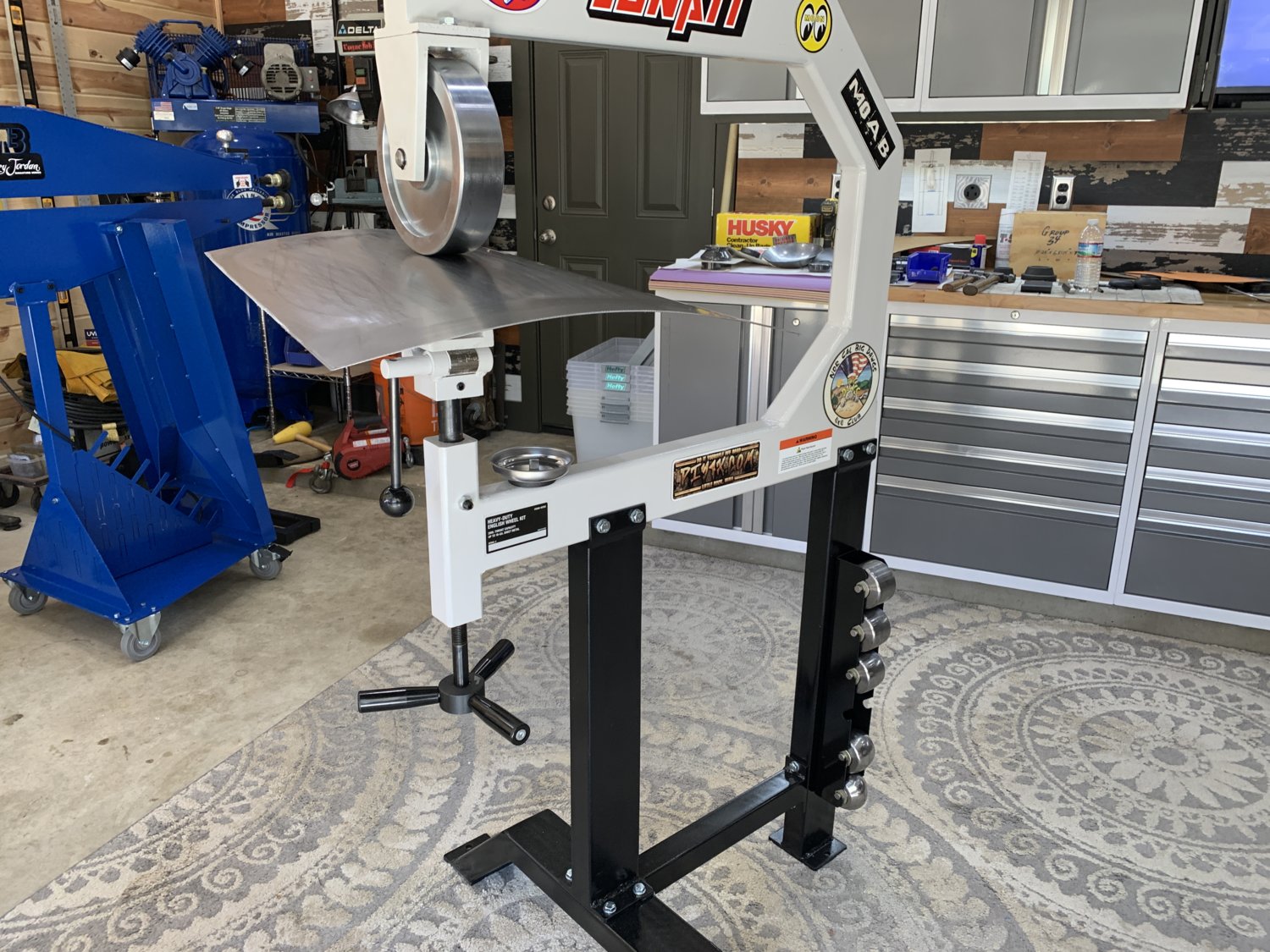
Started on the wheelwheel shape trying to make a sheetmetal version on the wireframe model that was already built. Cut a good sized sheet of 16GA (.060") and starting running it through the English Wheel.
So far...so good... it's easy to get the initial compound curve going especially when it's only a low-crown part that needs to be built.

full


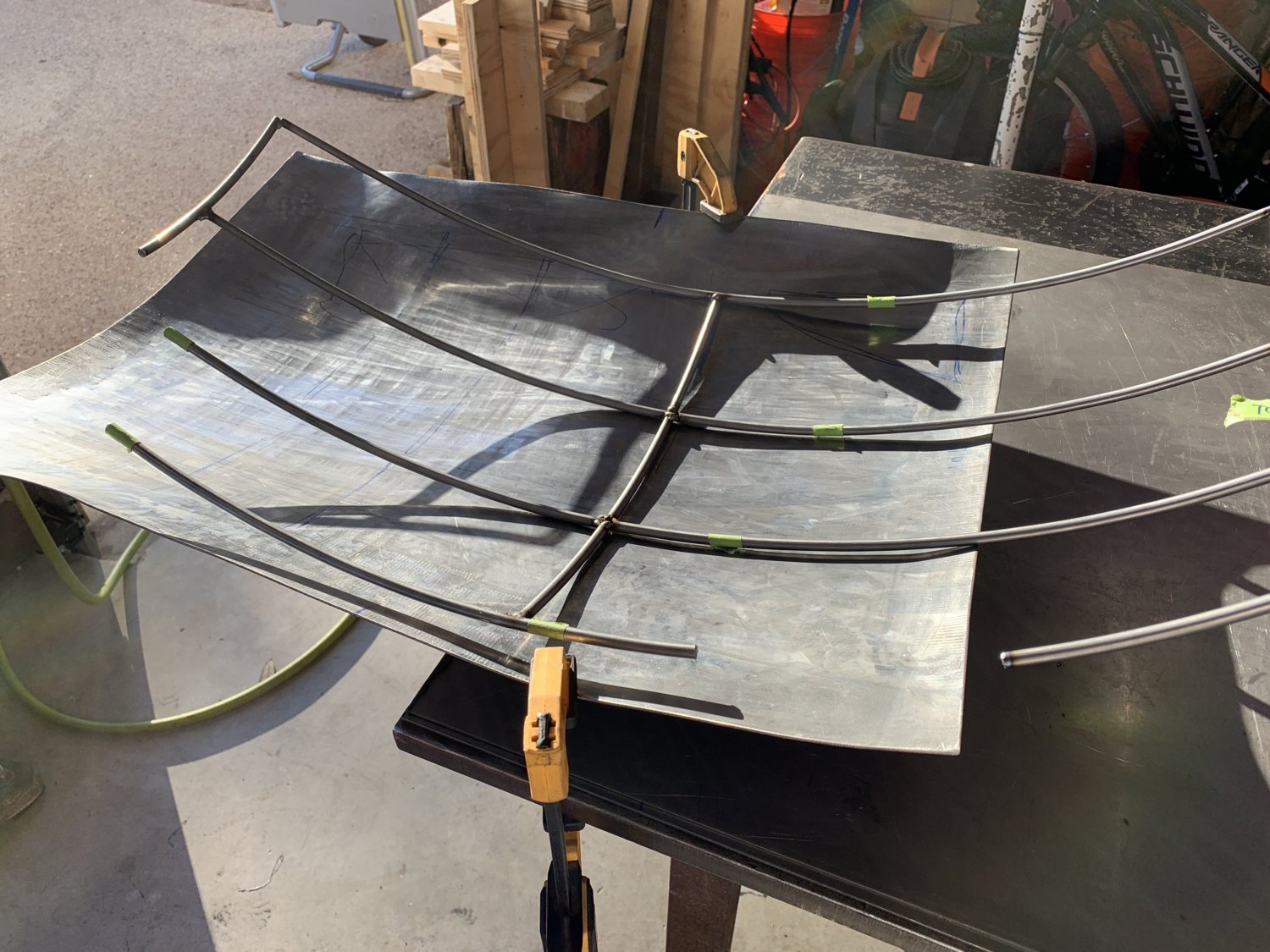
The problem is, that the footwell is NOT a low-crown part. It's a very high-crown part and that means that a LOT of stretching needs to happen in the center of the panel to get that strong curve that is needed.
After literally HOURS of wheeling back-and-forth and focusing lots of enery in the center of the panel, this is best that could be accomplished.

full


Being able to read the metal is definitely a skill.... from this image all that I wanted to do initially was figure out a way to shrink the perimeter so that the metal would curl up more and touch the wires. But that is easier said than done.
Some of the YouTube videos indicated that this entire panel could be rendered with only English Wheel... no shrinking. So I was determined to figure out what I was doing wrong.

LESSON 1: 16GA is stiff as hell

You don't just casually do metal shaping with 16GA... a lot of the videos are of guys working in either 19GA or 20GA metals and THAT gives a really unrealistic perspective of how easily the metal will stretch and move into the desired crown.
If you want to do the entire shape using only a wheel on 16GA, it is going to take forever.

LESSON 2: Use a combination of techniques (including a BFH)

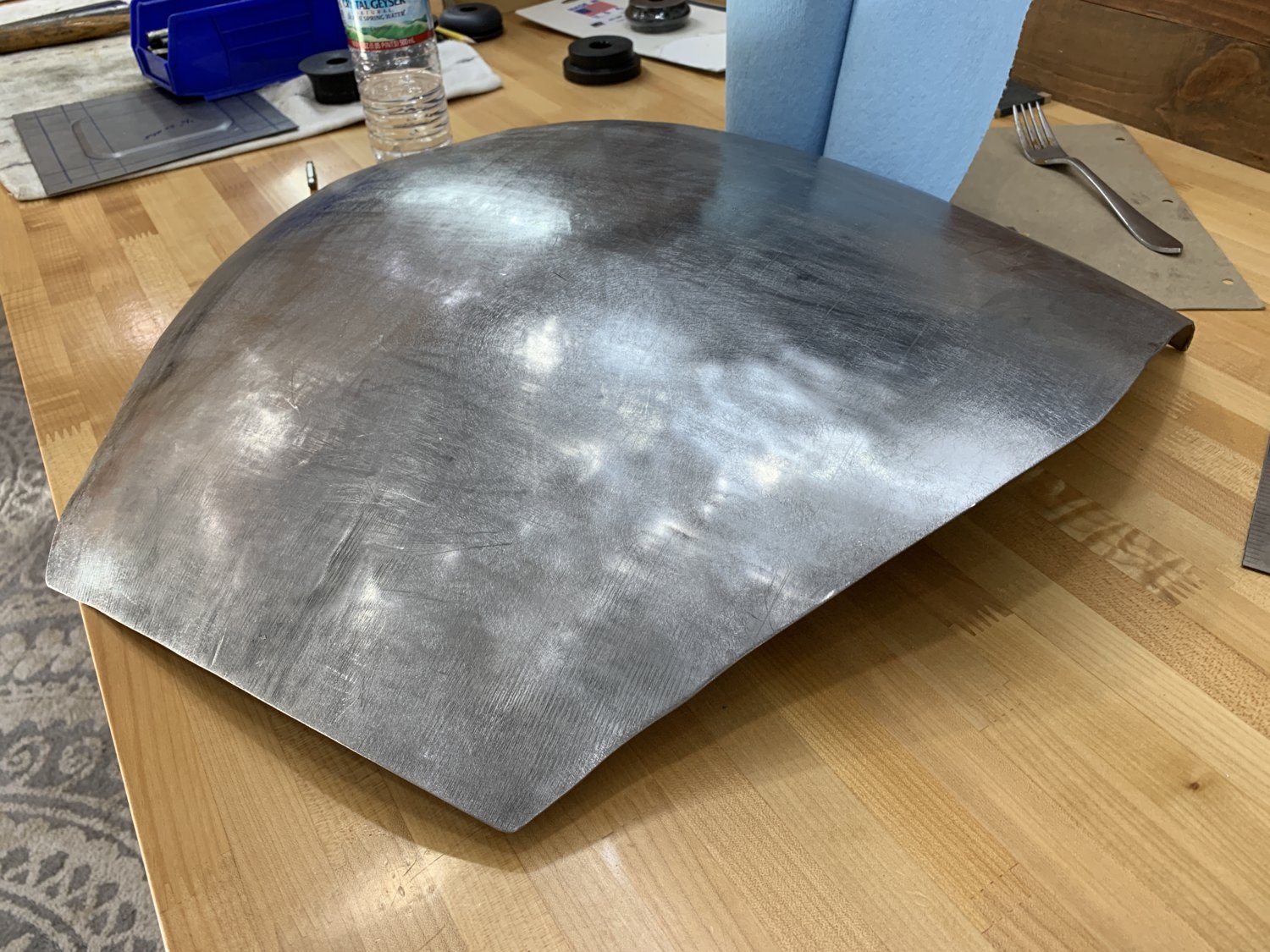
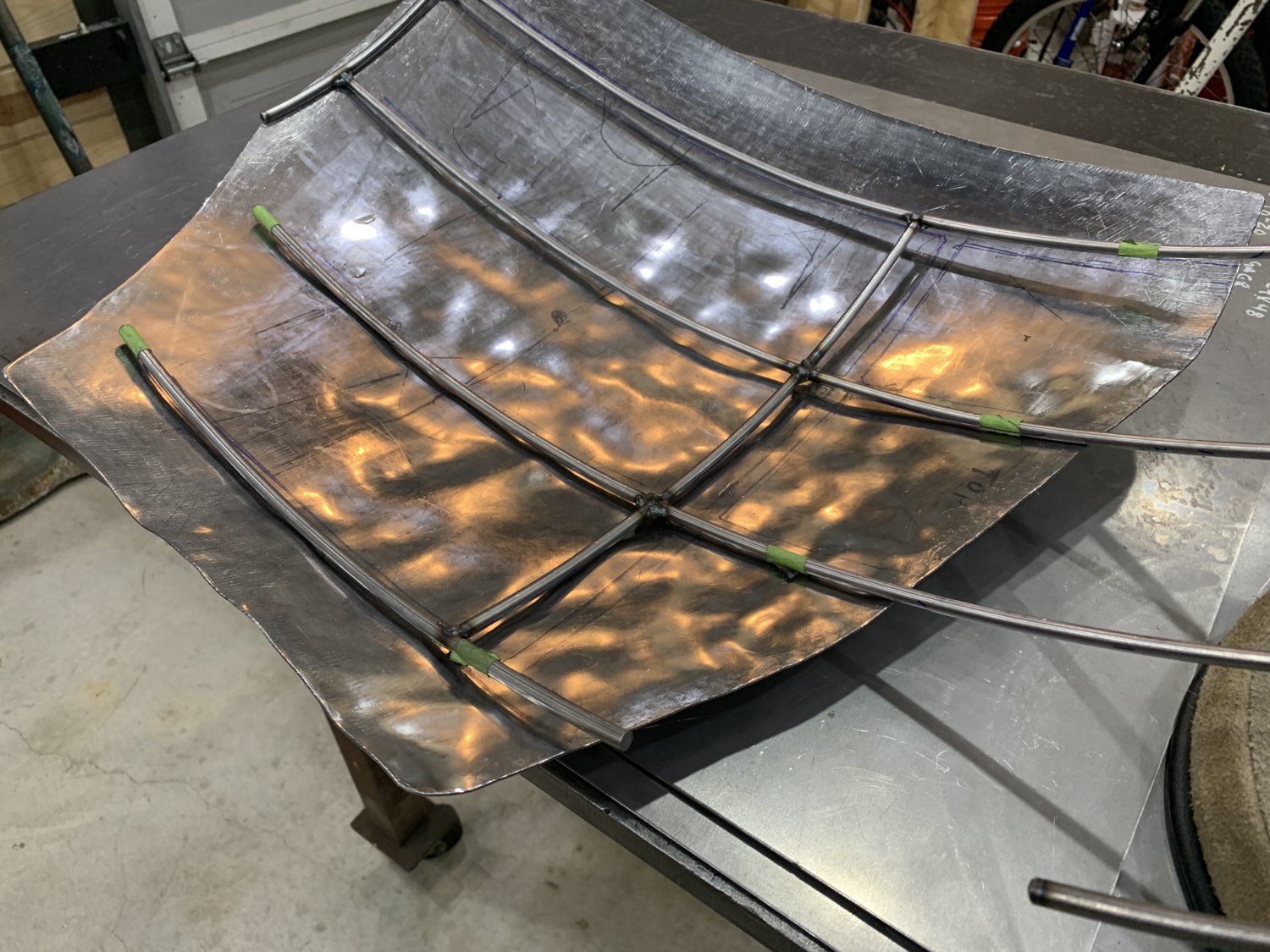
After a lot of study, I realized that the biggest problem was that the metal in the center just didn't have enough "area value" for the crown that was needed. The only way to get the perimeter areas to come UP was actually to work the CENTER of the panel........A LOT!!! Out of desperation, the shot bag and mallets came out and a ton of hammer blows were made in the center to create that "bag of walnuts" look that makes you think you've ruined the panel forever. Even then, trying to dent 16GA in any meaningful way took a lot of power and after a couple hours of that my arms were completely spent.

You can see the walnut pattern in the reflections along the right side of this part... But you can also see how high the crown of this panel has become!!!

full


LESSON 3: Stretch it where it touches the wires

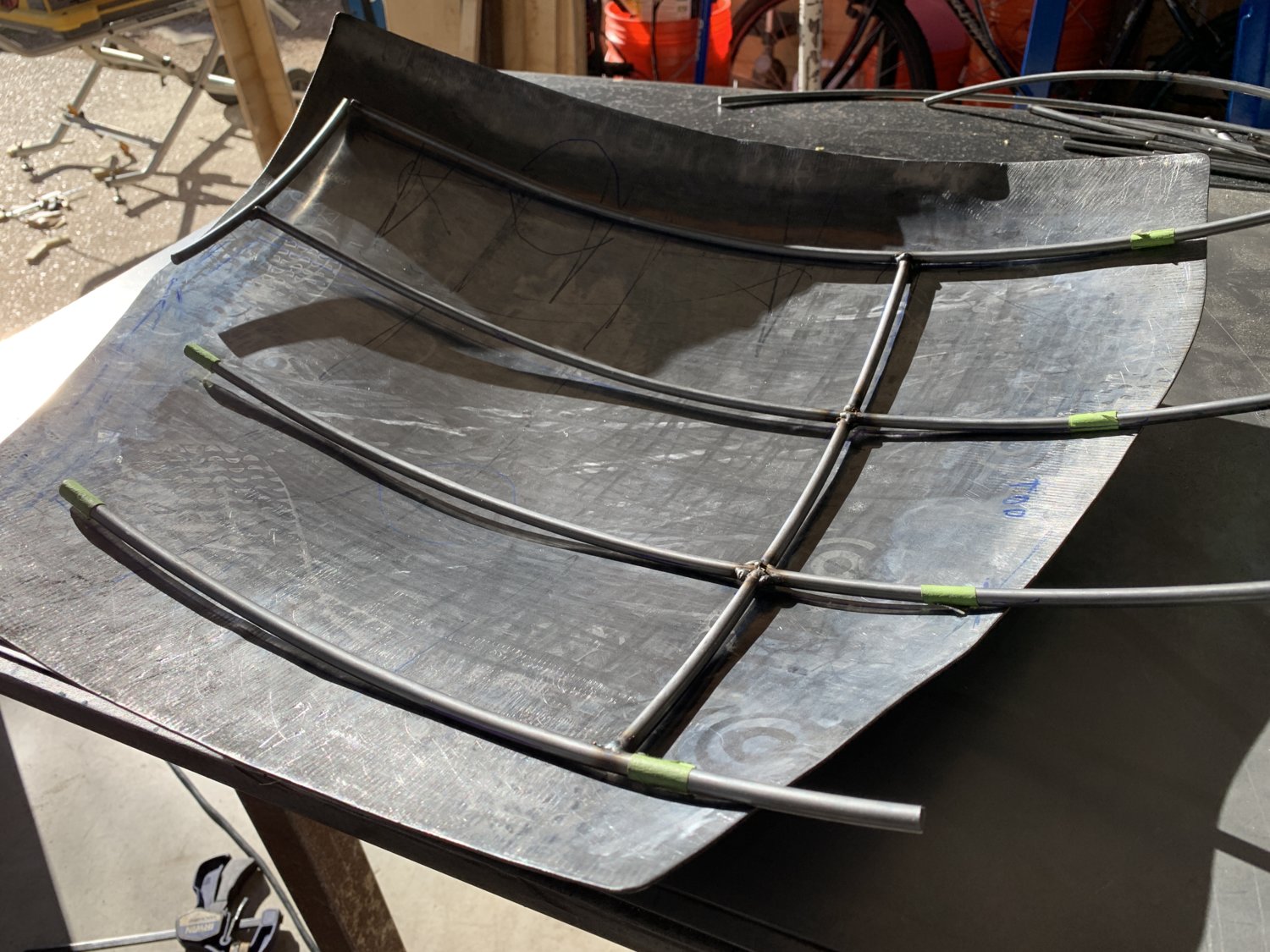
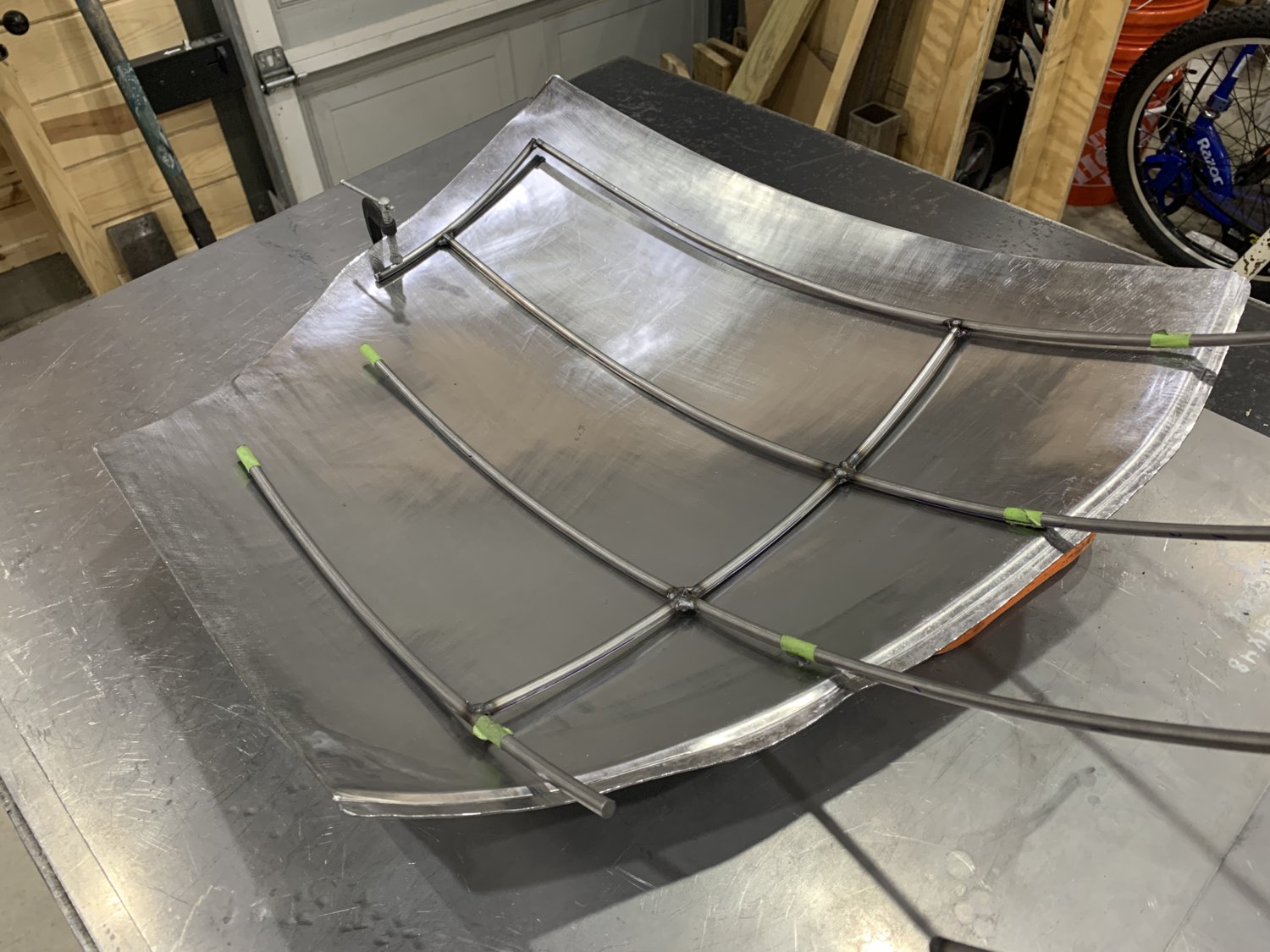
It seems so backward to keep working the metal in the areas where you finally got the sheetmetal to touch the wireframe, but ultimately, the gaps everywhere else are just telling you that the overall crown is just not high enough and needs to be developed more. Once this was understood more clearly.... a steady combination of strong hammerblows, and walnut-smoothing on the English Wheel brought the project to a pretty nice shape by the end of today.

full


There is a little more work to do in the upper part of the photo to bring that last corner up, and some general cleanup and refining of the crown shape overall to make it more uniform but overall the shape is pretty close to what is needed.

This one little panel is about 10 hours of labor as it sits here.... clearly, most of that was just learning about the English Wheel... making mistakes and wasting time trying to wheel really thick sheetmetal when I should have been beating the crap out of it with a hammer to get a crude shape into the part instead. But ultimately, that is how it goes when you don't have any experience and are trying to learn something new.

It was cool to test-fit this panel up in the footwell and see that it truly is following the curve that is needed and clears the tire everywhere. It's going to be really fun getting it installed and then start building the adjacent panels on the firewall and floor that connect to this one. And mercifully, they are much simpler parts... not even compound curves... so it looks like as usual, I jumped into the deep end right away. Might As Well.... :)


-G


2021.02.08 - UPDATE - !! WELCOME TO THE METAL DOME !!

School is in session in the MAW garage, and the tuition has been hard....

This update started last weekend, but there was so little progress that it was embarrassing to even post the photos. Today was a bit better and it appears that when it comes to metalshaping, I've finally paid enough "tuition" to understand how to make things happen.

Here's how it started and what I've learned so far....

Started on the wheelwheel shape trying to make a sheetmetal version on the wireframe model that was already built. Cut a good sized sheet of 16GA (.060") and starting running it through the English Wheel.
So far...so good... it's easy to get the initial compound curve going especially when it's only a low-crown part that needs to be built.

full


The problem is, that the footwell is NOT a low-crown part. It's a very high-crown part and that means that a LOT of stretching needs to happen in the center of the panel to get that strong curve that is needed.
After literally HOURS of wheeling back-and-forth and focusing lots of enery in the center of the panel, this is best that could be accomplished.

full


Being able to read the metal is definitely a skill.... from this image all that I wanted to do initially was figure out a way to shrink the perimeter so that the metal would curl up more and touch the wires. But that is easier said than done.
Some of the YouTube videos indicated that this entire panel could be rendered with only English Wheel... no shrinking. So I was determined to figure out what I was doing wrong.

LESSON 1: 16GA is stiff as hell

You don't just casually do metal shaping with 16GA... a lot of the videos are of guys working in either 19GA or 20GA metals and THAT gives a really unrealistic perspective of how easily the metal will stretch and move into the desired crown.
If you want to do the entire shape using only a wheel on 16GA, it is going to take forever.

LESSON 2: Use a combination of techniques (including a BFH)

After a lot of study, I realized that the biggest problem was that the metal in the center just didn't have enough "area value" for the crown that was needed. The only way to get the perimeter areas to come UP was actually to work the CENTER of the panel........A LOT!!! Out of desperation, the shot bag and mallets came out and a ton of hammer blows were made in the center to create that "bag of walnuts" look that makes you think you've ruined the panel forever. Even then, trying to dent 16GA in any meaningful way took a lot of power and after a couple hours of that my arms were completely spent.

You can see the walnut pattern in the reflections along the right side of this part... But you can also see how high the crown of this panel has become!!!

full


LESSON 3: Stretch it where it touches the wires

It seems so backward to keep working the metal in the areas where you finally got the sheetmetal to touch the wireframe, but ultimately, the gaps everywhere else are just telling you that the overall crown is just not high enough and needs to be developed more. Once this was understood more clearly.... a steady combination of strong hammerblows, and walnut-smoothing on the English Wheel brought the project to a pretty nice shape by the end of today.

full


There is a little more work to do in the upper part of the photo to bring that last corner up, and some general cleanup and refining of the crown shape overall to make it more uniform but overall the shape is pretty close to what is needed.

This one little panel is about 10 hours of labor as it sits here.... clearly, most of that was just learning about the English Wheel... making mistakes and wasting time trying to wheel really thick sheetmetal when I should have been beating the crap out of it with a hammer to get a crude shape into the part instead. But ultimately, that is how it goes when you don't have any experience and are trying to learn something new.

It was cool to test-fit this panel up in the footwell and see that it truly is following the curve that is needed and clears the tire everywhere. It's going to be really fun getting it installed and then start building the adjacent panels on the firewall and floor that connect to this one. And mercifully, they are much simpler parts... not even compound curves... so it looks like as usual, I jumped into the deep end right away. Might As Well.... :)


-G


Looking good, it's taking shape (no pun intended). :D
 
2021.02.08 - UPDATE - !! WELCOME TO THE METAL DOME !!

School is in session in the MAW garage, and the tuition has been hard....


This update started last weekend, but there was so little progress that it was embarrassing to even post the photos. Today was a bit better and it appears that when it comes to metalshaping, I've finally paid enough "tuition" to understand how to make things happen.

Here's how it started and what I've learned so far....

Started on the wheelwheel shape trying to make a sheetmetal version on the wireframe model that was already built. Cut a good sized sheet of 16GA (.060") and starting running it through the English Wheel.
So far...so good... it's easy to get the initial compound curve going especially when it's only a low-crown part that needs to be built.

full


The problem is, that the footwell is NOT a low-crown part. It's a very high-crown part and that means that a LOT of stretching needs to happen in the center of the panel to get that strong curve that is needed.
After literally HOURS of wheeling back-and-forth and focusing lots of enery in the center of the panel, this is best that could be accomplished.

full


Being able to read the metal is definitely a skill.... from this image all that I wanted to do initially was figure out a way to shrink the perimeter so that the metal would curl up more and touch the wires. But that is easier said than done.
Some of the YouTube videos indicated that this entire panel could be rendered with only English Wheel... no shrinking. So I was determined to figure out what I was doing wrong.

LESSON 1: 16GA is stiff as hell

You don't just casually do metal shaping with 16GA... a lot of the videos are of guys working in either 19GA or 20GA metals and THAT gives a really unrealistic perspective of how easily the metal will stretch and move into the desired crown.
If you want to do the entire shape using only a wheel on 16GA, it is going to take forever.

LESSON 2: Use a combination of techniques (including a BFH)

After a lot of study, I realized that the biggest problem was that the metal in the center just didn't have enough "area value" for the crown that was needed. The only way to get the perimeter areas to come UP was actually to work the CENTER of the panel........A LOT!!! Out of desperation, the shot bag and mallets came out and a ton of hammer blows were made in the center to create that "bag of walnuts" look that makes you think you've ruined the panel forever. Even then, trying to dent 16GA in any meaningful way took a lot of power and after a couple hours of that my arms were completely spent.

You can see the walnut pattern in the reflections along the right side of this part... But you can also see how high the crown of this panel has become!!!

full


LESSON 3: Stretch it where it touches the wires

It seems so backward to keep working the metal in the areas where you finally got the sheetmetal to touch the wireframe, but ultimately, the gaps everywhere else are just telling you that the overall crown is just not high enough and needs to be developed more. Once this was understood more clearly.... a steady combination of strong hammerblows, and walnut-smoothing on the English Wheel brought the project to a pretty nice shape by the end of today.

full


There is a little more work to do in the upper part of the photo to bring that last corner up, and some general cleanup and refining of the crown shape overall to make it more uniform but overall the shape is pretty close to what is needed.

This one little panel is about 10 hours of labor as it sits here.... clearly, most of that was just learning about the English Wheel... making mistakes and wasting time trying to wheel really thick sheetmetal when I should have been beating the crap out of it with a hammer to get a crude shape into the part instead. But ultimately, that is how it goes when you don't have any experience and are trying to learn something new.

It was cool to test-fit this panel up in the footwell and see that it truly is following the curve that is needed and clears the tire everywhere. It's going to be really fun getting it installed and then start building the adjacent panels on the firewall and floor that connect to this one. And mercifully, they are much simpler parts... not even compound curves... so it looks like as usual, I jumped into the deep end right away. Might As Well.... :)


-G


That’s a really good start!
I use 16g for any panels I repair and yeah to make it shape is no fun. Any curves I have made where totally caveman style with a BFH.
I really can appreciate the time you are spending learning how to make it work!
What a work out you got going. :waytogo:
 
Looking good, it's taking shape (no pun intended). :D

....tonight was just like the old days when we'd work in my shop and realize we didn't have the right tool for the job, it was time for some shopping.
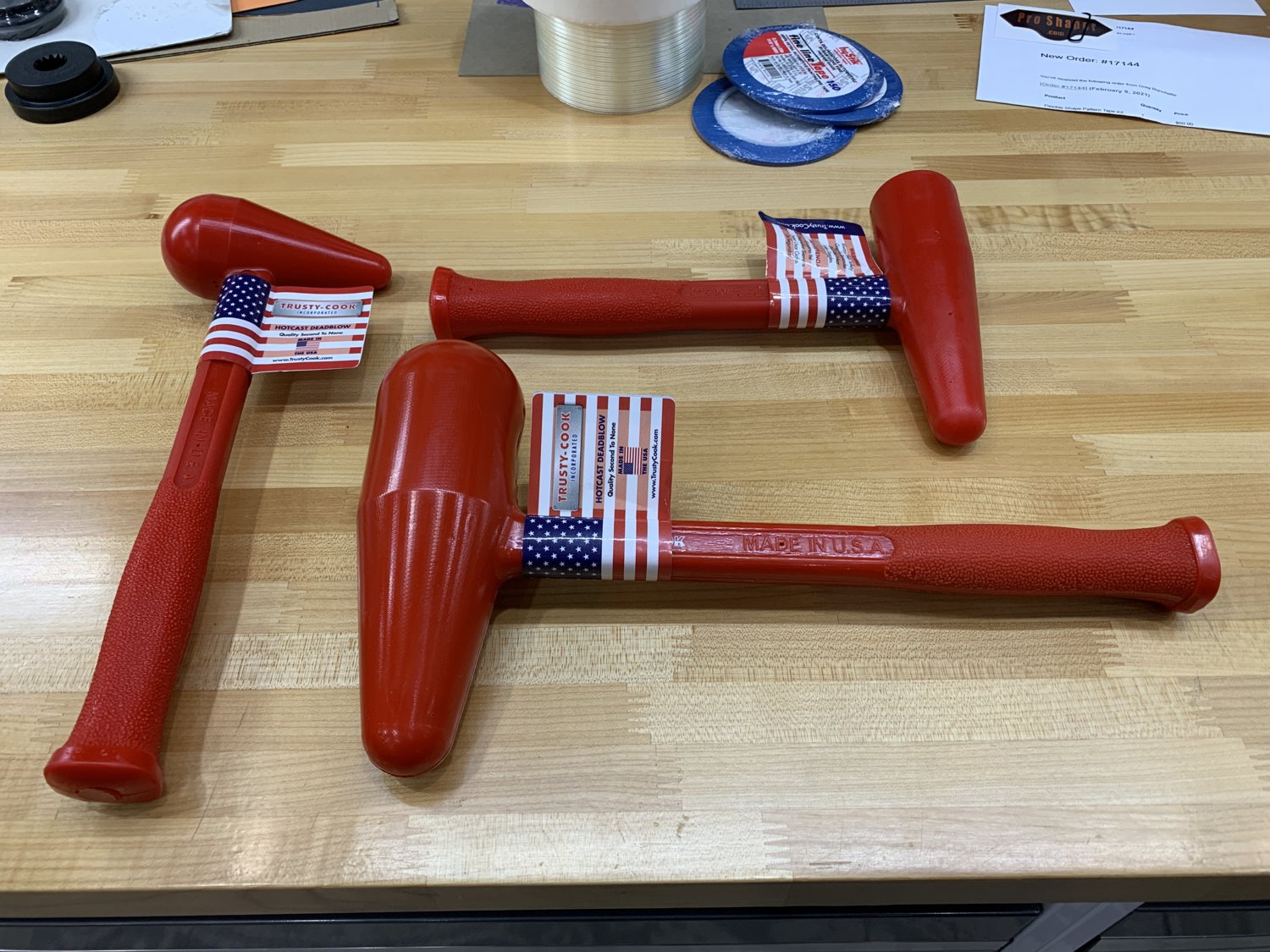
My aching arms will thank me for ordering up a new set of 3Lb deadblow bossing mallets. The ones in my shop are super light and barely move the metal. By the time I get to the driver's side footwell I'm going to be making some serious walnut patterns!!!

Truly outstanding.
Learning. Doing. Building.

David


Many props to you David, the full exhaust is a real labor of love and a work of art. I've enjoyed seeing that some together over the last several days.


-G
 
When I read 16 gauge at the beginning, I thought to myself, "that is some big material for a first time attempt. A lot of hammering will be needed."

You figured that out. Keep at it. The process will get better the more work you do. But the work still has to be done.
 
When I read 16 gauge at the beginning, I thought to myself, "that is some big material for a first time attempt. A lot of hammering will be needed."

You figured that out. Keep at it. The process will get better the more work you do. But the work still has to be done.

Yea as I was reading the first paragraph, I was thinking that he’d better get a big hammer out and get it started with that. Then in the next paragraph he had already figured it out.
 
2021.02.08 - UPDATE - !! WELCOME TO THE METAL DOME !!

School is in session in the MAW garage, and the tuition has been hard....

This update started last weekend, but there was so little progress that it was embarrassing to even post the photos. Today was a bit better and it appears that when it comes to metalshaping, I've finally paid enough "tuition" to understand how to make things happen.

Here's how it started and what I've learned so far....

Started on the wheelwheel shape trying to make a sheetmetal version on the wireframe model that was already built. Cut a good sized sheet of 16GA (.060") and starting running it through the English Wheel.
So far...so good... it's easy to get the initial compound curve going especially when it's only a low-crown part that needs to be built.

full


The problem is, that the footwell is NOT a low-crown part. It's a very high-crown part and that means that a LOT of stretching needs to happen in the center of the panel to get that strong curve that is needed.
After literally HOURS of wheeling back-and-forth and focusing lots of enery in the center of the panel, this is best that could be accomplished.

full


Being able to read the metal is definitely a skill.... from this image all that I wanted to do initially was figure out a way to shrink the perimeter so that the metal would curl up more and touch the wires. But that is easier said than done.
Some of the YouTube videos indicated that this entire panel could be rendered with only English Wheel... no shrinking. So I was determined to figure out what I was doing wrong.

LESSON 1: 16GA is stiff as hell

You don't just casually do metal shaping with 16GA... a lot of the videos are of guys working in either 19GA or 20GA metals and THAT gives a really unrealistic perspective of how easily the metal will stretch and move into the desired crown.
If you want to do the entire shape using only a wheel on 16GA, it is going to take forever.

LESSON 2: Use a combination of techniques (including a BFH)

After a lot of study, I realized that the biggest problem was that the metal in the center just didn't have enough "area value" for the crown that was needed. The only way to get the perimeter areas to come UP was actually to work the CENTER of the panel........A LOT!!! Out of desperation, the shot bag and mallets came out and a ton of hammer blows were made in the center to create that "bag of walnuts" look that makes you think you've ruined the panel forever. Even then, trying to dent 16GA in any meaningful way took a lot of power and after a couple hours of that my arms were completely spent.

You can see the walnut pattern in the reflections along the right side of this part... But you can also see how high the crown of this panel has become!!!

full


LESSON 3: Stretch it where it touches the wires

It seems so backward to keep working the metal in the areas where you finally got the sheetmetal to touch the wireframe, but ultimately, the gaps everywhere else are just telling you that the overall crown is just not high enough and needs to be developed more. Once this was understood more clearly.... a steady combination of strong hammerblows, and walnut-smoothing on the English Wheel brought the project to a pretty nice shape by the end of today.

full


There is a little more work to do in the upper part of the photo to bring that last corner up, and some general cleanup and refining of the crown shape overall to make it more uniform but overall the shape is pretty close to what is needed.

This one little panel is about 10 hours of labor as it sits here.... clearly, most of that was just learning about the English Wheel... making mistakes and wasting time trying to wheel really thick sheetmetal when I should have been beating the crap out of it with a hammer to get a crude shape into the part instead. But ultimately, that is how it goes when you don't have any experience and are trying to learn something new.

It was cool to test-fit this panel up in the footwell and see that it truly is following the curve that is needed and clears the tire everywhere. It's going to be really fun getting it installed and then start building the adjacent panels on the firewall and floor that connect to this one. And mercifully, they are much simpler parts... not even compound curves... so it looks like as usual, I jumped into the deep end right away. Might As Well.... :)


-G


Very nice work!
 
2021.02.16 - UPDATE!! - SNOWSTORMS IN AUSTIN, TX....


It was just like old times in NH this weekend....

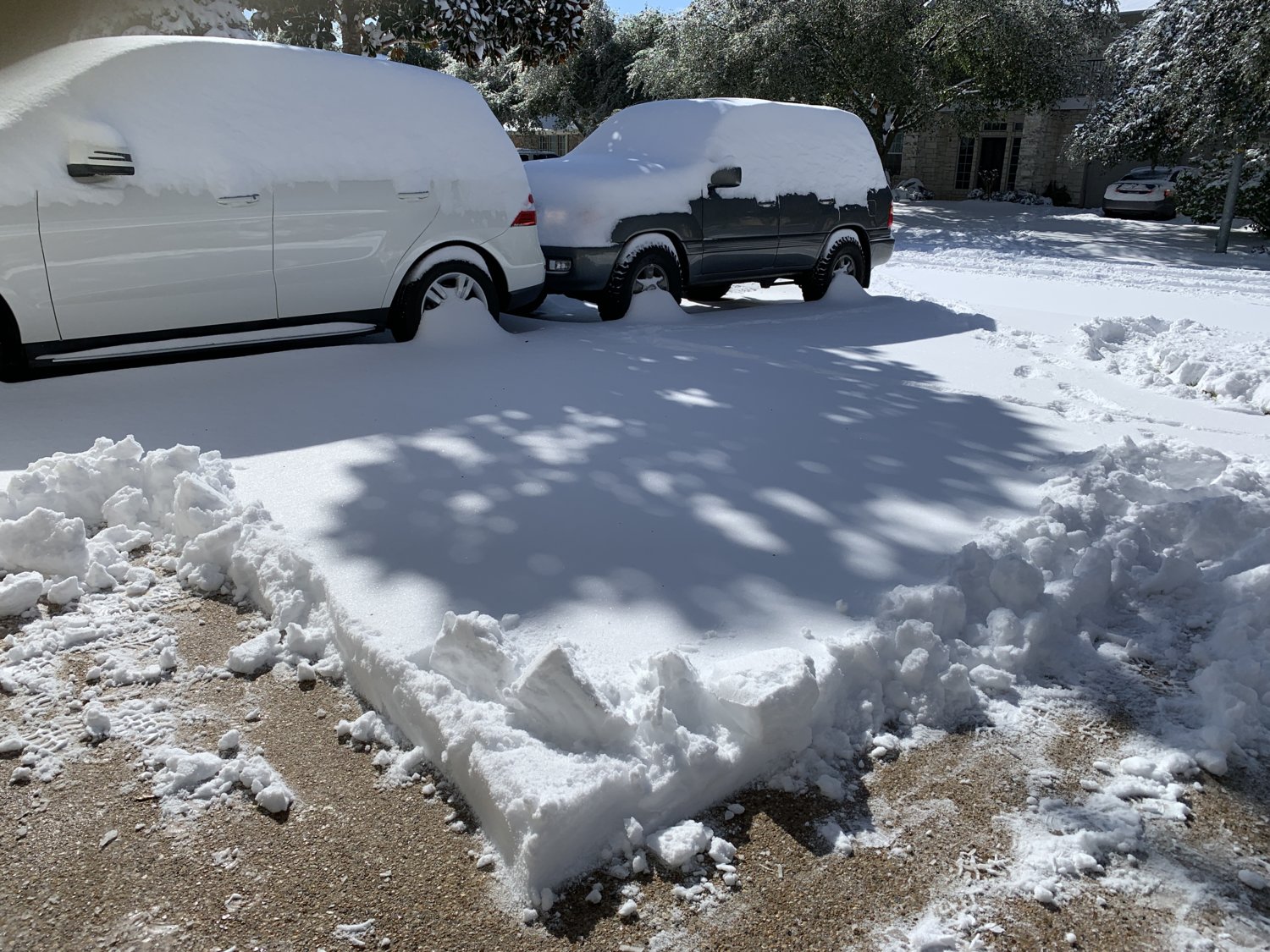
Woke up to 6" of fresh powder in the yard and driveway..... IN TEXAS!!! :yikes:

full


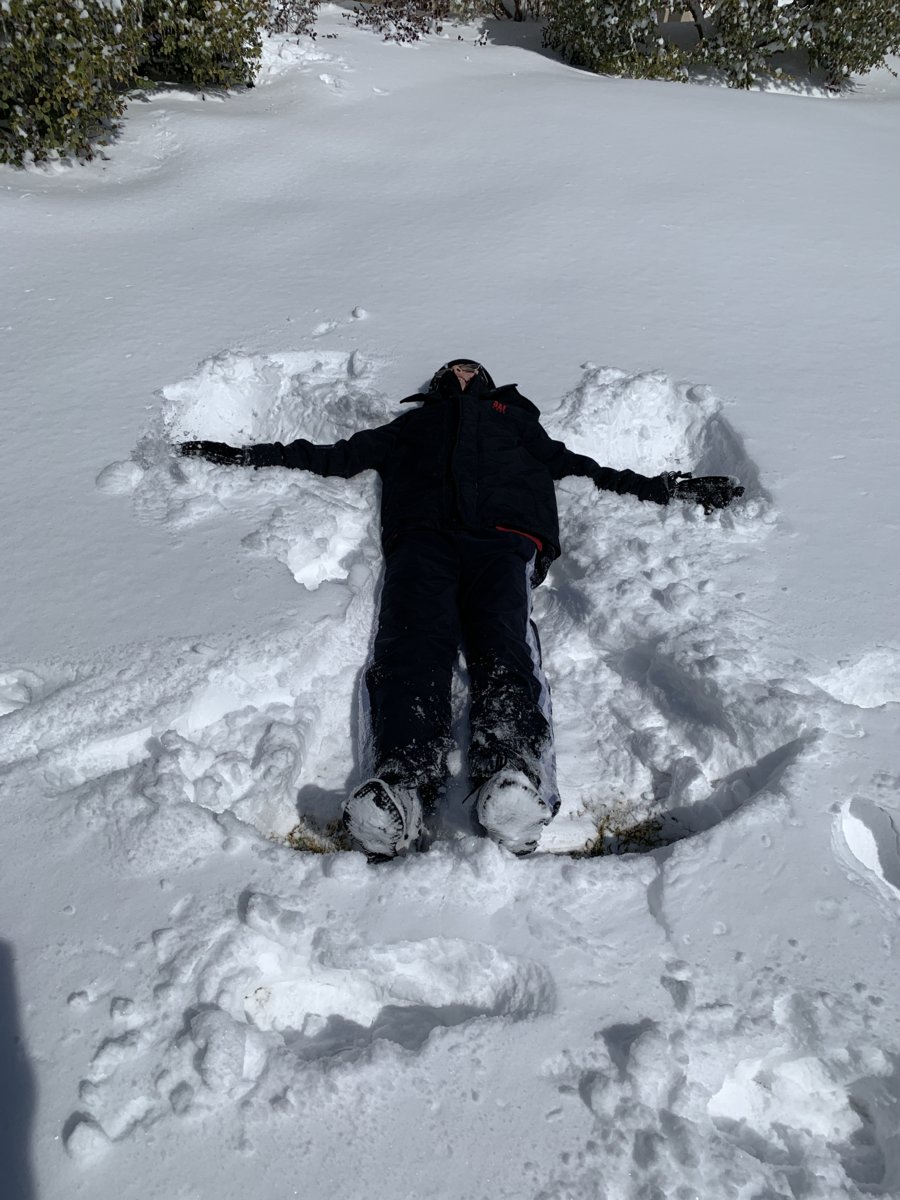
Charlie made the most of it though.... it was a nice trip down memory lane for him.

full


Fortunately, the recent orders placed for weekend progress arrived prior to the crazy weather... and it didn't matter that no snowplows were coming and that everyone was trapped indoors.

Because I had a new box of hammers! LOL

full


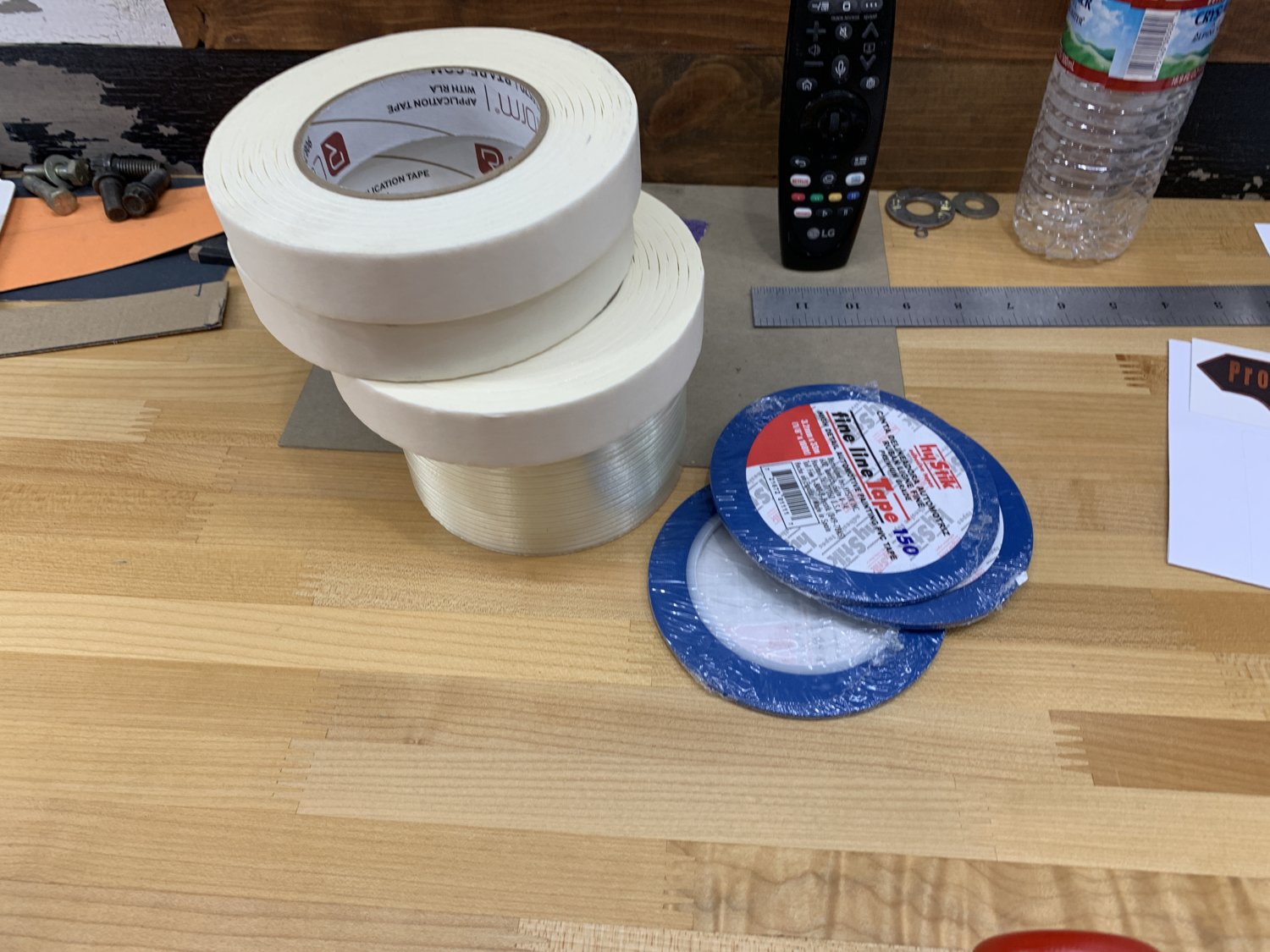
....and a new box of fancy "metalshaping" tape (for making Flexible Shape Patterns)

full


Once the driveway was shovelled, there wasn't really much to do which was a perfect excuse to go into the garage and log several more "tuition hours" developing my metalforming skills.

The new deadblow hammers made a pretty good difference, but I'm not going to lie.... it still takes a LOT of effort to make a dent big enough to truly stretch the metal in a meaningful way.

BEFORE:

full


AFTER: (probably 5 more hours spent on this panel)

full


The good news is that now I've got a perfect template for the driver's side... the tape will be applied to make a reversible pattern so that I don't have to use a wireframe model on the next one.

In the grand-scheme of metal shaping... the least preferable method is a wooden buck, followed by a wire-frame model.... with a flexible tape pattern being the best method. Wire frame wasn't ultimately that terrible, but it will be fun to see how much easier the flexible pattern is... and how much time can be shaved off from the 18 - 20 hours that were spent on this first one.


-G
 
Nice work Greg. Just remember, without a challenge there is no adventure, remember the adventure?

Yes.... I sure do.

This isn't "changing a bad waterpump in the dark on the side of the road" but it definitely is still an adventure... :)

-G
 
2021.02.16 - UPDATE!! - SNOWSTORMS IN AUSTIN, TX....


It was just like old times in NH this weekend....

Woke up to 6" of fresh powder in the yard and driveway..... IN TEXAS!!! :yikes:

full


Charlie made the most of it though.... it was a nice trip down memory lane for him.

full


Fortunately, the recent orders placed for weekend progress arrived prior to the crazy weather... and it didn't matter that no snowplows were coming and that everyone was trapped indoors.

Because I had a new box of hammers! LOL

full


....and a new box of fancy "metalshaping" tape (for making Flexible Shape Patterns)

full


Once the driveway was shovelled, there wasn't really much to do which was a perfect excuse to go into the garage and log several more "tuition hours" developing my metalforming skills.

The new deadblow hammers made a pretty good difference, but I'm not going to lie.... it still takes a LOT of effort to make a dent big enough to truly stretch the metal in a meaningful way.

BEFORE:

full


AFTER: (probably 5 more hours spent on this panel)

full


The good news is that now I've got a perfect template for the driver's side... the tape will be applied to make a reversible pattern so that I don't have to use a wireframe model on the next one.

In the grand-scheme of metal shaping... the least preferable method is a wooden buck, followed by a wire-frame model.... with a flexible tape pattern being the best method. Wire frame wasn't ultimately that terrible, but it will be fun to see how much easier the flexible pattern is... and how much time can be shaved off from the 18 - 20 hours that were spent on this first one.


-G

So how’s the tape supposed to work? Or is that being saved for the next update?
 
So how’s the tape supposed to work? Or is that being saved for the next update?

It's a trick I learned on that ProShaper link that I posted recently... I need to go back and watch the specific details again now that I'm ready to do one myself, but the basic concept is that you run parallel strips of very low-adhesion masking tape across the entire panel, then run a clear, fiberglass reinforced tape perpendicular to that first layer to lock it all together. Trim the edges, and remove it.... some kind of babypowder (maybe) on the tape to kill any remaining glue :thinking:

Then you've got a pattern with the true "area value" of the steel. In this case it will be a nice dome-shaped template.

As you stretch the next panel from a flat sheet, you just drop the pattern on top and tap it lightly to see what areas have dead-space under them. Those need to be developed more. Areas that are almost done will sit almost perfectly flat against the metal. Basically, you just work the worst areas to get the major parts of the shape in place... then fine-tune from there.

It's very cool... I'll take photos of it as I learn that process too. :waytogo:


-G
 
Yep, way cool stuff. I've recent done my first sheet metal shaping, too, but mines a lot more crude (no English wheel here, lots of hammer work). I think I have a decent process worked out for the small stuff, but the larger panels (nowhere near the size you're making) I made definitely didn't turn out as well as I wanted. Its nice to read about your process, and take some away from it.
 

Latest Posts

Top Bottom