CK5
Register an account today to become a member! Once signed in, you'll be able to participate on this site by adding your own topics and posts, as well as connect with other members.
Here is mine, with a 2 blade 38" deck....first I push mow to do all the trimming around everything, then use the tractor. Actually the tractor mowing only takes about an hour for about 1.5 acres. The push mowing around everything takes a good 1-1.5, and when I use the weed wacker thats another .5 or so.

HPIM1575.jpg
 
Chains year round?

No actually that was taken last fall, when prepping for snow.


I kinda like the look of this Mopar...Nukizer715.

I'm a long way from doing any body work, but I'd like to turn my front fenders into something like this:


DSC00512.jpg
 
I have a JET quad, and need to know what is the little plug for, right in the top-front-middle, right in front of the bowl vent. It is brass colored in this pic, and it gets covered by the air cleaner gasket?
Mine was loose and it seems like its tapped with a plug for a reason. The threads aren't pipe thread, so the supplied plug doesn't tighten down.


35001jet2.jpg
http://image.circletrack.com/f/8928161/ctrp_0607_01_z+quadrajet+rebuild_tech.jpg
 
Don't know what its for, but mine also has a plug that tightens down (I checked and its tight). The air cleaner gasket covers it about 2/3.

FWIW, my electric choke came off and Jet was great about replacing it. I called, they sent me a new one and I sent them the old one back in their box on their dime. Haven't ever installed it :doah:
 
Is what your talking about look like a brass sleeve in your pic? If so,(I think thats what your describing) that is the APT adjustable part throttle. They probly set it at the factory based on/if you gave engine specs or whatever. Does that plug engage the "jet" underneath?
 
Yes its that brass looking bushing on the top in the pic.
I didn't turn it in far enough to engage anything. I'll pull it out and see what is in the hole.
 
Yes its that brass looking bushing on the top in the pic.
I didn't turn it in far enough to engage anything. I'll pull it out and see what is in the hole.

What you are describing is a plug for the hole that is over the APT (metering rod hanger). If you remove the plug, down in the hole you will see a strange shaped adjustment screw. It looks like it was round and got flattened on two sides. This sets the minimum fuel at high vacuum conditions (ie cruise conditions). If you are cruising down the road and it seems like it could use just a little more fuel, give it a half-turn counter-clockwise and re-test. It is a great feature. When I build Q-jets, I enlarge the hole just a fuzz and tap it to 1/8NPT so adjustments can be easily made. From the factory, the aluminum plug was tapered and just driven into the hole.

Another way to look at it is the jets get the fuel delivery close to where it needs to be, the metering rods are the fine tuning of the jets and this screw is the fine tuning of the metering rods. So once you have the right jets and rods, you use this to tune everything into perfection.
 
Moses, I see that now that I took the plug out. It has a phillips head on it.
It feels like they tapped the hole, but not with a pipe thread tap. It feels like the pipe plug could go all the way through. Is it supposed to bottom out on that APT?
 
Last edited:
I've been trashing fuel line trying to get these bends right, and lengths. Only wasted 3 lines, but finally came up with this:

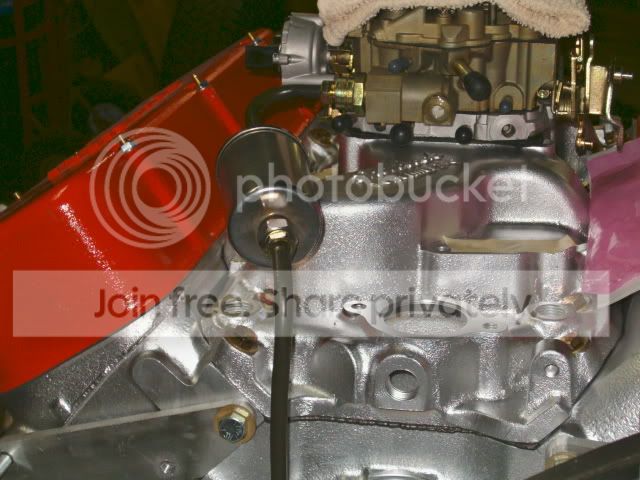
FUELLINE003-1.jpg


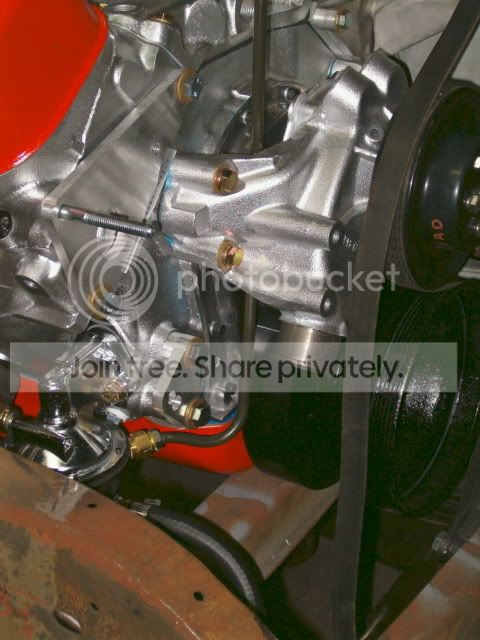
FUELLINE002-1.jpg


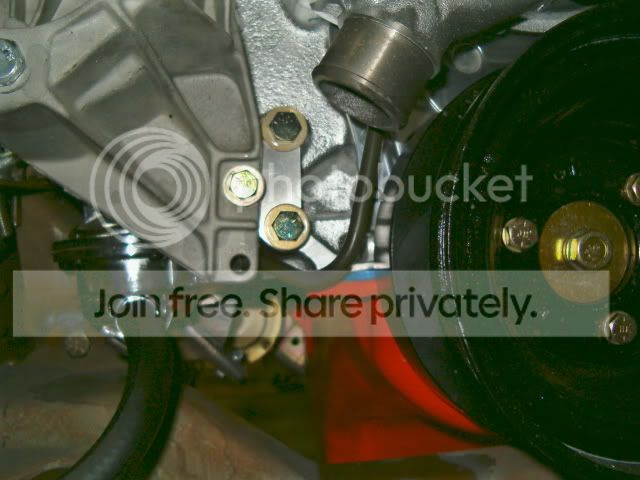
FUELLINE006-1.jpg


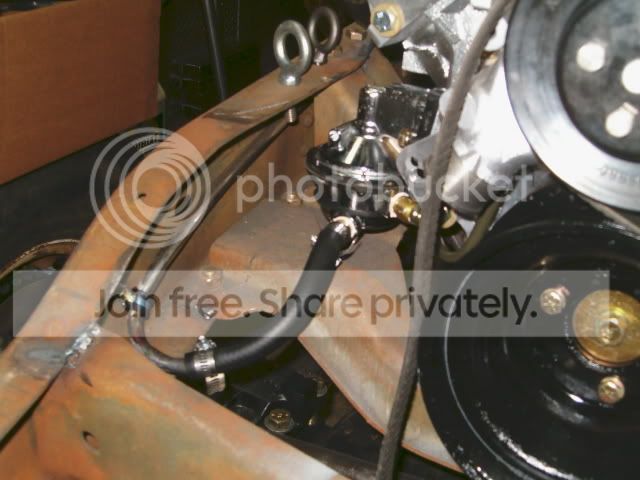
FUELLINE001-1.jpg


And back at the tank, pretty simple.
I will be using that 1/2" i.d. line for my supply, and another for vent, and will plug the 3rd line (that used to be a fuel pump return?)

FUELLINE004-1.jpg


I pressure checked the line with some dishsoap solution, all tight and sound, ready for fuel.
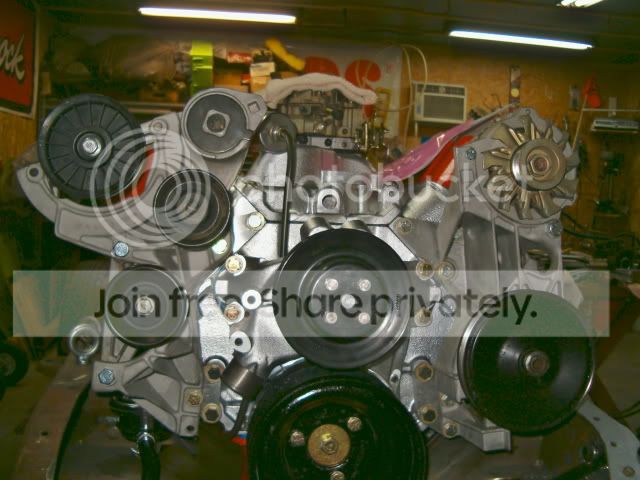
The I put the serp setup on it.

FUELLINE005-1.jpg


The belt I got with this kit (was in use on another truck) is too short. I'm not sure what the difference is, but I did put an idler in place of the A/C compressor (smaller diameter I think), I used the pulley for the PS pump that came with the kit, but maybe my crank pulley or waterpump pulley's are different diameter than was on this kit. Anyhow I need a longer serp belt, and my pulleys are slightly out of alignment, I think if I use a waterpump pulley shim they will come into line pretty good.
 
Last edited:
Modified crankcase evac system

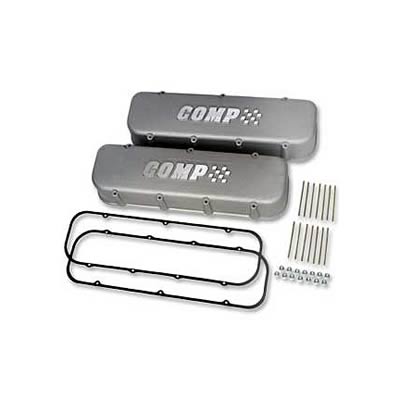
I have the solid cast aluminum valve covers on right now, that I will need to open up to vent the engine.
I was thinking of putting a baffled (to prevent pulling oil from the valve cover area) breather in each valve cover, in the front upper flat part of the valve cover, and running vac line back to the firewall, to a breather tank, then running a line from that tank back to the intake manifold (constant vacuum) to provide a pcv metered vacuum on the system. I would like to build the system so it isn't susceptable to water from splashing through waterholes.

If running this type of modified crankcase evacuation system would I also need to provide an outside air source to the crankcase somehow? If so would a vent on the mentioned breather tank suffice?


Breathers like this:

68781_part.jpg


On each valve cover in the area in front of the raised script, so it would be in the front of each valve cover:

cca-230_w.jpg


Those would run back to a common breather tank on the firewall, same principal as the picture, but I would make a simpler (cheaper) setup:

bt.jpg


The valve cover breathers would come into the can about in the middle.
Then a line running from the top of the breather can to the intake manifold, full vacuum at the base of the carb. with a PCV inline.

I've also considered a sight glass tube on the can to see if any accumulation is happening.


What are your thoughts, recommendations.
 
sounds like that setup would handle it.the engine just needs to vent so crankcase gases have somewhere to go.stock has a open breather on one side and a pcv going into the carb.as long as you have those baffled breathers into the vaccuum canister,you wont have to worry about oil accumulation.its really cool idea.
 
Thanks Joel...
With BBC's being a little bit of an oil consumption engine, I wasn't to keen on the idea of just putting a breather on the valve cover, and a PCV on the other. I wanted to let both covers get circulation through them, and provide a fresh source of airflow if the engine needed it. Thats how I come up with that idea.


In addition:
The 2 water pump ports on the top of the pump shown here:

FUELLINE002-1.jpg


The port on the right of the pump (in pic) goes to the intake, and the other port goes to the heater core right?
.
 
Last edited:
I wanted to let both covers get circulation through them, and provide a fresh source of airflow if the engine needed it. Thats how I come up with that idea.

I think you've got it a little backwards.
Air circulates through the entire engine with a regular pcv-system.

It goes in through the breather on one valve cover, then through the engine, up to the other valve cover and the pcv-valve, and then to the manifold (full vacuum)

A breather isn't really necessary either, the stock system with a hose to the air cleaner works just as well
The breathers only function is to make sure the air to enter the engine is filtered.

pcv_type1_opensystem_diag.jpg

I'm afraid this was the best picture I found:o
disregard the road draft tube, I don't think that's used anymore.
 
Fred, I appreciate your feedback on this, and that system you've pictured is good, but it seems like they always leave oil vapors around the breather, and it would still be somewhat susceptible to water splash. I've had a few vehicles that have the little breather filter in the air cleaner housing, and those always seem to be very wet with oil also. This leads me to believe that a positive flow from that filtered intake air through the crankcase, and out the other valve cover to the PCV, and then to the intake isn't the best way to control oil vapor flow. In an extreme case (like in a BBC)can even lead to oil consumption, and vapors collecting on the intake valves.

I've talked with a few competition engine builders, and they suggested running a breather/separator, similar to this unit on the right:

710-25900.jpg


from each valve cover, then run those to a common accumulator tank vented to atmosphere, and call it good.

the only problem I had with that, and it might not even be a valid concern, is that there wouldn't be any circulation of air through the system. It could remain stagnant, unless pressurized flow from the crankcase to the accum. tank pushed the vapors out of the crankcase, or when under vacuum it could pull fresh air from the accumulator tank breather into the crankcase.

my brain is hurting now....let me know what you think.

thanks again for the input.
 
about the water pump outlets,the right one goes to the intake, the left one probably goes to the heater core but i'm not positive. I didn't take this engine out. I got it after it was already taken out.
 
thats just a complicated marine setup..... I doubt you even need an accumalator can on a fresh motor..

very, very few marine engines run pcv systems to this day.... even the MPFI's don't usually...
 
there has been much debate about the pcv system on the big blocks. i run a pretty simple, stockish set up with the one line from the carb to one valve cover and the other from the valve cover to the air box (i run a stock air box w/ stock cai) it seemed to help with oil consumption over the breather/filter on the pass side.

your idea seems pretty cool, but maybe over kill :dunno: but then again, mine is a straight up beater compaired to your build....
 
Top Bottom