CK5
Register an account today to become a member! Once signed in, you'll be able to participate on this site by adding your own topics and posts, as well as connect with other members.

'81 K5, "BlaZeus"- How to NOT build the ultimate budget K5; 3 & 4 link build

And lighter, cheaper, easier to cut, notch and weld.

Maybe on a corner to corner bracing, not on a longer length....I think you might run a risk of them punching though the larger tube......Plus less weld area and I wonder if a side force would be the same since it's not wrapped around the side only the center.......This is just me thinking out loud, don't take it as fact.
As stated before......A cage ins't the place you go cheap.
 
Maybe on a corner to corner bracing, not on a longer length....I think you might run a risk of them punching though the larger tube......Plus less weld area and I wonder if a side force would be the same since it's not wrapped around the side only the center.......This is just me thinking out loud, don't take it as fact.
As stated before......A cage ins't the place you go cheap.
Considering many others have done it, I think I'll be fine.
 
To each his own.

Just found this......
  1. Size (outside diameter). The OD of the tube is the single biggest factor determining its strength. No other factor will have as great an effect on our link’s ability to resist bending. If you want the strongest links possible, the bottom line for tube size is pretty much "as big as you can fit”.
  2. Wall thickness. The thickness of the tube has the second largest effect on the links resistance to bending. However, since the biggest factor, OD, will likely be predetermined by the available space for the links, the thickness will likely be the factor we have to most carefully consider.
  3. Material. The material from which we choose to make our links follows closely behind thickness in terms of determining the strength of our links. Steel is the obvious choice for it’s combination of strength, stiffness, rigidity, elasticity, weight, ease of fabrication, and cost. There are four common types of steel to choose from: ASTM A-53 (or similar) pipe, electric resistance welded (ERW) tube, drawn over mandrel (DOM) tube, and chrom-moly DOM tube. The choice of material has a significant effect on the properties of the link – especially when you consider that yield strengths range from 30,000 psi for ASTM A-53 pipe to 90,000 psi for cr-mo tube. However, this difference is not as pronounced as you may think, and changing materials often doesn’t have nearly the same effect as changing the OD or thickness of the tube. For example, increasing a 1020 DOM tube link from 2” OD to 2.5” OD will have a much greater effect than staying at 2” OD and just changing to 4340 chrom-moly
http://www.pirate4x4.com/tech/billavista/Links/

I know this was written for links,,,,But metal tube is metal tube.
 
Last edited:
I will say I have never seen a smaller tube punch through a bigger tube. I use different sizes if tube in cages. Mostly for just that little tick of extra room. I tend to use the smaller tube for braces and gussets not as a main structure.

I have also seen this done by a whole lot of places.

I tend to agree though if you can using the same size tube would be the strongest.

But like I have said about a billion times. Design is more important in cage work
 
I've literally plowed the bottom of my car into the ground and flattened the tubes into a D, I've never had a tube go through another. Same car was rolled on two occasions over 65mph, dented some tubes, that's all. I don't have any pictures of the tube work, but I spent a lot of time designing it. When I got rid of it I put it on the frame machine supported either end and pulled down in the center. Both towers maxed at 15k lbs and the car didn't move.

Design is absolutely everything, welds and over heating tubes is next in my opinion.

One thing I'd say, the welds on your tubes are giant. They really shouldn't look like that. I know it's a dead horse, but spend more time on your skill set.
 
Last edited:
Just seems like a step backward to me.....But good to know anyhow.

While on the subject of cages, where would someone need to look for good cage design? Like most subjects, it's hard to find good info with out getting a 100 different ways of doing things and you end up more confused than when you started.
 
Every time I put a tube to a cage I ask myself, where is this force going. From all possible directions. My goal is to minimize forces and spread them out as much as possible.

That's one of the reasons dead nodes are frowned upon. That concentrates force to that junction.

Also remember triangles are rigid shapes. Squares and rectangles are not
 
I do the same, address the forces, then what's going in it, seats engine accessories etc, takes some vision, and understanding, but it starts to flow and take shape.
 
If nobody else is going to call this guy out on his blatant copying of my rollcage design, then I will....... :haha:

chop.jpg


-G
 
That is the hardest part, thinking in three-d. I try and think off the corners of the A and B pillers pushing down, front, back and sideways. The new part is having the rear suspension pushing up and pulling down.
 
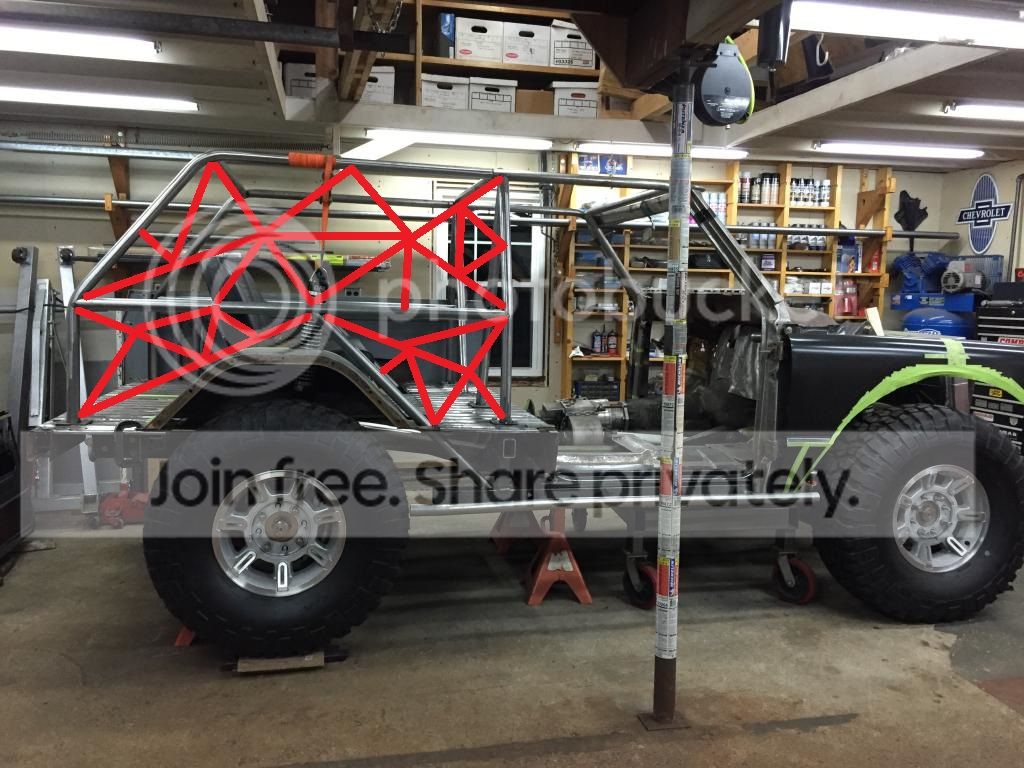
Finished most of the upper back half of the cage. Still want to add some corner gusseting with tube or tacos and also x members in the door frame area. Probly gonna work now on the lower back half portion under the bed to support this maze of tube on top :woot::saweet::1zhelp:
Any ideas??

image.jpeg

image.jpeg

image.jpeg
 
Looking a lot better up top. If I were doing the rear I would fabricate a new box tube frame in the shape you need for clearance and then fishplate box that to the hacked frame. But that's just me.

Doesn't have to be as big a frame rail as the original. 2x4 box would probably be fine if you did it right but 2x6 would be closer to factory size
 

Latest Posts

Top Bottom