CK5
Register an account today to become a member! Once signed in, you'll be able to participate on this site by adding your own topics and posts, as well as connect with other members.

The Shop Truck

1971 Chevy C20 with a custom flat bed.
I've got a holley regulator and in tank pump with a return setup and mine drops pressure once you turn the key off. I just wait for the holley terminator screen to boot up and by then it's primed and I start the truck.
My pump only runs for the 5 seconds default currently. That's barely enough time to build pressure in the big 1/2" lines and then it instantly drops once the pump shuts off. The only way to start it currently is to just crank until it starts or run the priming sequence twice which tends to piss off the Holley pro dash. I already modified the tune, I just need to upload it.
 
You’ve probably already thought this but…If it takes more than a couple seconds, are the lines draining somehow? If they’re full, just not under pressure, I would think it would only take a couple seconds to pressurize.
 
The lines aren't draining, but they are depressurizing. I'm not sure how long it takes to pressurize 35 feet of 1/2" PTFE line, but it definitely added about 3 seconds to cranking time for startup. With the pump only running for 5 seconds it was tricky to get the timing right before the pump shut back off. It should be easier with a 10 second run time, but I won't know until I get the new tranny fully installed and get the truck back on the road.
 
Right, just seems like there is an empty portion somewhere in that liquid doesn’t compress, so pressurizing should be minimal. What PSI is it set for?
Is the pump running full speed when energized?
Just ballpark shooting to trigger some ideas here…?
 
The regulator is set to 65psi with the engine off, the pump is running at 50% at startup. Fuel isn't compressible, but the fuel lines aren't completely rigid so they'll expand a bit. I think I'm just being a little picky, I'm using racecar parts and I shouldn't expect them to be like a factory setup.
 
Oh good point on the lines.
My setup on the Maiden is much the same for lines, and it takes a couple seconds, but only 43# on my EZ-EFI setup.
 
Oh good point on the lines.
My setup on the Maiden is much the same for lines, and it takes a couple seconds, but only 43# on my EZ-EFI setup.
Yea, the stock LQ9 injectors are barely big enough to keep up so I'm running the fuel pressure a little higher than I will with the new engine.
 
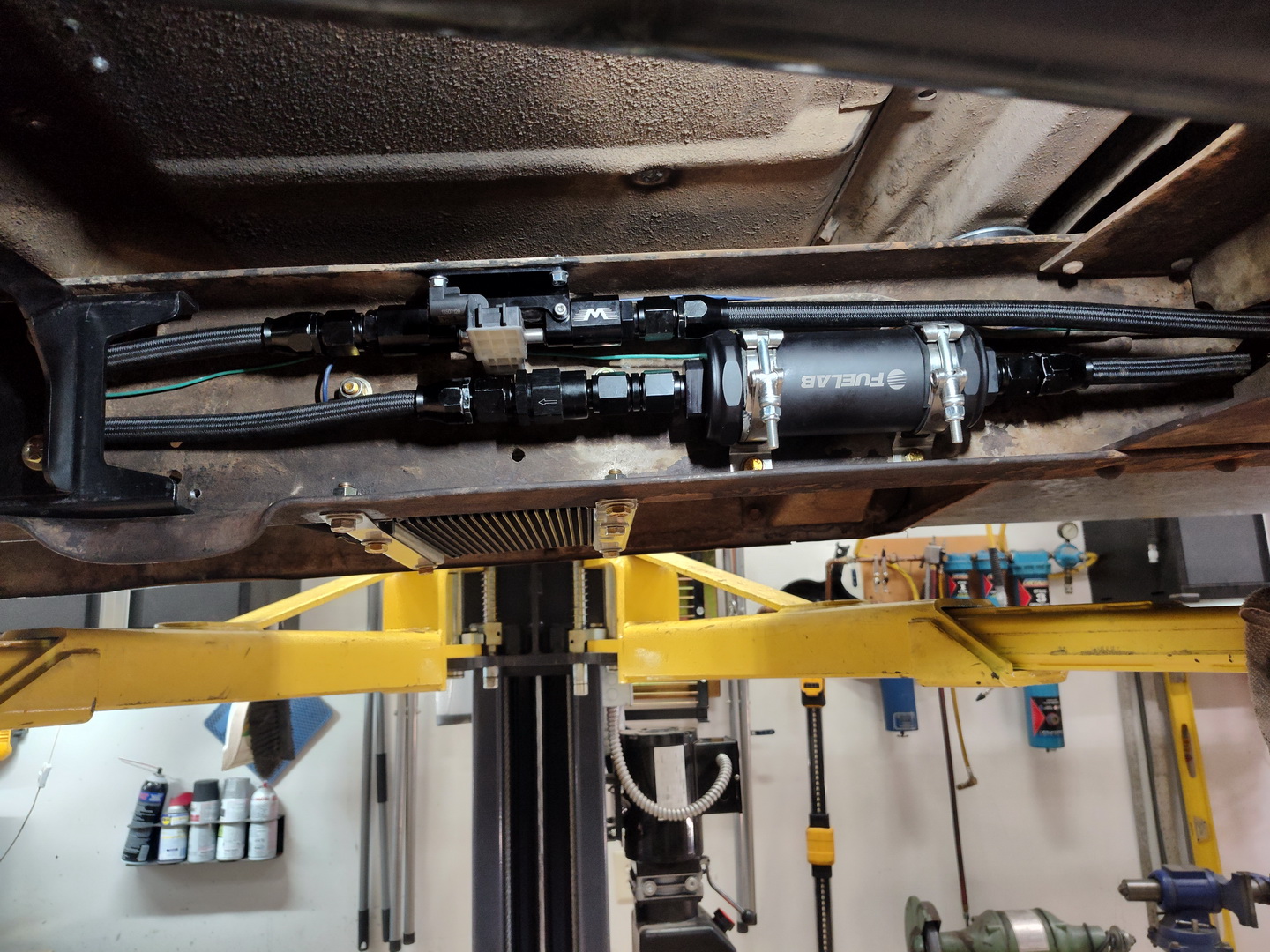
I got the final piece of the fuel system installed. This won't be needed for the current engine as I don't have enough injector for e85, but the new engine will be able to use it.
IMG_20250312_105102613_HDR.jpg

I should be able to finish up the trans install today and get the truck back on the road! Only a few things left on that.
 
It drives again! The trans shifts great and does all the automatic things it's supposed to. I'll have to do some testing with the Draggy to see how it compares to the old transmission, either that or wait until the 28th...
 
It's got a driveline vibration that starts around 75mph that I need to figure out before I do too much testing. I'm also not sure that it will hook up on the streets of Mexico with the higher stall.
 
After doing some research on driveshafts, I now understand why some companies won't make steel ones as long as what I have. I'm not sure why I wasn't having the problem before, but I'm hitting the driveshaft critical speed right around 70-75mph. That's the speed at which it's hitting the resonant frequency of the driveshaft. I did notice that surprisingly the roller bearings are looser on the yoke than my old bushing was, that's probably why it's more noticeable.

Fixing this will require either a 2 piece driveshaft, or a carbon fiber. The issue with the carbon fiber would be how close the x-pipe is to the driveshaft as the carbon fiber shaft has a heat limit of 350F and it almost touches the driveshaft at full stuff and is never more than 2 inches away where the X crosses over the shaft.

I'll have to call around next week to see if someone can make me a 2 piece with a heavy duty carrier bearing.
 
After doing some research on driveshafts, I now understand why some companies won't make steel ones as long as what I have. I'm not sure why I wasn't having the problem before, but I'm hitting the driveshaft critical speed right around 70-75mph. That's the speed at which it's hitting the resonant frequency of the driveshaft. I did notice that surprisingly the roller bearings are looser on the yoke than my old bushing was, that's probably why it's more noticeable.

Fixing this will require either a 2 piece driveshaft, or a carbon fiber. The issue with the carbon fiber would be how close the x-pipe is to the driveshaft as the carbon fiber shaft has a heat limit of 350F and it almost touches the driveshaft at full stuff and is never more than 2 inches away where the X crosses over the shaft.

I'll have to call around next week to see if someone can make me a 2 piece with a heavy duty carrier bearing.
What is the generally accepted longest they'll make?
 
What about aluminum? No heat problems, but still lighter.
The calculators I found show that an aluminum driveshaft wouldn't change the RPM by much, maybe a couple hundred.
What is the generally accepted longest they'll make?
Spicer has a calculator to give you the critical speed of any type of driveshaft. I'm assuming this is for mild steel, but honestly the composition doesn't matter that much until you get to carbon fiber.


At this point I'm looking to regear from 4.10:1 to 3.73:1. If you look at the critical speed of my current driveshaft:
1742139855408.png
With 4:10 gears and 275/55R17 tires at 75mph:
1742139985793.png
That's right where it starts vibrating. Switching to 3.73 gears pushes that up.
1742140063172.png
I generally cruise between 70 and 80 so that would fix my issue. My current driveshaft could also be lengthened slightly to give me better spline engagement which may help as well since the minimum engagement happens at ride height. I calculated yesterday that I could make it 1" longer.

When I talk to the driveshaft shop tomorrow about options I will ask about an aluminum shaft that is 1" longer. Between that and regearing I think I'll be good for now as long as it can handle the torque.
 
The calculators I found show that an aluminum driveshaft wouldn't change the RPM by much, maybe a couple hundred.

Spicer has a calculator to give you the critical speed of any type of driveshaft. I'm assuming this is for mild steel, but honestly the composition doesn't matter that much until you get to carbon fiber.


At this point I'm looking to regear from 4.10:1 to 3.73:1. If you look at the critical speed of my current driveshaft:
View attachment 499739
With 4:10 gears and 275/55R17 tires at 75mph:
View attachment 499740
That's right where it starts vibrating. Switching to 3.73 gears pushes that up.
View attachment 499741
I generally cruise between 70 and 80 so that would fix my issue. My current driveshaft could also be lengthened slightly to give me better spline engagement which may help as well since the minimum engagement happens at ride height. I calculated yesterday that I could make it 1" longer.

When I talk to the driveshaft shop tomorrow about options I will ask about an aluminum shaft that is 1" longer. Between that and regearing I think I'll be good for now as long as it can handle the torque.

The problem with the long shafts is they could whip into an arc, but aluminum shafts are lighter and less prone to whipping.
My chevy vans all had aluminum 8 feet long aluminum shafts stock.
My local driveshaft shop will not do anything longer than 5' , he doesn't do aluminum or carbon fiber.
He also does my big rig shafts.
 
I drove the truck again last night and tried to drive through the vibration. I think I got up to 95 before I thought the truck was going to fall apart.

The only thing I did was swap the high precision balanced chromoly Sonnax 700R4 yoke out for a high precision balanced chromoly Strange 4L80E yoke. The driveshaft angles and everything else are approximately the same between the two transmissions. Before I go to the driveshaft shop today, I'm going to swap that front u-joint out just in case I damaged it somehow when I swapped the yokes.
 
Top Bottom