CK5
Register an account today to become a member! Once signed in, you'll be able to participate on this site by adding your own topics and posts, as well as connect with other members.

Wiring Tips & Tricks

What is the best way to tap in to a wire without using a scotchlok?

Unfortunately I've never seen a connector seal that was designed for multiple wires. I'm guessing liquid tape is the only option. I've done the double wire to a single connector setup through a single seal, but you can't run two wires through a round hole without the potential for water ingress if you don't seal it some other way.

But this is a reason to run a panel with plenty of outputs, so you can avoid this whenever possible. Still not always possible if you don't want to use scotchlocks (like me, I have a phobia), I made a "Y" harness for my reverse light connector so I could trigger my backup camera.
 
You think the ignition post of the starter would be another option for ignition "hot" only option or the stud of the alt
 
I agree a panel is best. In this case I’m looking to tap the brake light circuit for the 3rd brake light on a camper shell and then a constant 12v for some sort of switched light inside the shell.
 
For brake light, I'd just get one of those four wire trailer adapters that goes between the body and light connector for the taillights. If you HAD to splice something, I'd do it on the trailer side of the adapter, so the stock wiring was intact and could be easily taken back to original if there was an issue.

I can't think of a 12V battery source at the back of a pickup, unless there is a factory trailer harness already there. Flat four wire won't do it, but GM ran a thick red and blue paired wire for trailering if the truck had a tow package.
 
If the truck is a 6 or 7 wire plug, then you should have 12V battery and brake lights on it, if it's wired up properly.

Easy fix if so, just go buy (or find) the proper "trailer" side of that setup and you could hard wire it to your camper, so you could disconnect it when you removed the camper.
 
You can crimp up to about 12ga with the cheap (~$20) tools made for weather and metri-pack terminals. Weather-pack is a relatively large connector.

While you can probably get buy with other crimping methods, the tools made for them really allow the terminals to grip the wire, and for you to make a pretty good circle "crimp" to hold the seals.
 
Weatherpack crimper. Just a cheap one from S&K but I've got an identical one from Blue Point at home. It does the different gauge terminals and you can do the part around the wire seal.
1582141037678638471241.jpg
 
Also, if you spend a bit of time on ebay, there is at least one US vendor that sells 10 pack "kits" of everything to make 10, two wire weather-pack connector assemblies. I don't think I've seen them cheaper. Just stay away from the chinese knockoffs.

It's fairly important to get terminals (and seals) that match the gauge wire you are using though. They don't crimp/hold as well if you don't.
 
As I work on the dash wiring I’m curious about a couple of things -

How does the fuse box come apart? I see one screw at the lower left corner, is that all? Does it plug in to anything on the back side or will it fall loose once unbolted?

I will be adding an auxiliary fuse box (6 IGN slots and 6 BAT slots). I found an empty 20a slot on the stock fuse box, do you think that’s adequate to power the IGN portion for items like choke, tach, MSD, alternator?

(fyi, I checked the MSD installation paperwork and it does not specify a power requirement for the switched IGN wire.)
 
As I work on the dash wiring I’m curious about a couple of things -

How does the fuse box come apart? I see one screw at the lower left corner, is that all? Does it plug in to anything on the back side or will it fall loose once unbolted?

I will be adding an auxiliary fuse box (6 IGN slots and 6 BAT slots). I found an empty 20a slot on the stock fuse box, do you think that’s adequate to power the IGN portion for items like choke, tach, MSD, alternator?

(fyi, I checked the MSD installation paperwork and it does not specify a power requirement for the switched IGN wire.)
To be on the safe side you could always use that 20A ign feed to switch a relay controlling a larger gauge circuit coming from bat power for your new ign feeds. More involved but easily turns one ign source into many with no possibility for issues.
 
Oh that’s a nifty idea! :pimp: Typical universal 30a relay or something fancier / higher amperage?
 
Oh that’s a nifty idea! :pimp: Typical universal 30a relay or something fancier / higher amperage?
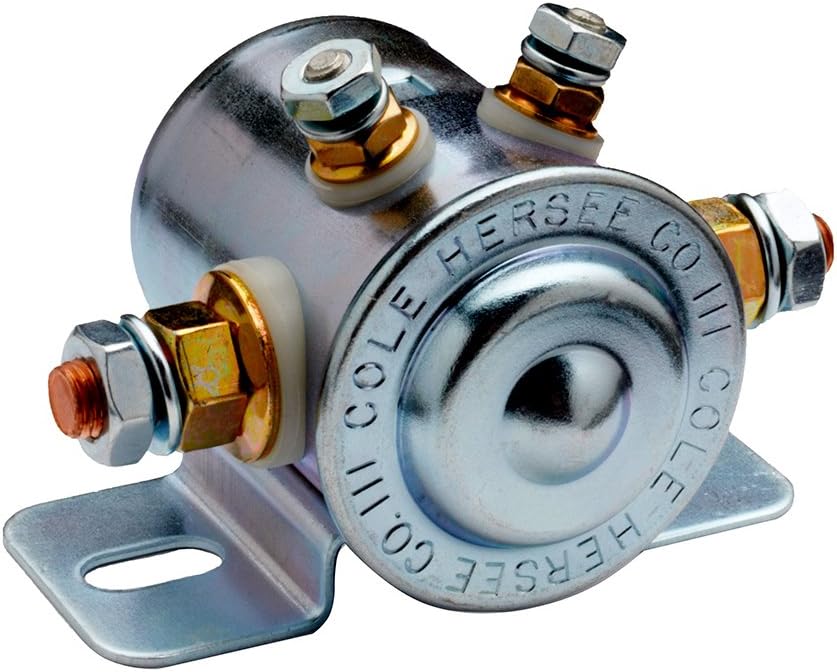
Just your normal one unless you plan on some high loads. You could even go big and do a constant duty solenoid if you want some juice. https://www.amazon.com/Cole-Hersee-24059-BP-Insulated-Continuous/dp/B0064MX7US
61loBzR2zVL._AC_SL1000_.jpg
 
Blue sea comes recommended often, and if I had a better connection I'd check out what they offer.

I'm pretty happy with the way the Eaton Bussman setups are made.

I do not like being limited to ignition only power...if I need battery 12v, I dont want to run yet another panel. I also dont want more components tied to the panel (relays) randomly about. At some point things are going to fail, being able to easily test/swap/replace makes sense IMO.

Those are 35A relays, one of which is faux mounted to the panel. Mini fuses and relays save space.
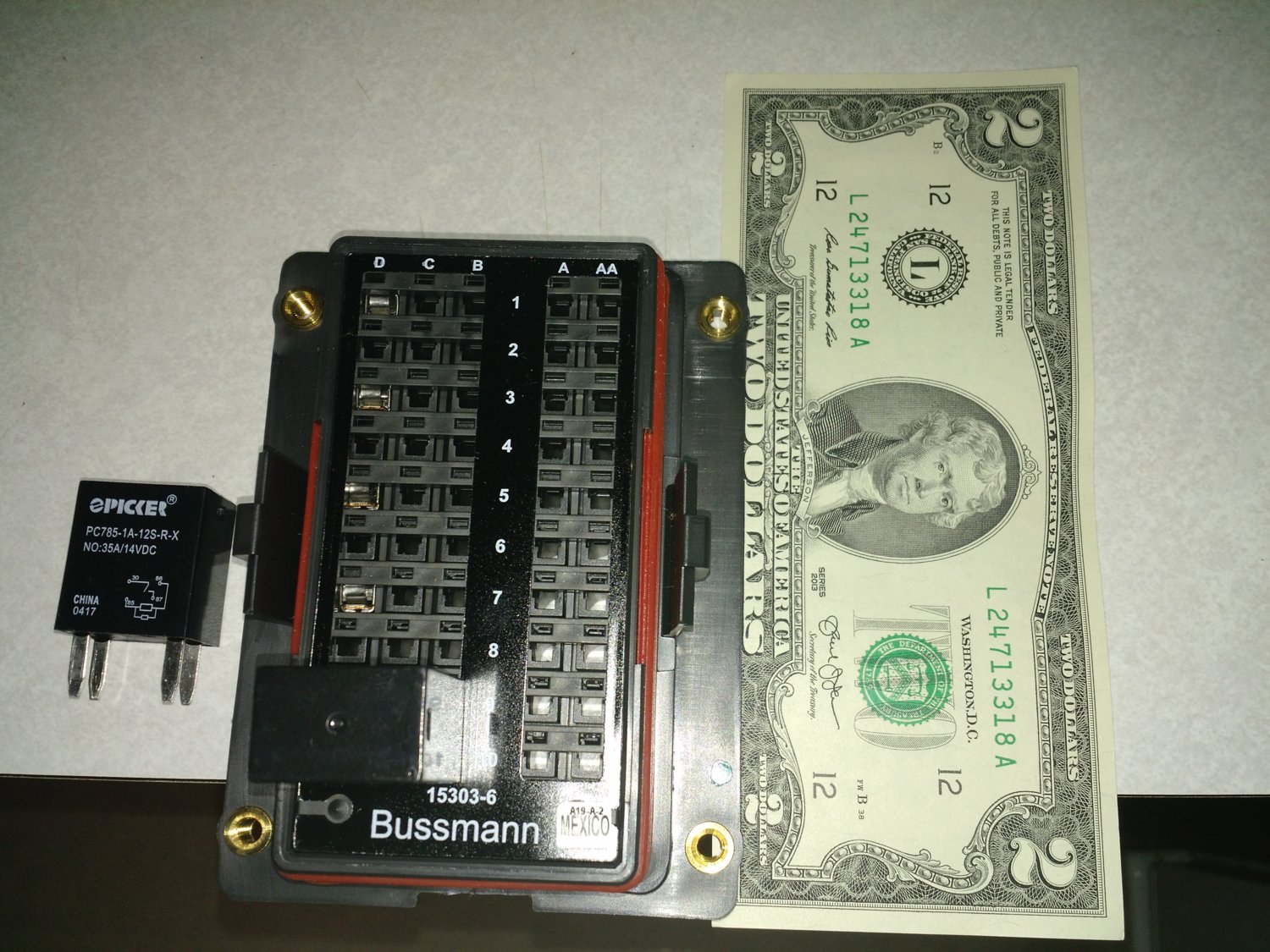
full
Check out the blue sea systems 5032
Its split so you can run 6 circuits on constant power, and 6 circuits switched.


https://www.amazon.com/Blue-Sea-Systems-Blade-Blocks/dp/B01BXTXV1Q
 
Top Bottom