CK5
Register an account today to become a member! Once signed in, you'll be able to participate on this site by adding your own topics and posts, as well as connect with other members.
I'm sure a lot of reading on my part will answer this, but it'll be easier to just ask: Why make the sliders removable? When would you not want them?


When I'm "stock" of course!!!! :haha:

Seriously, I will have a second set of "lightweight" tapered supports welded to the backside of a painted factory rockerpanel, so that if I wanted to I could make the truck look completely "normal"..... you know, for concours-type events and fancy countryclub dinners... stuff like that.


-G
 
I think you are trying to overanalyze the TIG amperage, yes you are right that the avg amperage is somewhere lower with pulse, but who cares. Use the amperage that gets enough heat but not too much, yes it will require a little higher when pulse is on vs when there is no pulse.

I think you are right that pulse can help take some of the extra heat out of the weld. I really like those pyrex tig cups with the huge gas coverage with stainless, they help out a lot as it covers the weld for a longer time as you pass over it.

If you are having a lot of doubts about the pulse, try it without, once you get that down, then turn it on and turn the amps up 10% or so and try it again. Don't forget you have a foot pedal, not a foot switch. Its very easy to forget that and just floor it or shut it off thinking of it as a switch. You should be varying your pedal position to keep the same puddle width as you progress. This means it takes less heat toward the end and more heat in the beginning of the weld, and varying in between.

When welding stainless exhaust tubing I found it helps if you get the gaps so tight that you don't even need to add filler. Although that is easier said than done.

Also, pay very close attention to your torch angle, the torch angle has a much larger effect than you would think.
 
I think you are trying to overanalyze the TIG amperage, yes you are right that the avg amperage is somewhere lower with pulse, but who cares. Use the amperage that gets enough heat but not too much, yes it will require a little higher when pulse is on vs when there is no pulse.

I think you are right that pulse can help take some of the extra heat out of the weld. I really like those pyrex tig cups with the huge gas coverage with stainless, they help out a lot as it covers the weld for a longer time as you pass over it.

If you are having a lot of doubts about the pulse, try it without, once you get that down, then turn it on and turn the amps up 10% or so and try it again. Don't forget you have a foot pedal, not a foot switch. Its very easy to forget that and just floor it or shut it off thinking of it as a switch. You should be varying your pedal position to keep the same puddle width as you progress. This means it takes less heat toward the end and more heat in the beginning of the weld, and varying in between.

When welding stainless exhaust tubing I found it helps if you get the gaps so tight that you don't even need to add filler. Although that is easier said than done.

Also, pay very close attention to your torch angle, the torch angle has a much larger effect than you would think.


Word.

I had a little "realtime FaceBook coaching session" last night on That K5 Site group. :)

I was struggling with all the 1PPS stuff.... then I did some reading on WeldingTipsandTricks.com about TIG welding thin stainless... Jody suggests using a higher pulse setting (30 or higher) as well as 30% PEAK / 30% BACKGROUND with around 50 Amps (IIRC). So I tried that new setup for a while and fumbled around and wasn't making very good progress.

Finally, the angry FB crowd got impatient and said "Shut off the damn pulser and just weld!!!" :haha: That was good advice.

I had been trying to break-down the process into small skills that I could learn before trying to combine two-hands and a foot pedal all at once. All I was trying to do was find a setup that would let me create a quick puddle, and then start trying to move it around and see if I could fill a gap (without filler rod) on tight fitments.

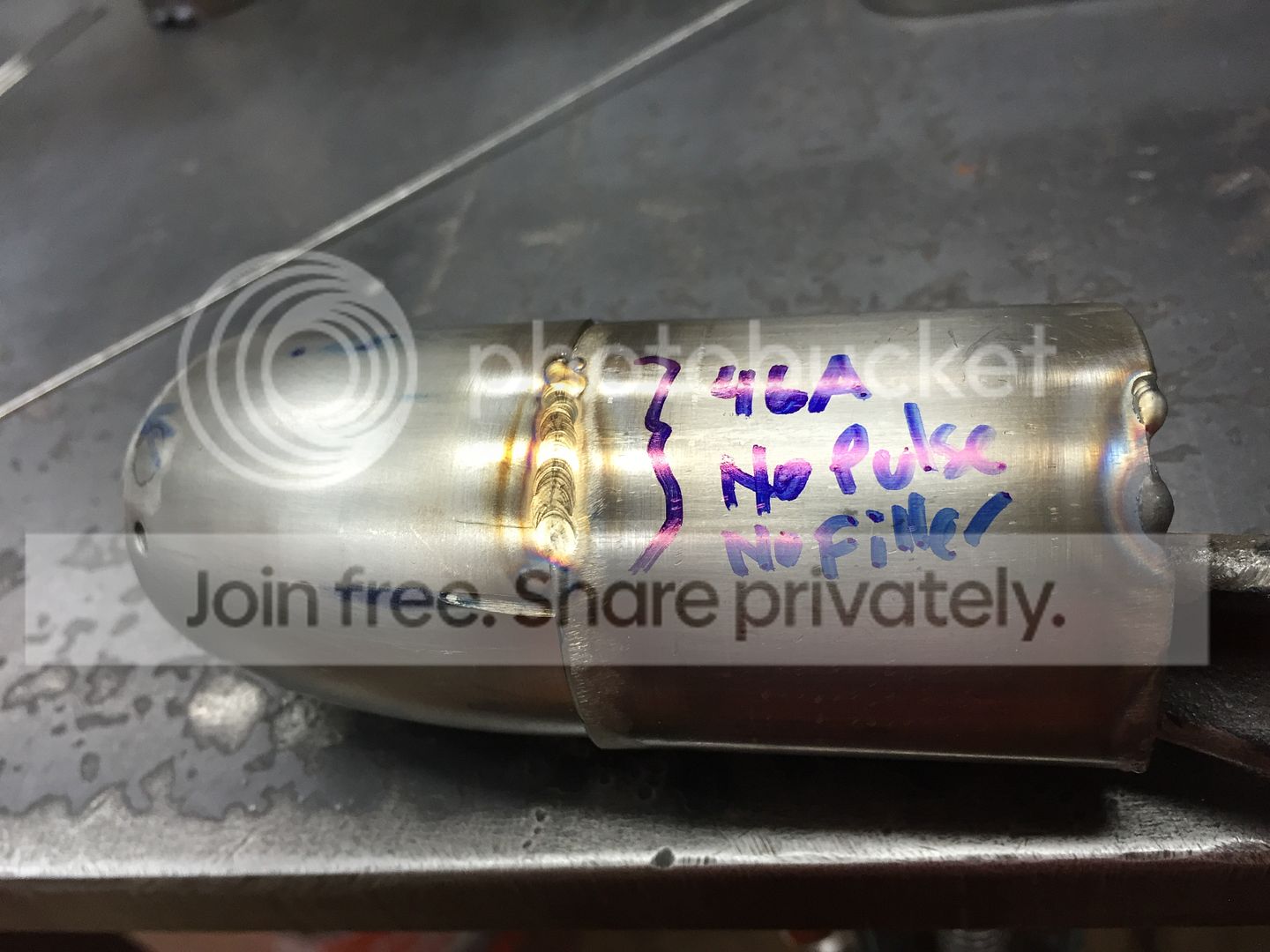
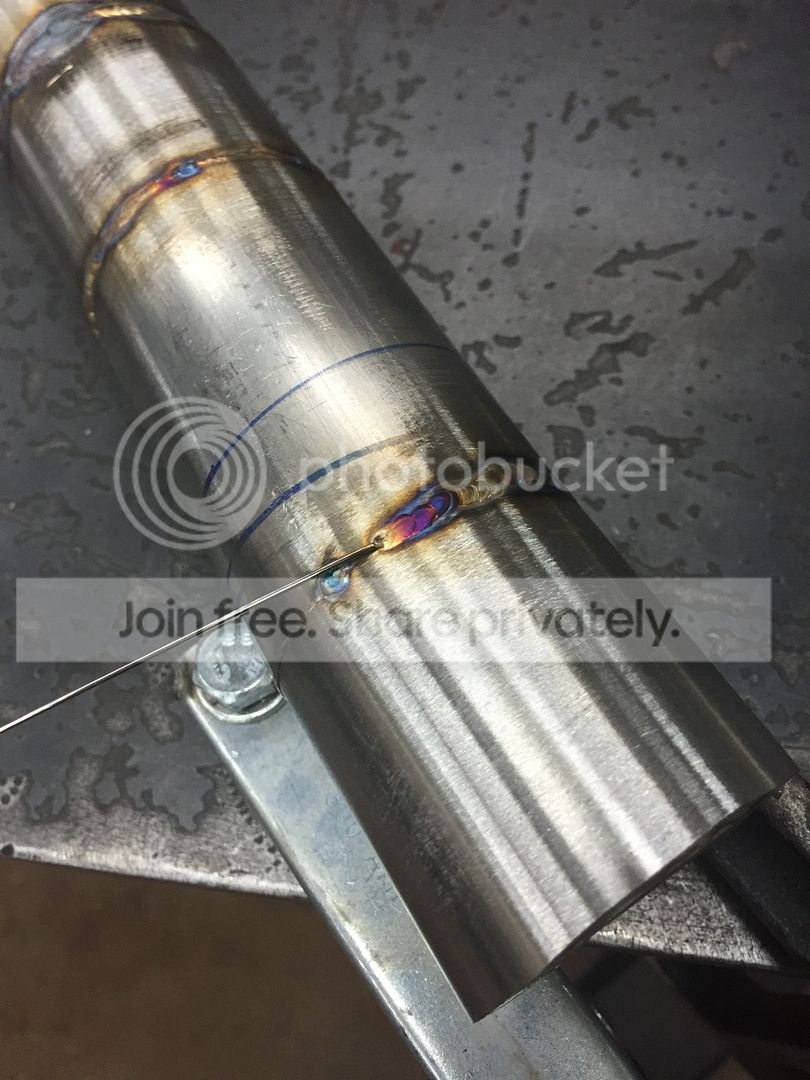
46A seemed to work pretty well (1/16" Tungsten 2% Lanthinated, 30CFH Argon flow, Pyrex cup):

IMG_1799.jpg


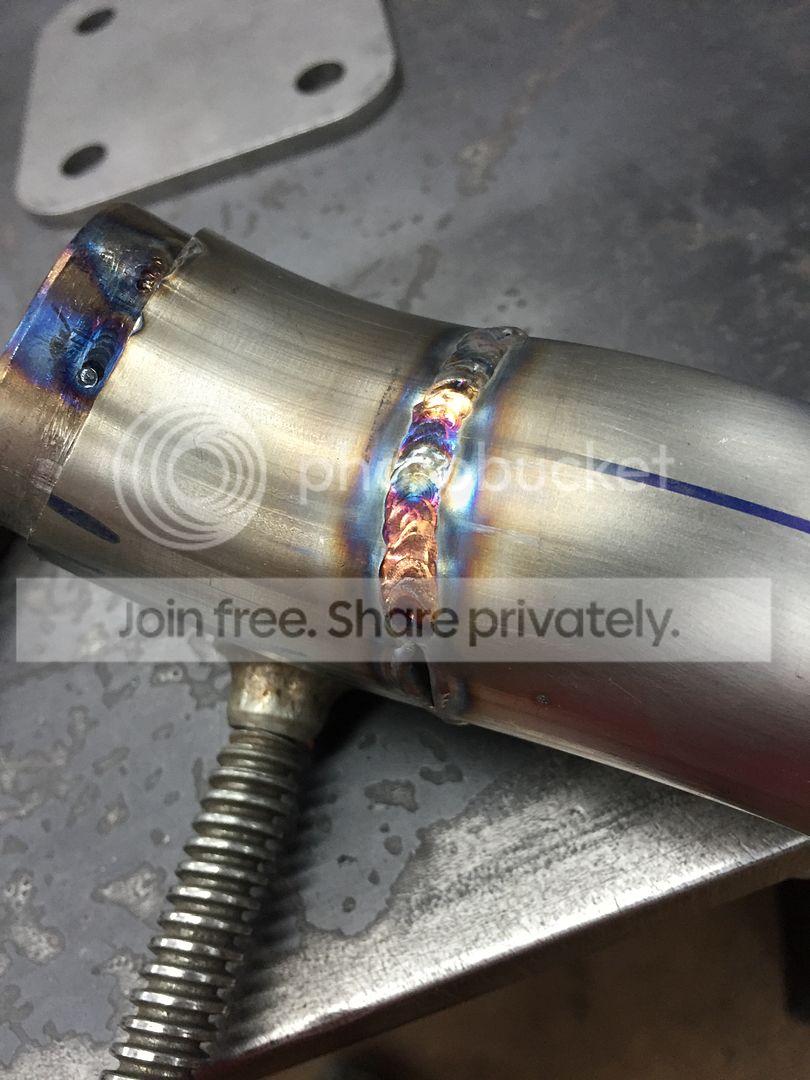
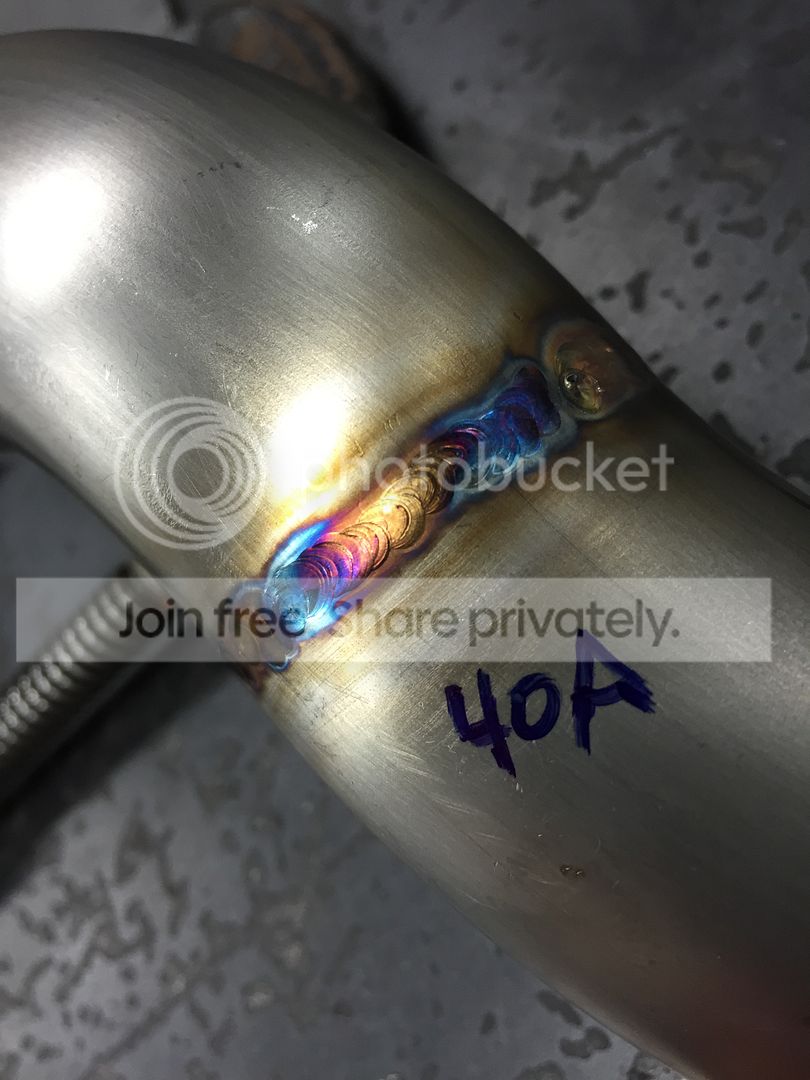
The coloring was a nice light-gold color and it seemed to flow pretty well also. I decided to turn down the amperage a little more to see what would happen and if I'd have more time to work the puddle before blowing-through... I went down to 43A.... and then eventually to 40A:


IMG_1803.jpg


IMG_1807.jpg


The weld color definitely was different.... more of a dark blue / purple hue than before. I don't know if that was a result of pulling away the post-flow shielding gas too early... or just that the weld was "cooler" at only 40A?? :dunno:


In any case, it was a relief to finally be fusing parts together instead of blowing through them. Another "lightbulb moment" was when I struck the arc about 1/32" away from the tubing gap (instead of directly on TOP of it!).... I don't know why I thought it was a great idea to always start in the middle of the gap, but obviously the molten puddle melts-away from the heat source so I'd always get a crater. By starting a puddle where there was good metal I could more easily "sweep" the puddle across and onto the gap where it would start to fill in, and if I swept slightly past the gap to the other side, I could maintain the puddle and then work it back the opposite way to slowly move down the seam and close it up (even without any filler rod).

This was a huge breakthough.

I sat there for about 3 hours last night just practicing, making mistakes, sticking the tungsten (A LOT!) and spending a lot of time walking over to the grinding wheel to resharpen the tungsten.... at the very end of the night I tried dipping some filler rod (.030" 308) into the puddle, but that process still feels REALLY awkward and clumsy. I guess I will try that tonight to see if I can get more comfortable with it.


-G
 
I don't ever pulse, never learned it, never cared. I run my Miller 351 at 35a typically on stainless exhaust tubing


What about the pedal?

I was basically just mashing it to the floor.....then welding for a few seconds, then I taper it off.... letting the post-flow gas cool the weld. Do you spend a lot of time pumping the pedal in-and-out to create each new puddle for the weld, or are you keeping steady amperage and using the torch to manipulate the puddle?

:dunno:


-G
 
I typically start cold, dab a little filler rod and bring my heat up to flow it out and start the weld from there. Avoids overheating the first part of the weld, I just work the pedal from there to maintain puddle width and flow. I try and avoid pulsing the pedal, I don't typically like how those welds look.

Adding filler rod is your puddle definition, right now if I understand correctly your not using any? That's why you need to pulse other wise it would just be a pointy smooth thing. Start working on adding filler, if your gaps are nice and you maintain good pedal and torch control adding filler will have a rhythm to it and you'll end with a lovely little weld. Keep the filler about 1" away from puddle, and make a quick dab into the puddle. I find most new to tig welding are apprehensive with filler rod and it tends to ball up and make a mess. Quick dabs in and out, forearm planted and dab in with your wrist

Edit - try cutting your filler rod into smaller pieces, say 8" long or so, sometimes a brand new stick can get kind of hard to control especially if your just getting the feel for things, don't be afraid to make somthing to help stabilize either arms, in some cases when welding in position I will use a clamp or somthing to give me a something to plant my forearm on to stabilize my hands.
 
I like to see the casters being put to use.
I've been using big custom made Dolly's for years now.
I put the blazer body on one to move it around years ago and now have the crewcab body sitting on one and the box on another. Also have one for the 454/T400 that came out of the CC. Sure beats getting the cherry picker out to move things around. I did find that having stationary casters on one end and swivel on the other makes the object easier to control as opposed to 4 swivels, especially if your floor isn't smooth and level.
So what are you doing with those 502 heads?
 
I like to see the casters being put to use.
I've been using big custom made Dolly's for years now.
I put the blazer body on one to move it around years ago and now have the crewcab body sitting on one and the box on another. Also have one for the 454/T400 that came out of the CC. Sure beats getting the cherry picker out to move things around. I did find that having stationary casters on one end and swivel on the other makes the object easier to control as opposed to 4 swivels, especially if your floor isn't smooth and level.
So what are you doing with those 502 heads?

The iron ones? Nothing probably

EDIT:

I'm also going to end up with a brand new matching intake manifold (never run) and a CompCams roller cam also.... stamped rockers, a set of original pushrods, etc.

Who knows? If Heath convinces me to go DIS... I will have be putting an MSD Pro-Billet dizzy in the discard pile as well. :D


-G
 
What about the pedal?

I was basically just mashing it to the floor.....then welding for a few seconds, then I taper it off.... letting the post-flow gas cool the weld. Do you spend a lot of time pumping the pedal in-and-out to create each new puddle for the weld, or are you keeping steady amperage and using the torch to manipulate the puddle?

:dunno:


-G
Haven't been around for a long time so I just spent a while catching up from before the header into the floor, till now. Good progress.

It's been a long time since I did any header welding, but I found a test piece in the scrap pile that had some of your same difficulties. Unfortunately, my scribbled Sharpie notes on the tube don't mean anything to me now. 60-20-1, surely mean 1 PPS, and the 20 might be background%, not sure if the 60 was amps or peak time. Amps arent critical, they ultimately depend on your foot. I really liked the pulse controls, you get a beneficial increase in control of the weld puddle. Kind of softens it up and slows everything down.

I still recommend bringing a professional in to use your Dynasty and help you get the welding kickstarted. Or a Dynasty is easy to move, take it and the headers to someone. If you want to forge down the road on you own, practice, practice, practice. But start out on something thicker, it slows the whole process down and lets you see what is happening when you lose control of the puddle and a blowout starts. Also, before you make any decisions on your settings, cut some of your welds apart, and see what they look like from the backside.
 
Not sure if you ever watch the show roadkill, but Mike Finnegan has his own youtube channel called Finnegans garage. Has alot of useful info on building headers and welding.
You have to skip past all the usless stuff at first.. somewhere around 8min. and @ 30 Min.

Might help, Might not. Im not a welder so :dunno:

P.s. Your build and your skills are FAWESOME!
 
Sidebar:

Does anyone remember my idea for removable rocksliders? The idea was to use tapered cone-shaped receivers in the lower rockerpanel square tube, then build a slider with 5 tapered (and threaded) supports that would be drawn together and torqued-down tight with an internal 5/8" bolt at each location. A buddy of mine started this project with me over a year ago, but we've both been too busy to mess around with it.... I guess he finally got some extra bandwidth and sent me a pic and quick video of his progress yesterday. :saweet:


-G
I'm surprised he is using a mill. That is a natural job for a lathe.
 
Last edited:
:D
Not sure if you ever watch the show roadkill, but Mike Finnegan has his own youtube channel called Finnegans garage. Has alot of useful info on building headers and welding.
You have to skip past all the usless stuff at first.. somewhere around 8min. and @ 30 Min.

Might help, Might not. Im not a welder so :dunno:

P.s. Your build and your skills are FAWESOME!

Cool video. Of course Greg is now kicking himself since could have saved tons of time and money by just using turbos instead of worrying about keeping the exhaust tube lengths the same...:thumb:
 
Not sure if you ever watch the show roadkill, but Mike Finnegan has his own youtube channel called Finnegans garage. Has alot of useful info on building headers and welding.
You have to skip past all the usless stuff at first.. somewhere around 8min. and @ 30 Min.

Might help, Might not. Im not a welder so :dunno:

P.s. Your build and your skills are FAWESOME!


kylerj,

Thanks for the link. :waytogo:

I ended up subscribing to Finnegan's YouTube page, and watched everything he has there... unfortunately, he doesn't have the headers finished yet so I'm still waiting to see how he does some of the fussy welding (like the collector to the primaries, etc).

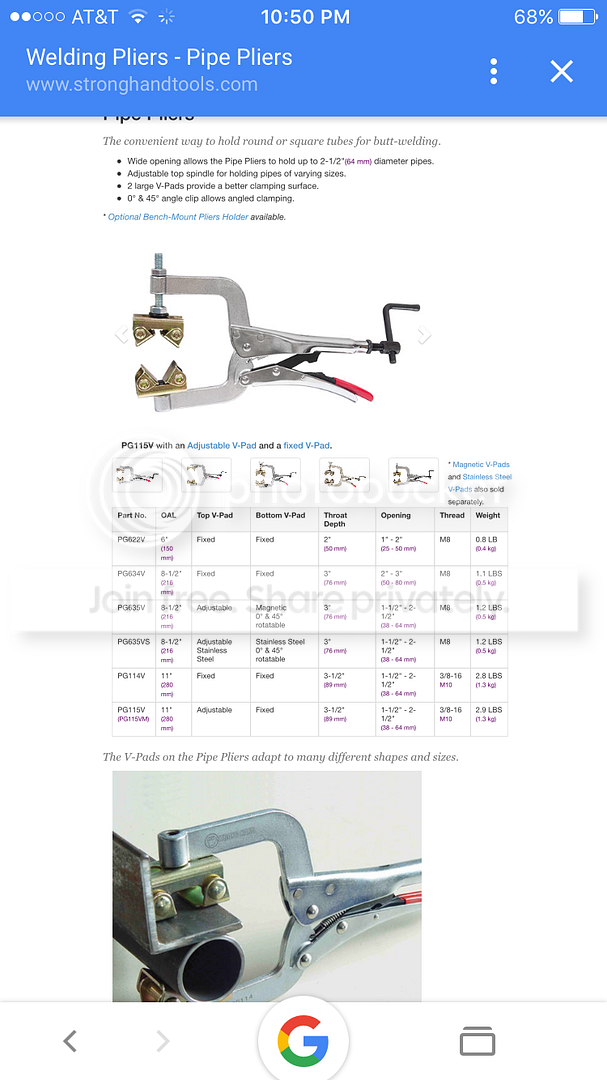
There were some good tips in there about fitment, weld settings, and purging. I ended up buying one of those Stronghand Tools tube clamps that he showed in his video (Amazon Prime, delivered tonight!) so that I can more easily fixture and hold my primary tubes in the positions I want them without a lot of struggling.

IMG_1883.png


I'm up to 9 hours of TIG practice so far.... and I'm getting better at adding filler rod into the puddle and I'm sticking the tungsten a LOT less than before.

That's not to say I "never" do.....here's a 2-fer. I stuck the tungsten AND the filler rod into a big group hug. :haha:
IMG_1878_1.jpg


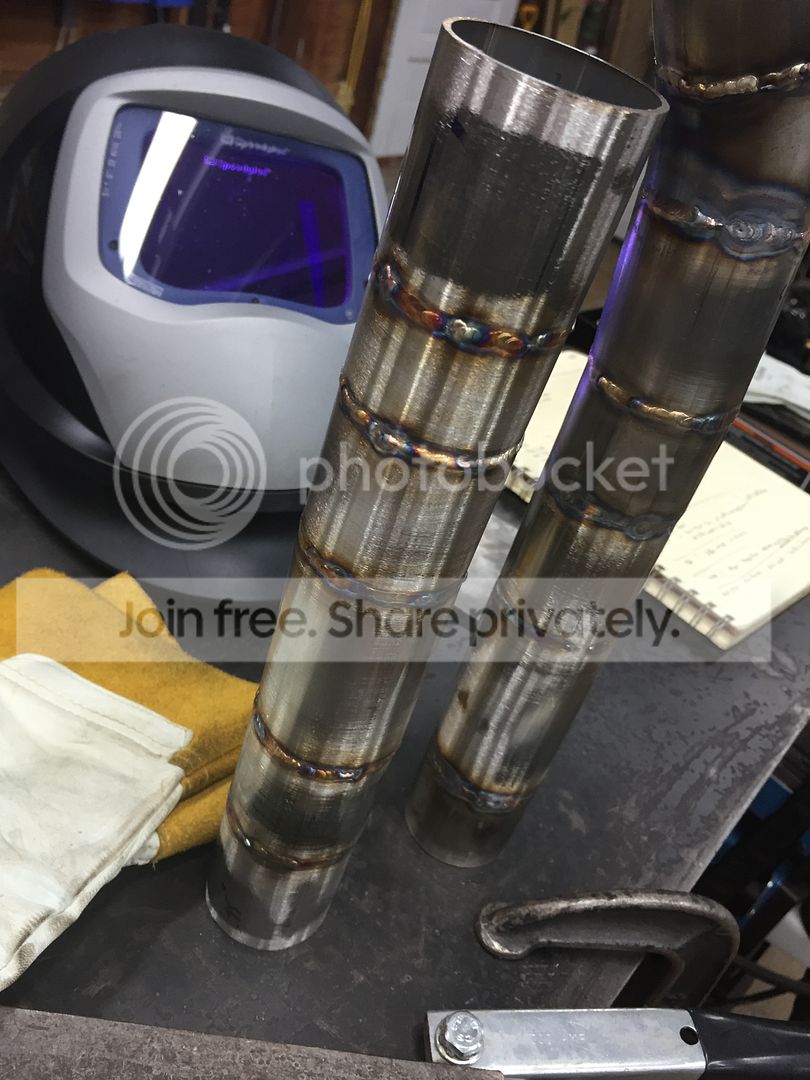
Fusion Welding practice (right), Filler rod practice (left)
IMG_1881.jpg


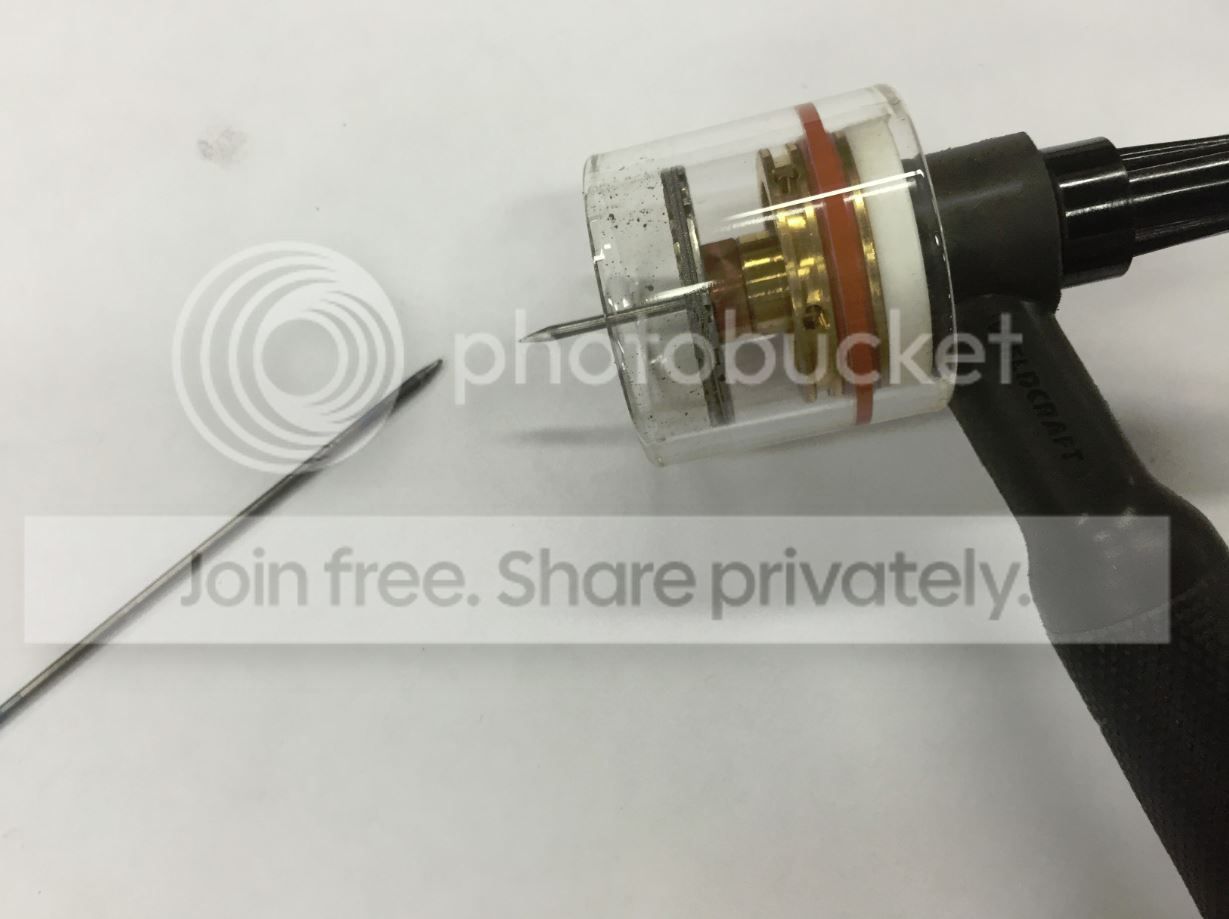
My TIG torch setup. There was a small fiber on my old tungsten that was contaminating things for a while, and I had a fan set up to keep me cool one of the nights I was out there. It blew away all of my shielding gas and was driving me CRAZY with crappy welds and colors for a solid hour until I figured it out.
IMG_1823e.jpg


More practice......and a refill on my Argon tank!!! :waytogo:

-G
 
I like those pyrex cups for stainless. You can slide the glass down further, as long as you slide the end past the orange o-ring. It might give you a straighter gas flow path, right now you have a very short distance after the diffuser.

And yeah, there have been times I turned on the ceiling fan in the shop to cool things off, then you forget it's on and start welding again, doh!
 
And yeah, there have been times I turned on the ceiling fan in the shop to cool things off, then you forget it's on and start welding again, doh!
Yup, I have a big evaporative cooler blowing down directly over my work area. If I'm doing any welding it turns out like crap if I forget to turn it off. :P
 

Latest Posts

Top Bottom